
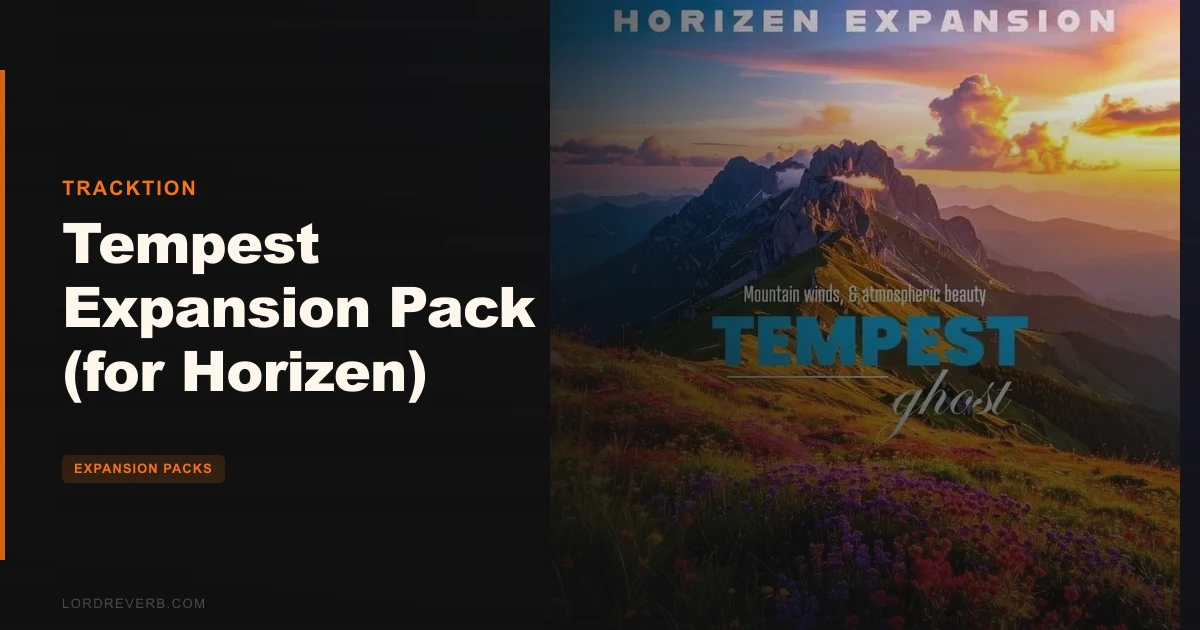
Tempest Ghost is a 53-preset ethnic wind expansion for Horizen 2 that targets film composers, trailer producers, and ambient beatmakers who want organic, atmospheric textures without building them from scratch.
We loaded it on a Tuesday afternoon with a half-finished trailer cue open in the session. Needed something between a duduk and a shakuhachi. Nothing too specific, nothing too synthetic. We scrolled to one of the mid-range atmospheric presets, pressed a low C, then added a little aftertouch pressure. The sound opened up. Not a filter sweep, not a sample crossfade. Something that felt like breath. That got our attention.
At $30, it sits in the territory where you either get genuine utility or you get a folder of sounds you use twice and forget. Tempest Ghost earns its keep, but with some honest caveats. Here's the full picture.
What Tempest Ghost Actually Is
This is a Horizen 2 expansion pack. That's the whole frame. If you don't own Horizen 2, there's nothing to buy here.
What it delivers inside that frame: over 53 presets built around ethnic-inspired wind instruments with an atmospheric, cinematic edge. Think bansuri, duduk, and pan flute adjacent tones, processed and layered into something wider than a solo instrument recording.
It's not a sample library. It's not a ROMpler. The presets live inside Horizen's synthesis engine, which means they're editable, they respond to modulation, and they'll sit differently in a mix than a dry multisampled instrument would.
What it's not good for: modern pop production, EDM sound design, anything rhythmic and punchy. This is texture and atmosphere. If you want leads, pads that don't breathe, or anything percussive, look elsewhere. We'd also say it's not a replacement for a dedicated ethnic instrument library if authenticity is your primary goal. It's expressive. It's evocative. It's not ethnomusicologically precise.
For what expansion packs like this actually offer, the short version is: they're tools for speed, not substitutes for deep sample libraries.
Living With Tempest Ghost Day to Day
Setup is frictionless if Horizen 2 is already in your system. Install, scan, done. The presets appear in the Horizen browser and load in under two seconds each.
We spent three sessions with it across different project types. The first was that trailer cue. The second was an ambient drone piece. The third was a contemporary hybrid orchestral demo.
In the trailer cue, three presets did heavy lifting. One gave us a low, slow swelling tone we used under a tension section. Another opened into something almost like a processed shakuhachi on high notes. We layered them with a static string pad and the blend felt organic. The mod wheel pull-back on the wind preset gave us a natural soft-to-loud arc that would have taken automation otherwise.
In the ambient session, we found ourselves loving the whisper-soft articulations. Dial back velocity, reduce the mod wheel, and some of the presets almost disappear into a breath. That kind of dynamic range is harder to find than it sounds.
The hybrid orchestral demo is where we hit the first honest limitation. Some presets plateau at the top of their expression range and stop feeling responsive. Push the aftertouch too hard and a handful of sounds compress into a similar tonal space. It's not ugly, but it's a ceiling you'll feel if you're performing expressively over long sections.
CPU load was light throughout. No appreciable hit on a session already running a full template.
The Trade-Offs Worth Knowing
The aftertouch implementation is the strongest selling point, and it's also where the pack sets its limits. When it works, it's satisfying in a way that most wind expansions aren't. A breath-to-swell response that tracks your finger pressure without sounding digital is rare. Tempest Ghost nails it on maybe 70% of the presets.
The other 30% feel less connected. Some presets respond to aftertouch in ways that sound processed rather than performed. It's inconsistent, and that inconsistency is frustrating when you're in a creative flow and the next preset breaks the immersion.
The size is another honest trade-off. 53 presets is enough to get real work done, but not enough to feel like a definitive resource. We'd have wanted closer to 80 to feel like we'd fully explored the palette. What's there is quality. There just isn't enough of it yet.
The Horizen 2 dependency is a hard lock. That's either a non-issue (you already own it) or a dealbreaker. There's no middle ground. If you're still on Horizen 1, this won't work.
For context on how other expansion libraries handle the size vs. depth question, this breakdown of Maschine expansion packs covers the tradeoffs well.
Against the Field
The closest comparisons are other instrument-specific wind expansions and dedicated ethnic instrument libraries.
Spitfire's LABS releases have covered ethnic wind territory with free multisampled instruments. LABS wins on sample authenticity. Tempest Ghost wins on playability, modulation, and real-time expression. They're complementary more than competitive.
Strezov Sampling's Rhodope series goes far deeper into Bulgarian vocal and wind territory if documentary-grade authenticity matters. It costs more and demands more CPU.
Within Horizen's own expansion ecosystem, Retro Legends hits a completely different genre space. If you need both, they don't overlap at all.
For composers who want atmospheric ethnic wind sounds inside their existing Horizen 2 workflow without switching hosts or libraries mid-session, Tempest Ghost has no direct competition. That's a narrow lane. But it's a real one.
If you're weighing this against a full VPS Avenger expansion for trance and electronic work, they don't overlap at all. Different genres, different tools.
The Real Verdict
Buy it if Horizen 2 is already in your rig and you score for picture, cut trailers, or build ambient textures. The aftertouch response alone justifies the ask for performers who use it. The presets are well-crafted. The CPU footprint is non-existent.
Skip it if you don't own Horizen 2, if you need genre versatility, or if 53 presets feels light for your workflow. It's also the wrong call if you need acoustic realism over expressive synthesis.
We'd buy this again. That's the cleaner version of everything above.
Specs & Technical Details
| Developer | Tracktion |
| Price | $30 |
| Plugin Format | Expansion for Horizen 2 (VST3 / AU / AAX via host) |
| OS Support | Mac / Windows (via Horizen 2) |
| Activation | N/A (via Horizen 2 license) |
| CPU Usage | Light |
| Trial Available | N/A |
| Version Reviewed | Horizen 2 compatible (2026) |
Score Breakdown
| Category | Score | Notes |
|---|---|---|
| Sound Quality | 4.0/5 | Expressive and textured; a few presets sound processed at full expression |
| Value for Money | 4.0/5 | Competitive for a focused expansion; 53 presets keeps it from scoring higher |
| Ease of Use | 4.5/5 | Loads instantly, performs intuitively, no friction if you own Horizen 2 |
| Features | 3.5/5 | Aftertouch and mod wheel depth is strong; preset count is modest |
| CPU Efficiency | 4.5/5 | Negligible load across all test sessions |
| Overall | 4.0/5 | A well-executed niche expansion that delivers where it promises |
Alternatives to Consider
Spitfire LABS (Ethnic Wind instruments): Free multisampled options exist across LABS releases. Better for acoustic realism. Less expressive in real-time performance than Tempest Ghost. Good as a complement, not a replacement.
Strezov Sampling Rhodope Series: Goes deeper on Bulgarian and Eastern European wind and vocal territory. More expensive, heavier CPU, but more authentic for high-budget cinematic work. Tempest Ghost is the faster, lighter tool.
Other Horizen 2 Expansions (Retro Legends): If your sessions lean more vintage and electronic, the Retro Legends pack covers completely different sonic ground inside the same host. No crossover between the two.
Tempest Ghost is the right call when organic wind textures and cinematic breathing room are exactly what the session needs. At $30, you're not gambling much. But you are locked into the Horizen 2 ecosystem, so make sure that door is already open before you walk through it.
Related reviews: Expansion Amplified Funk Still Beats Rivals in 2026
Frequently Asked Questions
Does Tempest Ghost work without Horizen 2?
No. Tempest Ghost is a preset expansion for Horizen 2 only. It has no standalone mode and won't load in other synths or samplers. You need a valid Horizen 2 license installed and activated before the expansion will work at all.
How many presets does Tempest Ghost include?
Tempest Ghost includes over 53 presets. They're all built around ethnic-inspired wind instruments with atmospheric and cinematic processing baked in. The count is on the modest side compared to some expansions, but the quality-to-quantity ratio is solid.
Is Tempest Ghost suitable for EDM or pop production?
Honestly, no. The palette is atmospheric, organic, and cinematic. It's built for film scoring, trailer work, ambient production, and contemporary hybrid compositions. If your sessions are club-oriented or rhythm-driven, this expansion won't pull its weight.
Does Tempest Ghost respond to aftertouch?
Yes, and that's one of its strongest features. The presets are built to respond to both aftertouch and mod wheel input, giving you a dynamic range from whisper-soft articulations to full cinematic swells. A MIDI controller with aftertouch support gets the most out of it. Standard velocity-only keyboards will still work, but you'll miss some of the expressiveness.