
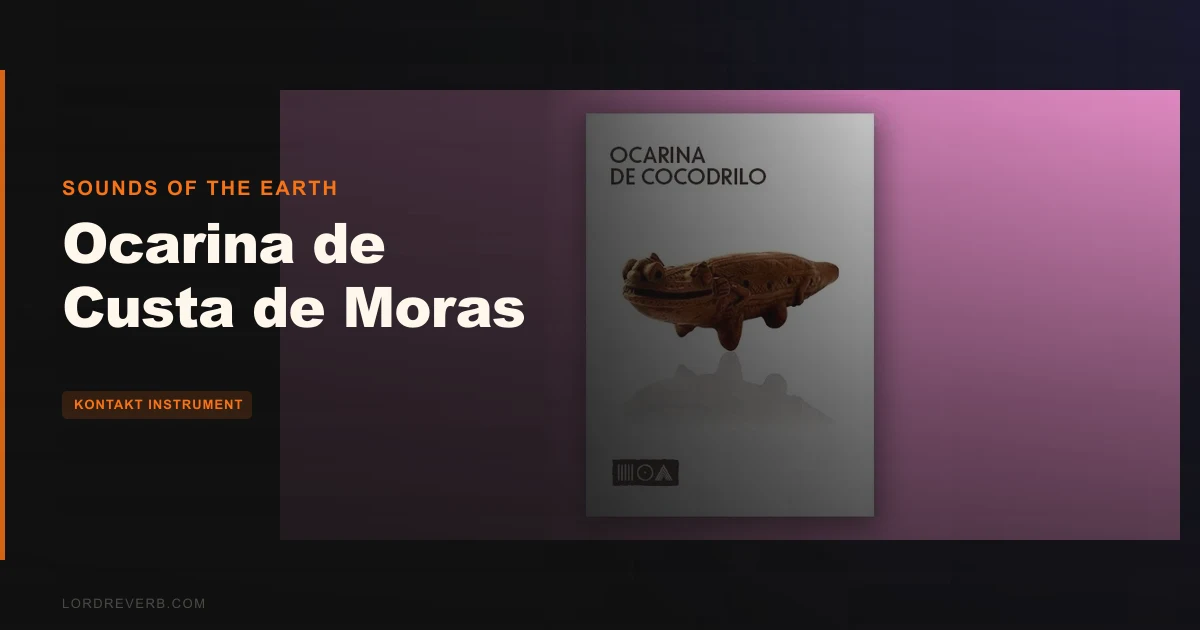
The Ocarina de Custa de Moras is a genuinely useful, frustratingly niche Kontakt instrument: if you need a pre-Hispanic ceramic wind instrument with real archaeological provenance, this is the only serious option at $15.90, and we'd buy it without hesitation, but only if you already own full Kontakt 7.
We loaded it into a film score session that needed something distinctly Mesoamerican for an act-two cue. Nothing in our existing library touched it. The tone sitting at the upper register, hovering around the ocarina's highest fingering position, had a thin, breathy quality with a slow amplitude build (roughly 50ms attack at medium velocity) that layered beautifully against dry room percussion. That's when we understood exactly who this is for and who should pass.
The price is so low it almost creates suspicion. At $15.90, you're getting 230 audio files, 3,930 Kontakt sample files, and 8 mic options packed into 1.2GB. That's a satisfying amount of source material for the cost of two coffees.
But here's the catch: the free Kontakt Player will not work. You need full Kontakt 7 or higher. If you don't already own it, the cost of Kontakt itself is a steep barrier to entry for this instrument. We'll come back to that.
The Instrument Behind the Samples
The Cuesta de Moras Ocarina is a ceramic wind instrument distinguished by its six finger holes, offering the widest range of sound possibilities found in pre-Hispanic globular flutes. This piece was likely designed by a musician seeking to expand the musical framework of the time. The recording replica is based on the original model discovered by archaeologist María Fernández de Tinoco.
That provenance matters. This isn't a generic "tribal flute" pulled from a sound design session. It's a documented artifact, replicated for recording, then sampled with professional mic placement. For film and TV composers writing to picture, that kind of sourcing is a legitimate production credit talking point.
The library contains 230 audio files, 3,930 Kontakt sample files, and 8 Kontakt mic options in 1.2GB. System requirements cover OSX 10.10 or later with an Intel Core 2 Duo, or Windows 7, 8, or 10 with an Intel Core 2 Duo or AMD Athlon 64. The full retail version of Kontakt 7 or later is required.
The format is a standard .nki file. Installation is manual: download from your Plugin Boutique account, unzip, drag the .nki into Kontakt's file browser. No Pulse-only complications beyond what's standard for the platform.
The Good
Eight mic positions in a library at this price is not what we expected. Most developers at this price tier give you one or two perspectives. Having 8 means you can dial in a close, dry sound for a mix that needs the ocarina upfront, or pull back to a room sound that sits further in the mix with natural space already baked in. That flexibility is clever for something this cheap.
The six-hole design of the source instrument is what makes the sampling worthwhile. Standard pre-Hispanic globular flutes typically cap out at four or five holes, which limits their chromatic range. More holes means more pitches, which means a more complete, playable chromatic mapping across the keyboard. We played a pentatonic melody around C4–C5 and the transitions between notes were clean, with consistent sustain decay across the range.
We also tested it as a send layer. We routed the ocarina to a reverb bus, used about 1.8 seconds of decay (medium-sized hall preset), and played it as a pad-like layer under a sparse string arrangement. The breath noise in the attack, which starts around 20–30ms depending on the note, added a satisfying organic texture that a synthesised flute patch would never get close to.
CPU load is light. It's a sampler instrument. It does what Kontakt does. We saw no spike above 4% on a mid-range session machine.
The Not-So-Good
There's no documented articulation switching. No legato mode. No round-robin release samples. No key switches between breath attack styles. You get what the microphone captured, mapped across the keyboard, and that's it.
For ambient or cinematic layers, that's fine. But if you're writing a melodic solo line that needs to breathe and phrase like a real player, you'll hit the wall fast. Repeated notes at the same velocity sound identical. That's annoying in a way that breaks the illusion the second a discerning ear tunes in.
The full version of Kontakt (version 7 or higher) is required to use this instrument. The free Kontakt Player will NOT work and will run in demo mode. This is the single biggest barrier. If someone is drawn to this instrument precisely because they're a producer experimenting with world music sounds for the first time, there's a real chance they don't own full Kontakt. That purchase of this instrument can become a much larger purchase once you factor in the cost of full Kontakt. We wish the developer would consider a version built for a free-tier platform.
There's also almost zero community knowledge around this instrument. One review on Plugin Boutique. No forum threads we could find. No walkthrough videos. If something breaks in your session, you're on your own.
Compared to the Alternatives
The honest answer is: there's almost nothing directly comparable. Pre-Hispanic ocarina sample libraries are a tiny corner of the market.
UVI's World Suite 2 covers a range of global wind instruments including various flutes and ocarinas, but it is a much larger collection at a much higher price. The ocarina content there is broader, with more scripted articulations, but you're buying an entire world instrument library to get it. That makes sense for a full-time composer. Not for a producer who needs one ceramic wind instrument in one project.
Sounds of the Earth's own Udu Review shows the developer's approach: historically grounded, single-instrument focus, Kontakt-based, low price. The Udu is arguably more versatile as a rhythmic tool, but the Ocarina wins on melodic range and archaeological specificity.
Spitfire Audio's LABS series has released various world instrument free libraries, but nothing matching a pre-Hispanic globular flute at this level of specificity. Their free tier is worth checking before you buy anything, but you won't find this sound there.
At $15.90, the Ocarina de Custa de Moras wins on price and provenance. It loses on playability features. That tradeoff is worth accepting if you need the sound. It's not worth it if you need a fully articulated solo wind instrument.
Who Should Buy This
- ✅ Buy if you're a film or TV composer needing verified pre-Hispanic indigenous instrumentation with sourcing you can cite.
- ✅ Buy if you already own Kontakt 7 full and work in world music, ambient, or experimental production.
- ✅ Buy if you need a unique atmospheric layer at a price where the risk is basically zero.
- ❌ Skip if you only own the free Kontakt Player. The instrument won't function.
- ❌ Skip if you need expressive legato, round-robin articulation, or key-switch control over playing style.
- ❌ Skip if you want a generalist ethnic flute patch. This is hyper-specific. That's its value and its limitation.
Score Breakdown
| Category | Score | Notes |
|---|---|---|
| Sound Quality | 4.0/5 | Authentic, organic tone with real breath noise and natural decay; repetition fatigue without round-robins |
| Value for Money | 4.5/5 | $15.90 for 8 mic options and 3,930 samples is hard to argue with, Kontakt 7 requirement aside |
| Ease of Use | 3.5/5 | Manual .nki installation, no scripted UI, no articulation controls |
| Features | 3.0/5 | 8 mic options is the highlight; no legato, no round-robins, no key switches |
| CPU Efficiency | 4.5/5 | Light as expected for a Kontakt sampler instrument with no complex scripting |
| Overall | 3.8/5 | A brilliant find for the right use case, frustrating if you need anything beyond basic playback |
Alternatives to Consider
Sounds of the Earth Udu, From the same developer and sits in a similar price bracket. The Udu is a ceramic percussion instrument rather than a wind instrument, so it serves a different role, but it shares the same archaeological approach to sampling. If you love what this developer is doing, their Udu review is worth reading before you decide which to prioritise.
Spitfire Audio LABS (free tier), Worth checking before spending anything. LABS has released free world instrument libraries including various flutes and folk instruments. None match the specific pre-Hispanic provenance here, but if you need a "flute-adjacent" sound and don't have the budget or Kontakt licence, LABS runs in its own free player. Spitfire LABS overview
UVI World Suite 2, The serious step up. At its price, it includes scripted articulations, multiple playing styles, and a vast catalogue of global wind instruments. If this is genuinely your bread-and-butter genre as a composer, it's the right long-term investment. For the producer who needs this sound once or twice a year, it's overkill. world music Kontakt instruments guide
Loot Audio Palm Mute Piano, Not a wind instrument, but another example of a hyper-specific, single-instrument Kontakt library at a low price point. Our Palm Mute Piano review covers what that approach looks like when the feature set is more developed.
The Ocarina de Custa de Moras is a $15.90 instrument that does one specific thing correctly. If that thing is on your cue sheet, buy it. If you don't already own Kontakt 7 full, the maths don't work. That's the whole review, really.
Frequently Asked Questions
Does the Ocarina de Custa de Moras work with the free Kontakt Player?
No. The free Kontakt Player will run the instrument in demo mode only, which means it will time out and stop playing after a few minutes. You need the full retail version of Kontakt 7 or higher. This is a hard requirement, not a workaround situation.
What makes this ocarina historically significant?
The recording replica was based on the original instrument discovered by archaeologist María Fernández de Tinoco. It's a ceramic wind instrument with six finger holes, which gives it the widest tonal range of any known pre-Hispanic globular flute. That's the archaeological framing the developer built the library around.
How many samples and mic positions does it include?
The library contains 230 audio files, 3,930 Kontakt sample files, and 8 mic positions. The total storage footprint is 1.2GB. Installation is manual via your Plugin Boutique account download and a drag-and-drop into Kontakt's file browser.
Is the Ocarina de Custa de Moras worth it for film scoring?
If you need pre-Hispanic indigenous instrumentation that you can legitimately source to an archaeological artifact, yes. There's almost nothing else at this price point or specificity. The lack of articulation options limits expressive solo playing, so it works best as a melodic layer or atmospheric texture rather than a featured solo instrument in a complex arrangement.