Whale Drum Review: Still Beats 5 Rival Percussion Libs 2026
By Salvatore Tomaselli·2 albums, 6 singles as Lord Reverb. Now I test the gear that made them.
·Updated October 4, 2026
Affiliate disclosure: Some links in this article are affiliate links. If you buy through them we earn a small commission at no extra cost to you. We only recommend products we genuinely believe in — our editorial opinions are never influenced by affiliate relationships. Full policy
⭐
Score4 / 5
⏱
Read time9 min read
4.0/5
★★★★☆
Best forFilm, game, and ambient composers who need a melodic tongue drum with genuine dynamic depth at $39
+Dual mic positions let you dial in dry studio or wet hall tone without extra reverb plugins
+Bonus slit drum, toy xylophone, and FX pads add genuine production value
✗ Cons
−Requires full Kontakt 5.5.2+, free Player won't cut it
−Only 8 tongue notes on the main drum limits melodic range without creative retuning
−Atmospheric pads are a nice bonus but won't replace a dedicated pad library
You're two minutes into an ambient cue and every melodic percussion library you own sounds either too clinical or too obviously "ethnic-instrument-pack." The marimba is too bright. The steel tongue drum preset in your stock library has two velocity layers and machine-guns the same transient on every hit. Soundiron's Whale Drum exists specifically for that moment. It's a deeply sampled, marimba-adjacent Kontakt instrument built from a real 14" 8-tongued vermilion tongue drum, and it's priced at $39. This review is for film composers, ambient producers, and bedroom beatmakers who need a melodic percussion sound that breathes and moves, without paying orchestral library money.
The Gap This Actually Fills
Most melodic percussion Kontakt libraries fall into two camps: pristinely recorded academic instruments that feel stiff in modern mixes, or heavily processed "world music" packs with no playable dynamics.
The Whale Drum sits between those worlds. Soundiron selected this specific drum for its marimba-like warmth, dreamy tone, gentle softly-rounded attack, and subtly undulating decay, with especially deep richness in the lower notes. That's not marketing copy; it's a functional description of why this instrument works in the places it does.
What's frustrating about most tongue drum libraries isn't the sound. It's the depth. Two or three velocity layers and zero round-robin means you hear the same sample loop over itself the moment you play anything melodic. That gets annoying fast, especially in slow, exposed passages. Soundiron recorded each mallet-struck note at tongue center and edge positions, with an average of 10 dynamic velocity layers and 10 round-robin variations per note. That's the actual fix.
How It Performs in the Session
The 14" 8-tongued vermilion tongue drum was recorded in a dry studio environment with mallets, wooden sticks, and brushes. The stick and brush articulations were played over various edges and surfaces around the drum. That gives you different tonal characters across the same instrument without loading a different patch.
We loaded the dry mallet patch into a sparse piano-driven ambient cue at 72 BPM. We played a simple descending phrase across four notes. The velocity response was satisfying in a way we didn't expect at this price. A light tap at MIDI velocity 45 produced a thin, breathy ting. Pushing to velocity 100 gave a full-bodied strike with a decay tail that spread naturally over about 2.5 seconds before fading. No jarring jumps between layers.
Soundiron also recorded a second session with the instrument in a large reverberant tile and stone hall from a slight distance, using mallets and sticks. That "wet" hall sound is built for orchestral arrangements and atmospheric songwriting. We blended the dry and hall mic positions at roughly 60/40 in the GUI. The result sat in the mix without needing additional reverb on the bus. That's a real workflow win.
We then tried the instrument inside a lo-fi beat at 90 BPM with a dusty vinyl texture underneath. The brush articulation over the drum edge worked brilliantly as a textural hi-hat alternative. We cut 3dB at 6kHz with a Q of 1.2 to roll off some high-end sheen, and it locked into the groove cleanly. This isn't just a "cinematic composer" tool. It's more versatile than its positioning suggests.
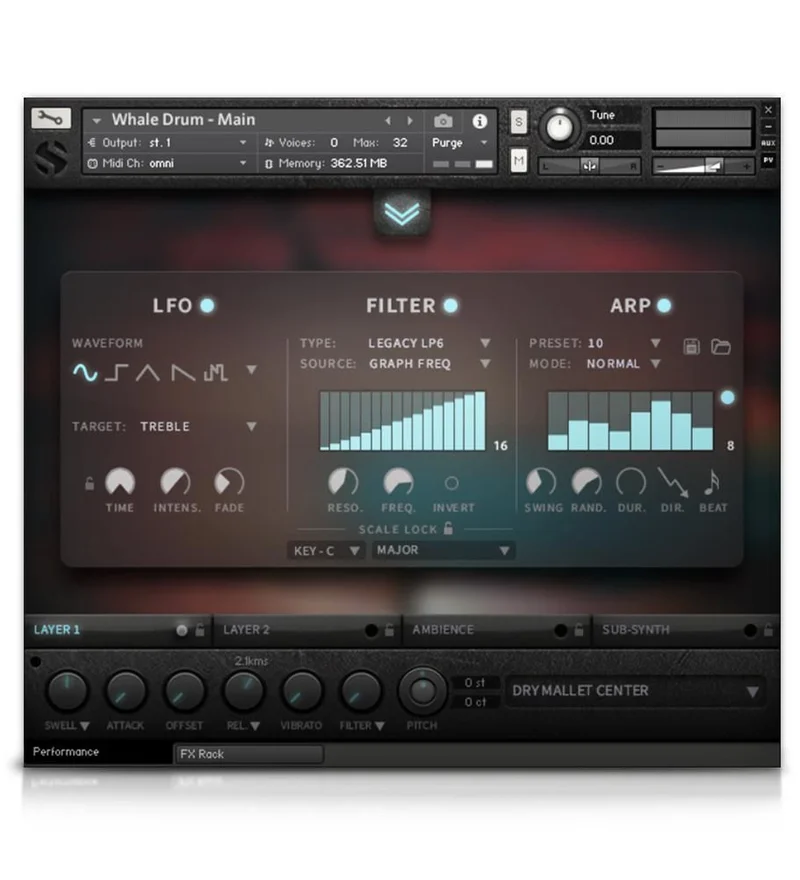
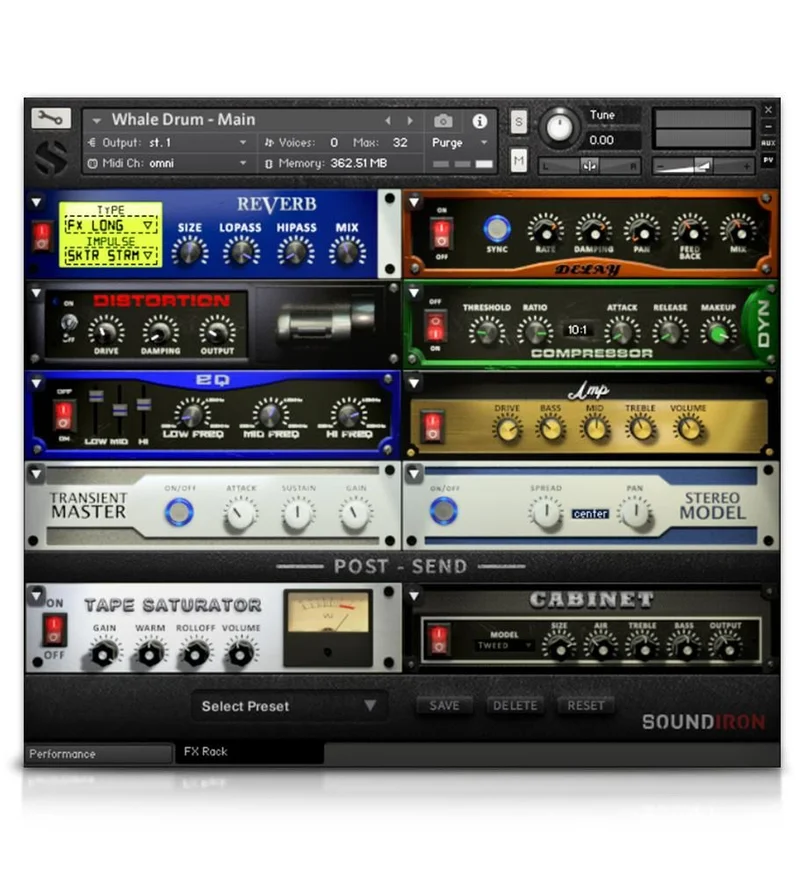
The GUI includes swell, attack, release, offset, vibrato, filter, pitch (coarse and fine), articulation switching, crossfading, and layering. The Advanced Control window adds an LFO with shape, target, speed, intensity, tempo-syncing, and fade-in. There are 12 low-pass, high-pass, and FX filters with assignable modulation targets, velocity, modwheel, expression, key position, and a step-sequencer table. The ARP system has velocity sequencer controls for direction, note timing, swing, randomization, and duration. A key and scale lock system makes melodic composition and live performance easier. It's all completed by a modular FX rack with 18 DSP effect modules assignable across 10 slots in any order.
CPU load in our test sessions (Logic Pro on M1, Kontakt 7) was light. We saw around 3–5% CPU per instance with the dry patch loaded. Load two or three instances simultaneously and you're still well clear of trouble on any modern dual-core setup. No complaints there.
Strengths and Weaknesses
The round-robin depth is the headline strength. Ten variations per note is legitimately impressive for a $39 library. We played fast 16th-note runs and never heard a blatant machine-gun repeat. That's where most budget libraries fall apart.
The bonus instruments are a genuine plus: a smaller 3-note slit drum and a wooden toy xylophone, plus a selection of delicate atmospheric pads and evolving ambiences sculpted from the original acoustic source material. That's three additional instruments on top of the main library. The toy xylophone in particular has a fragile, brittle character that works well layered under piano in low-energy passages.
The weaknesses are real, though. Eight tongue notes is a tight melodic range. You can retune patches and cover more ground, but you're doing workaround work. That's annoying for composers who want to build full melodic phrases without pitch-shifting artefacts creeping in at the extremes.
The free Kontakt Player doesn't fully support this library, it runs in a time-limited demo mode only. If you don't own the full Kontakt, this library costs you more than the sticker price. Factor that in.
The total installed footprint is 1.14GB across 3,173 stereo samples at 24-bit/48kHz PCM WAV format. Lightweight by modern library standards. An SSD load takes under 10 seconds.
Is $39 Actually Worth It?
For $39, you get 3,173 samples recorded at 24-bit/48kHz, dual mic positions, three bonus instruments, 20 sound-designed FX/ambient presets, and an FX rack with 18 modules. On raw content-per-dollar, this is hard to argue with.
The honest caveat: if you need a chromatic, full-range melodic percussion library for detailed melodic writing, you'll hit the 8-note ceiling and feel the frustration. For textural, atmospheric, and accent work, $39 is underpriced. For chromatic leads, look elsewhere.
We'd buy this at $39. We'd still consider it at a higher price. The lower introductory price that has been offered periodically makes it a genuinely clever purchase. Check the manufacturer's site for current pricing and any active promotions.
Who Should (and Shouldn't) Buy This
✅ Buy if you score for film, games, or trailers and need a melodic percussion accent with real dynamic nuance
✅ Buy if you produce ambient, lo-fi, or neo-classical and want an instrument that feels acoustic, not synthetic
✅ Buy if you already own the full Kontakt and want maximum content-per-dollar from a specialist library
❌ Skip if you only have the free Kontakt Player, demo mode won't serve you
❌ Skip if you need a fully chromatic tongue drum library for detailed melodic composition across multiple octaves
❌ Skip if you're hunting for a rhythmic percussion workhorse, this instrument's sustained, gentle character isn't built for aggressive groove programming
Score Breakdown
Category
Score
Notes
Sound Quality
4.5/5
24-bit/48kHz, dual mic positions, genuine dynamic depth, sounds clean and real
Value for Money
4.5/5
3,173 samples, 3 bonus instruments, and 18-module FX rack for $39 is hard to beat
Ease of Use
3.5/5
GUI is well laid out but the Advanced Controls window has a learning curve; scale lock helps
Features
3.5/5
FX rack, ARP, LFO, and dual mics are generous; 8-note range is the ceiling that limits it
CPU Efficiency
4.5/5
Light footprint at 1.14GB installed; minimal CPU draw even with multiple instances
Overall
4.0/5
A clever, underrated melodic percussion library that earns its price without pretending to be something bigger
Alternatives to Consider
Soundiron Angklung, if you love the Whale Drum's ethnically-rooted melodic character, Soundiron's Angklung library covers bamboo tube percussion with a similarly deep sampling approach. It's fuller chromatically. browse Soundiron Kontakt instruments
Loot Audio Palm Mute Piano, not a percussion library, but it serves a strikingly similar emotional role: an intimate, textural, acoustic instrument with unusual attack character that sits beautifully in ambient and cinematic contexts. Worth considering as a companion or alternative for soft melodic writing. Palm Mute Piano Review
Soundiron M1 Garand Rifle, completely different use case, but it shows how far Soundiron pushes unconventional source material into playable instruments. If you love the Whale Drum's "unexpected instrument becomes something musical" concept, Soundiron has a whole catalogue of these. Soundiron M1 Garand Rifle Review
For a direct tongue drum comparison: Felt Instruments Lekko covers similar atmospheric melodic percussion territory inside a more streamlined interface, though it lacks the raw sample depth of the Whale Drum's 10x10 round-robin engine. browse melodic percussion Kontakt libraries
At $39 for a 24-bit, dual-mic, 3,173-sample library with genuine dynamic behaviour, the Whale Drum isn't asking you to believe the hype. It's asking you to play eight notes and decide. If those eight notes are the right ones for your track, and more often than we expected, they are, you'll love it. If your cue needs more harmonic range, don't force it. That's not a knock on the library. That's just knowing your tools.
Frequently Asked Questions
Does the Whale Drum work with the free Kontakt Player?
No, not fully. The free Kontakt Player runs this library in a time-limited demo mode only, you'll lose audio after a set period mid-session. You need the full retail version of Kontakt 5.5.2 or later to use it without restrictions. If you're on Kontakt 6 or 7, you're fine.
How many notes does the Whale Drum cover?
The main instrument is based on a 14" 8-tongued drum, so the core melodic range is 8 tongue notes. Soundiron recorded these at both tongue center and edge positions, giving you tonal variety across those notes. For extended range, you'll need to use Kontakt's pitch retuning or layer with the bonus slit drum and toy xylophone patches.
Can I use the Whale Drum for lo-fi and hip-hop, or is it only for orchestral scoring?
We used it in both contexts and it worked in both. The brush and stick articulations over drum edges produce textural hits that sit well in lo-fi and downtempo grooves. Cut a little top-end at 5–8kHz and it integrates cleanly under sampled drums. The "cinematic only" positioning undersells its flexibility.
What's the difference between the dry and wet mic positions?
The dry position was recorded in a studio environment and gives you a clean, close-mic sound you can process yourself. The wet hall position was captured in a large reverberant tile and stone hall, adding natural space and spread that works for orchestral or atmospheric cues without additional reverb plugins. You can blend both positions inside the GUI for a hybrid tone.
The short version
Whale Drum · 4.0/5
Buy it if:Film, game, and ambient composers who need a melodic tongue drum with genuine dynamic depth at $39
3,173 stereo samples at 24-bit/48kHz for a $39 library
Salvatore Tomaselli has spent twelve years in studios as a producer, mix and mastering engineer. He's worked across genres, tested hundreds of plugins, and built more signal chains than he can count. Salvatore started writing for LordReverb because most gear coverage is either sponsored fluff or spec-sheet copy-paste. He tests everything before writing about it. No gear gets a pass just because it's popular.
Community
What's in your stack?
Every artist on LordReverb has a setup. Show yours. DAW, plugins, hardware, the lot. Free, takes 2 minutes.