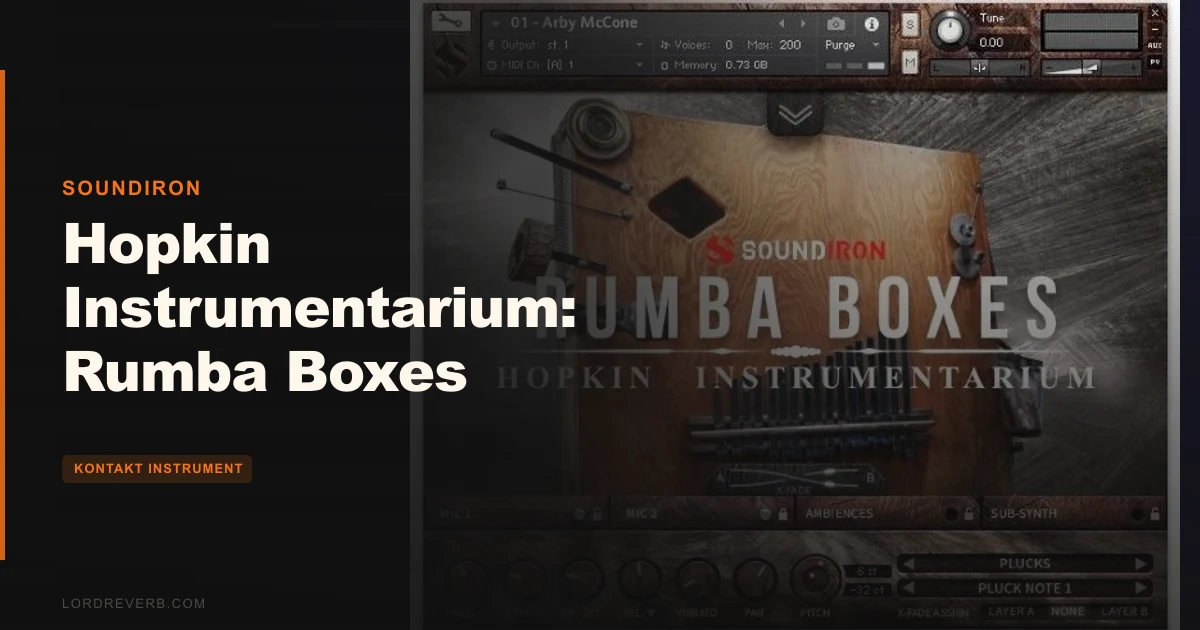
You’ve got a loop that’s almost done. Drums are solid, bass is locked, but the top half feels like every other track you’ve made this month, and the usual pluck libraries all sound like old friends. That’s the moment you open Hopkin Instrumentarium: Rumba Boxes by Soundiron, a library built from two handmade instruments that sound like nothing else in your sample folder, at $19.50.
This is for producers who hunt for texture, not for anyone who wants a safe piano.
Quick Verdict: Is the Hopkin Instrumentarium Rumba Boxes Worth It?
Yes, if you want unusual tuned percussion. We score it 4.1 out of 5, and at $19.50 it’s an easy yes for that job.
The sample set is deep, the Kontakt engine is generous, and the source instruments are one of a kind. The catch: it’s a specialist tool. If you need a bread-and-butter melodic instrument, look elsewhere.
What It Is (and What It's Not)
Two instruments, both designed and built by Bart Hopkin. The developer says Hopkin has made over 110 original instruments since 1974, and these are bespoke creations you won’t find anywhere else.
The first is a chromatic rumba box. Spring-tempered steel rods or bars act as tines, and those tines have been reshaped to adjust the tuning of their overtones. Some carry rattles to bring those re-tuned overtones out.
The second, Arby McCone, is a rumba-box, cajón and percussion-gadgetry hybrid.
What it’s not: a general-purpose melodic workhorse. It’s a character instrument. You’ll reach for it to add color, not to carry a song.
What's Inside the Library?
The numbers: 13,719 stereo samples, 24-bit, 48 kHz, stored in lossless NCW format. Installed size is 7.13 GB.
Each rumba box gets 2 stereo microphone positions. That matters because you can pick the perspective that suits the track instead of fixing it with EQ later.
Articulations cover plucks, picks, hand percussion and auxiliary percussion. Owners report that the playable articulations span the entire keyboard range and keep the acoustic character across pitch registers. That’s the thing to check in any tine instrument. Plenty of them fall apart at the extremes.
The Chromatic Rumba Box
This is the melodic one. Reshaped tines mean the overtones sit differently than you’d expect from a standard thumb piano.
Play a simple two-note figure and listen to the upper partials. They’re the point. Some tines have rattles, so you get that buzz riding on top of the pitch.
Arby McCone
Arby McCone is the weirder one, and the more fun. It stacks spring-mounted metallic sounds, clave sounds, shekere-type beads, shakers, rattletines and bells on a box that doubles as a cajón.
Think of it as a one-instrument percussion rack. Drop it under a loop and it fills the gap between your hats and your shaker without sounding like a stock kit.
How Does the Kontakt Interface Handle Sound Shaping?
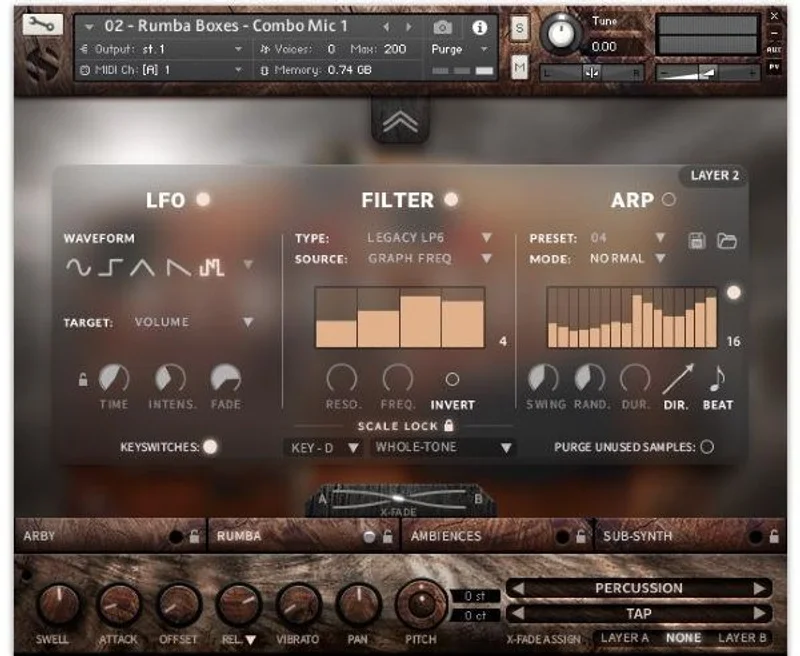
The front panel gives you swell, attack, release, offset, vibrato and filter controls. Pitch control comes with coarse and fine tuning options.
There’s also articulation switching, cross-fading and layering. Layer a pluck with a hand-percussion hit and you get a transient that feels played, not triggered.
Offset is the one we’d reach for first. Push the sample start forward and you cut the initial strike, leaving just the ring of the tine. That’s a quick way to turn a percussive hit into a soft, bell-like pad voice.
What Can the LFO and Filters Do?
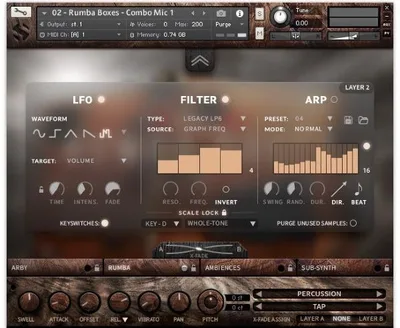
The LFO is adaptable. You pick the shape, the modulation target, the speed and the intensity. It supports tempo-syncing, plus a fade-in time so the movement creeps in instead of slapping you on the first note.
Sync it to your project, point it at filter cutoff, and let it breathe over a held rumba box note. Slow and shallow works best here.
Then there are the 12 filters, covering lowpass, high-pass and FX types, each with assignable modulation targets. Those targets include velocity, modwheel, expression, after-touch, key position and step-sequencer table control.
Key position as a modulation source is the sleeper feature. Low notes darker, high notes brighter, without touching a single automation lane.
Is the Arpeggiator Actually Useful Here?
It is, and it suits this source better than most. The arpeggiator is customizable and includes a velocity table. You control direction, timing, swing, randomization and duration.
Tine instruments already have a natural pattern feel. Turn on swing, shorten the duration so the notes stay plucky, and a held chord becomes a rhythmic bed you didn’t have to program.
Randomization is the setting people overdo. Keep it low. A little drift keeps it human. A lot turns it into noise.
Key and Scale Lock: Cheating, Or Smart?
The key and scale lock system constrains notes to common scales and keys. The developer pitches it as a way to make melodic composition and live performance easy.
We think it’s clever, and it earns its slot on an instrument with unusual overtones. Lock to a scale, then mash keys. You can’t hit a wrong note, which frees you to focus on timing and velocity.
Purists will call it a crutch. We’d call it a sketching tool. Use it to find a hook fast, then turn it off and refine by hand.
How Deep Is the FX Rack?
This is where the library stops being a sample player and starts being a sound-design box.
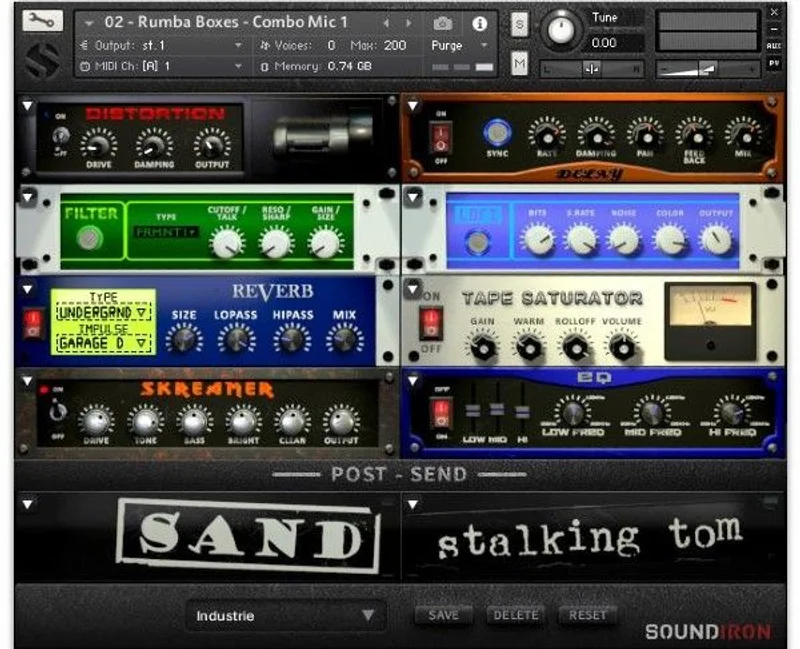
The modular FX rack panel holds 18 DSP effect modules, assignable in any of 10 slots. The list includes phaser, flanger, delay, distortion, amp and cab simulators, compressors, EQ and a rotator.
The reverb carries 99 impulse responses covering rooms, halls, chambers and outdoor environments. On top of those, there are 40 custom FX impulses.
Here’s a move worth trying. Run a single plucked note into the amp and cab simulator, then into a long hall. A tidy tine sound becomes something gritty and distant. Owners say the FX presets can take traditional kalimba-style tones into otherworldly ambiences and atmospheric textures, and the rack is how that happens.
The developer says the reverb can radically transform sound. We’d put it more simply: the impulse library gives you real range, and the custom FX impulses are the ones to audition first.
What About the Presets?
You get 4 master presets and 20 custom sound-designed FX and ambient presets. The library also includes a wide spread of textures, pads and drones.
Master presets get you playing in seconds. The FX and ambient set is the more interesting half, because it shows you what the rack can do before you build your own.
Honestly? Start there. Load a drone preset, then dig into the rack to see how it’s built. That’s the fastest way to learn the engine.
Where It Fits In Your Session
Back to that stale loop. Load Arby McCone, pick the closer mic position, and drop it under the hats. Pull back on the filter with a slow tempo-synced LFO and you’ve got movement that isn’t a hi-hat.
Then bring in the chromatic rumba box for a sparse melody. Lock it to your key, set the arpeggiator to a short duration with some swing, and print a few bars. Bounce the results and chop them.
A reviewer notes the library suits producers across modern pop to jungle house. That tracks. Because the source is so distinctive, it works as a hook in pop and as texture in something rougher.
Where it won’t fit: a dense mix that already has three mid-range melodic parts. It’s a lead-by-character instrument, not a pad to fill space.
The Trade-Offs
You get a sound no one else has, and you pay for it in specialism. It’s a narrow tool with a deep engine.
The 7.13 GB footprint is fair given the sample count, but it’s a lot of disk for something you’ll use as an accent. If you only want a quick percussion layer, that’s a chunk of storage for a small slice of your projects.
Setup is a small snag. You need Kontakt Player 6 or later, or Kontakt 5.6.8 or later, and you must register the serial online through the Native Instruments Service Center app. Not hard. Slightly annoying if you’re on a dodgy connection.
On the plus side, it plays nicely with the Kontakt Libraries browser and Native Access, and it’s fully compatible with Komplete Kontrol and Native Instruments S-Series keyboards. If you already live in that world, it slots straight in.
The feature depth is the real upside. 18 FX modules, 12 filters and a step-sequencer-capable modulation setup mean you can keep digging for a long time. Whether you’ll need all of it is another question.
Who Should Skip It?
Skip it if you want one reliable melodic instrument to anchor every track. This isn’t that.
Skip it if you’re on a tight disk or a tighter workflow and only touch Kontakt occasionally. The setup and the size won’t feel worth it for casual use.
And skip it if you don’t already own a compatible Kontakt. You’ll need to factor that in before you decide $19.50 is cheap.
The Real Verdict
Buy it. At $19.50, it’s a rare chance to own two handbuilt instruments with a serious sound-design engine wrapped around them. The texture is the product, and the texture is excellent.
It’s wrong for you if you need a conventional instrument, or if you can’t spare the 7.13 GB. For everyone else hunting something odd, this one’s worth the slot.
Specs & Technical Details
| Spec | Detail |
|---|---|
| Developer | Soundiron |
| Price | $19.50 |
| Plugin Format | VST / AU / AAX (via Kontakt) |
| OS Support | N/A |
| Activation | Online serial registration via Native Instruments Service Center app |
| CPU Usage | N/A |
| Trial Available | N/A |
| Version Reviewed | N/A |
| Sample Count | 13,719 stereo samples |
| Sample Format | 24-bit, 48 kHz, NCW lossless |
| Installed Size | 7.13 GB |
| Requires | Kontakt Player 6 or later, or Kontakt 5.6.8 or later |
Score Breakdown
| Category | Score | Notes |
|---|---|---|
| Sound Quality | 4.5/5 | Handbuilt tines with reshaped overtones, two mic positions per rumba box. |
| Value for Money | 4.5/5 | 13,719 samples and a deep engine at $19.50. |
| Ease of Use | 3.5/5 | Lots of controls, plus mandatory online registration. |
| Features | 4.5/5 | 18 FX modules, 12 filters, arpeggiator, scale lock. |
| CPU Efficiency | N/A | No figures available, so we don't score it. |
| Overall | 4.1/5 | A distinctive, deep specialist instrument that's easy to recommend for texture work. |
Final Call
Buy the Hopkin Instrumentarium: Rumba Boxes for $19.50 if your tracks need one strange, memorable sound and you’ve already got Kontakt. Skip it if you want a do-everything melodic instrument or can’t spare 7.13 GB.
The loop that felt stale at the start? This is how you fix it.
Frequently Asked Questions
What do I need to run Hopkin Instrumentarium: Rumba Boxes?
You need Kontakt Player version 6 or later, or full Kontakt 5.6.8 or later. It loads as a VST, AU or AAX instrument and works with the Kontakt Libraries browser and Native Access.
How big is the install?
The installed size is 7.13 GB. It holds 13,719 stereo samples in 24-bit, 48 kHz lossless NCW format. Plan your drive space before you download.
How many instruments are in the library?
There are two, both designed by Bart Hopkin. One is a chromatic rumba box with reshaped steel tines, and the other is Arby McCone, a rumba-box, cajón and percussion-gadgetry combination.
Can I use it with Komplete Kontrol?
Yes. It's fully compatible with Komplete Kontrol and Native Instruments S-Series keyboard controllers. If you already use that hardware, browsing and playing it is straightforward.
Does it include effects, or do I need my own?
It includes a modular FX rack with 18 DSP modules across 10 slots, covering phaser, flanger, delay, distortion, amp and cab sims, compressors, EQ and a rotator. The reverb adds 99 impulse responses and 40 custom FX impulses.
Is the activation process complicated?
You register the serial number online through the Native Instruments Service Center app. It's a one-off step, but you do need a connection to complete it.