The real question with Mongolian Voices - Ancient Phrases isn't whether it sounds exotic enough. It does. The question is whether 621 pre-recorded phrases can feel compositional rather than like sonic wallpaper you're pasting onto your cue. After spending time with it, the honest answer is: yes, if you understand what you're buying before you open your wallet.
This is a phrase library. Not a playable instrument. Not a flexible vocal synth. If you want to sing a melody note by note in Mongolian throat style, this isn't your tool. If you want to build an atmospheric underscore for a fantasy battle scene in the next hour, it absolutely is.
Sonuscore built this as part of their Lyrical and Ethnic Phrases series. The current price is shown in the buy box on this page. It targets composers working in media: games, trailers, film, TV. That context matters.
Does It Actually Deliver on the Phrase-Library Promise?
Three real vocalists. That's the foundation here, and it matters.
Ashit Nergui handles throat singing. Erdenetsetseg Khenmedekh covers the female register. Munkhbaatar Bat-Ulzii brings male vocals. All three were recorded with a Neumann M149, U87, KM184, and Sennheiser MD421 in the same session, which keeps the tonal character consistent across voice types.
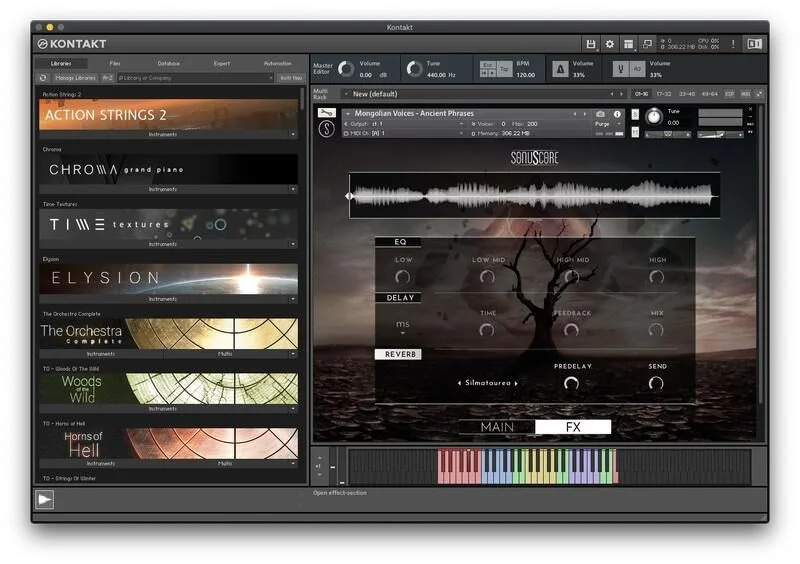
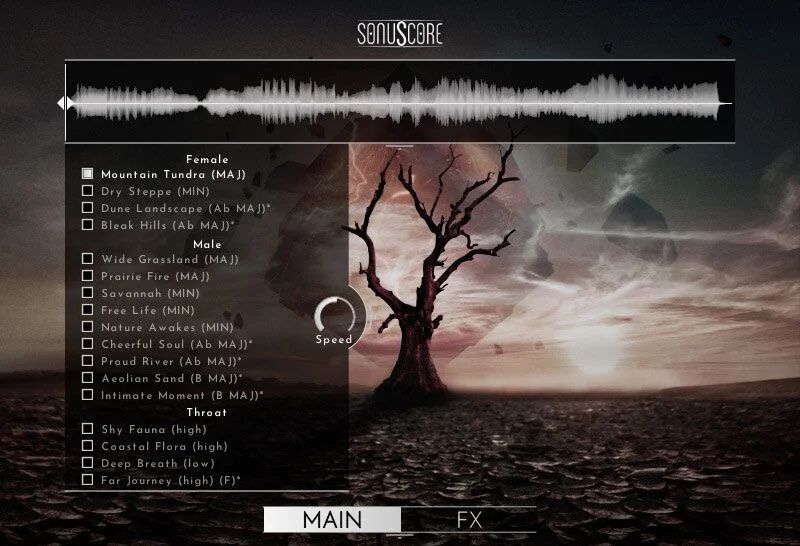
The library organises 621 phrases into 17 themes: 10 main themes plus 7 bonus themes. Each of the 10 main themes contains 51 snippets covering openings, middles, and endings in three keys. You're building musical sentences from real recorded words, which is a clever way to handle material that doesn't map neatly onto Western pitch grids.
And that's exactly what Sonuscore is honest about: these vocals don't follow standard Western intervals. They work in major keys and most modes, but you're adapting your composition to the library more than the other way around. We found that frustrating at first. Then we stopped fighting it and wrote something we actually liked.
Where Mongolian Voices - Ancient Phrases Shines
The throat singing is where we kept returning. We loaded Ashit Nergui's throat phrases onto a sparse minor-key pad bed, brought the opening phrase in at bar 5, layered a middle phrase underneath 8 bars later, and it locked immediately. No pitch correction, no formant adjusting. The overtones sat above the mix naturally without masking anything in the 2-4kHz range.
That's the practical test we run: does it fit without surgery? This did.
The three-key-per-theme structure is genuinely useful. Most phrase libraries give you one key and leave you to transpose, which destroys the natural vowel resonances in vocal recordings. Having C, Eb, and G variants (the actual keys vary by theme) means you're shifting root, not pitching audio. Your tail won't smear. Your consonants stay sharp.
The female vocal phrases are the underrated section of this library. Erdenetsetseg's phrasing sits in a register that doesn't conflict with orchestral strings, which makes her lines work as colour on top of a full ensemble texture. We ran her "ending" snippets under a string swell and the combination was genuinely satisfying. That's a usable moment for a TV score.
For composers without access to ethnic vocal libraries, this fills a real gap in a template.
Where It Falls Short
The phrase-lock is real and annoying. You cannot free-form perform with this library. Every phrase has a defined shape, a defined rhythm, a defined contour. If your cue needs a vocal line that rises where the library falls, you're stuck.
We tried stacking phrases from different themes to build a custom melodic arc. It worked about 60% of the time. The other 40%, the phrase endings clashed rhythmically with the openings we were feeding into them. Editing around that ate time we didn't want to spend.
The CPU and latency performance data is simply absent from all documentation. That's not a small omission when you're building a 60-track orchestral template and need to know whether this instance will cost you 8% or 2% of your CPU budget. We'd expect Sonuscore to publish that. They haven't.
The 4.5GB install is reasonable, but the 4GB RAM minimum suggests this was specced for 2023 machines. On modern rigs it runs fine. On older laptops, test before committing. how to manage Kontakt library RAM
How It Stacks Up Against Similar Libraries
The closest comparison is Spitfire Audio's Tibetan and Mongolian Voices if you can source it, and Native Instruments' Komplete's ethnic vocal content more broadly.
Spitfire's approach tends toward sustained tones and legato lines: more playable, less phrase-locked. If you want to sing a melody and have it feel organic, that architecture wins. Mongolian Voices - Ancient Phrases wins on combinatorial depth: 621 phrases versus a much smaller playab
le set means more raw material for long-form composition.
NI's broader ethnic content inside Native Instruments Komplete review is more versatile across world traditions but shallower on any single one. If Mongolian specifically is the sound you're after, this Sonuscore library goes further than anything NI bundles.
The honest comparison: phrase libraries are a different tool from playable instruments. Decide which workflow you're in before you buy either.
Is the Price Fair for What You Get?
At the intro price it was a solid buy. At full price, check the manufacturer's site for current pricing, because the value calculation shifts depending on whether Sonuscore is running a promotion.
Three professional vocalists, professional microphone chain, 621 phrases. The production cost clearly went into the recordings. If Mongolian atmospheric vocal content is a recurring need in your work, the price is fair. If you're buying it for one cue, it's not.
Score Breakdown
| Category | Score | Notes |
|---|---|---|
| Sound Quality | 4.3/5 | Neumann/Sennheiser chain shows; three vocalists sound cohesive and properly captured |
| Value for Money | 3.5/5 | Fair at intro price; tighter at full price if use cases are narrow |
| Ease of Use | 3.5/5 | Key-switching is intuitive; phrase-lock limits creative flexibility |
| Features | 3.8/5 | 621 phrases and 17 themes is strong content depth; no playable mode is a real gap |
| CPU Efficiency | N/A | No published data; developer should fix this |
| Overall | 3.8/5 | Strong recording quality carrying a workflow that suits only specific composers |
Alternatives to Consider
Spitfire Audio LABS Choir is free and gives you a playable sustained vocal texture. Different tradition, different workflow, but if you need flexibility over specificity, start there. Spitfire Audio LABS review
8Dio Requiem offers phrase-based workflow in a Western choral tradition if Mongolian specifically isn't essential to your cue. Much larger library, higher price. 8Dio Requiem review
Soundiron's Voices of Gaia covers world female vocals with more playable options and a larger pitch range per phrase. Worth comparing directly if you want sustained world vocal textures rather than constructed phrases. best world vocal Kontakt libraries
The one thing none of these alternatives give you is Ashit Nergui's throat singing on a Neumann M149. If that's the sound your cue needs, nothing else on this list covers it.
Buy this if you score for media and Mongolian vocal colour appears in your briefs more than twice a year. Skip it if you need free melodic expression: this library will frustrate you into bad habits. At its best, Mongolian Voices - Ancient Phrases is a brilliant texture source. At its worst, it's a $99.99 reminder that phrase libraries and playable instruments are not the same thing.
Frequently Asked Questions
Do you need the full version of Kontakt to run Mongolian Voices - Ancient Phrases?
Yes. This library requires Kontakt 6.7.1 or higher in full version. The free Kontakt Player won't load it. The alternative is HALion Sonic 7, which Steinberg offers as a free download and fully supports this library, so you do have a no-extra-cost route if you don't own Kontakt.
Can you use these phrases in any key, or are you locked to specific keys?
Each of the 10 main themes includes phrases recorded in three keys, so you have real options per theme rather than a single transposed version. Transposing audio phrases degrades vowel formants and timing, so the multi-key approach matters for quality. You'll still need to write your composition around the available keys rather than freely modulating.
Is this library suitable for traditional Mongolian music performance or cultural projects?
We'd be cautious here. The library uses real vocalists and professional recordings, but Sonuscore built it for film and game scoring workflows, not ethnomusicological accuracy. The phrase selection, curation, and presentation prioritise what sounds useful in a Western media context. For a project where cultural accuracy is the primary requirement, we'd recommend working directly with Mongolian musicians.
Does Mongolian Voices - Ancient Phrases work in Cubase, Logic Pro, or Ableton?
Yes, it works in any DAW that hosts VST3, AU, or AAX formats through either the Kontakt or HALion Sonic 7 player. There are no DAW-specific restrictions. Kontakt runs in all three of those hosts. HALion Sonic 7 runs as a standalone or VST3 plugin in compatible DAWs including Cubase, Logic, and Ableton Live.