Mezza Coda is a baby grand piano Kontakt instrument that sounds good clean and genuinely interesting when you push its Cassette and Distbox signal layers, and yes, it's worth $59. The doubt most producers have before buying it is fair: isn't this just a pretty piano with a trendy lo-fi filter bolted on? It isn't. The vintage processing is baked into the sample chain at a hardware level, not added as an afterthought plugin. That's the real differentiator. Built by Sonora Cinematic, Mezza Coda targets producers working in media scoring, jazz, pop, and electronica who want a baby grand that already has a personality. If you need a flat, accurate concert grand for orchestral work, look elsewhere.
Does It Actually Deliver on the "Gritty Twist" Promise?
Sonora Cinematic built Mezza Coda as a companion to their upright Verticale library. It offers a rich sound that captures the nuances of a baby grand piano, enhanced by two unique signal layers, with the same Cassette layer found in Verticale adding a vintage vibe and touch of grit.
The piano samples were passed to cassette using an old Portastudio running at maximum speed, then converted back to digital and slowed down as far as possible. That's not a plugin chain. That's physical tape doing physical things to the audio before it ever hit a hard drive.
The Distbox layer goes further: it was sampled using the Portastudio as a distortion device, recording a stereo mix of the piano to cassette while hitting the preamps with a very hot signal, then slowing the tape. The result is a raw, distorted signal that adds unique character and texture, suited for adding an edge or creating lo-fi vibes.
The promise is kept. This is character by design, not by accident.
Where Mezza Coda Shines
We loaded Mezza Coda into a sparse jazz-adjacent session: Rhodes on the left, brushed snare on the right, bass sitting around 80Hz. We pulled up the ribbon spot mics, rolled the Color knob about 30% left (darker, more body in the low-mids), and let a chord breathe. The sustain sat exactly where we wanted it without touching the DAW EQ. Satisfying.
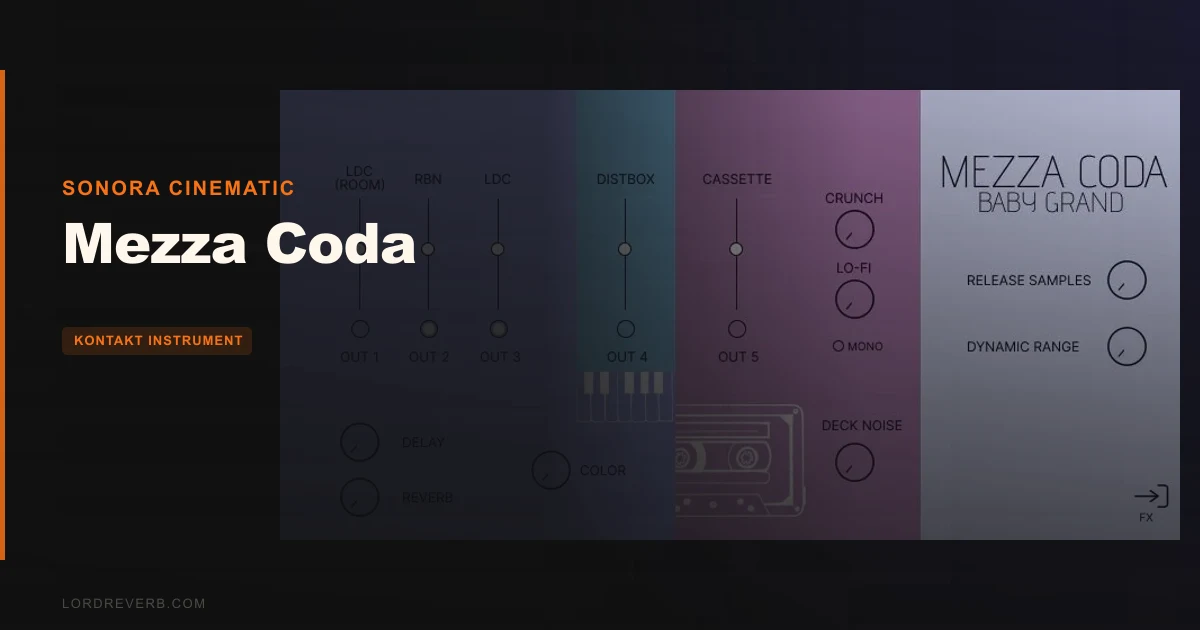
Three stereo mic positions are available: room and two spot mics. One spot pair is ribbons, the other is large diaphragm condensers, giving real control over tonal character. The ribbons pull the high-frequency content back above 8kHz, which is where cheap piano libraries get brittle. The large diaphragm condensers bring detail back when you need it for tighter pop contexts.
Two sends to reverb and delay are built in, both with multiple modes. The Color knob works like a tilt EQ: left for darker with more body, right for thinner and brighter. This matters for workflow. You can dial in a production-ready piano sound without leaving the instrument.
The Cassette section includes a Crunch control for tape saturation and a Lo-Fi macro that controls bit and sample rate reduction simultaneously. We pushed the Distbox to about 60% blend on a cinematic cue with a drone underneath. The piano stopped sounding like a piano and started sounding like something found in a box. That's the whole point.
Where It Falls Short
A baby grand is not a concert grand. We need to say that clearly before you buy this. The dynamic range between a whispered pianissimo and a forte chord is narrower on a baby grand instrument, and Mezza Coda doesn't hide that. For solo classical repertoire or exposed solo piano pieces where dynamic nuance is everything, this is the wrong tool.
The Cassette and Distbox layers are also all-or-nothing at the output stage within the instrument. You can blend them, but you can't send them to independent DAW channels without some routing gymnastics in Kontakt. Annoying if you want to compress only the Distbox signal while leaving the clean piano untouched.
The 15.5GB footprint feels large for a library with three mic positions and two processing layers. That's not a dealbreaker, but it's worth knowing before you download. Libraries like Spitfire Audio's LABS Piano come in well under 1GB. You're paying for multi-mic, multi-layer sampling quality, not just file count.
There's no trial available. You're buying on demo audio and trust.
How It Stacks Up Against the Competition
Spitfire Audio's LABS Felt Piano is free and brilliant for lo-fi textures, but it has one mic position, no Cassette or Distbox equivalent, and much thinner dynamics. It's the starting point; Mezza Coda is a step up in flexibility and depth.
Native Instruments' The Gentleman is the direct baby grand competitor at a higher price. It's more dynamically nuanced and better for clinical realism. It does not have anything like the Cassette or Distbox layers. If your session needs a piano that disappears into the arrangement with character, Mezza Coda wins. If you need a piano that sounds like a real baby grand in a concert hall, The Gentleman wins.
Mezza Coda occupies a specific lane: produced, characterful, modern. For lo-fi and cinematic Kontakt instruments, it's one of the better options at this price.
Is the Price Fair?
$59 for three stereo mic positions, two hardware-processed signal layers, a tilt EQ, reverb/delay sends, and a Crunch/Lo-Fi macro is a fair price. It's not cheap enough to be an impulse buy for everyone, but it's priced right for what it delivers.
The Mezza Coda + Verticale bundle at $59 when available is the obvious buy if you don't own either, given how much you save off the regular price. Two complementary piano libraries for the price of one. Check the manufacturer's site or Plugin Boutique for current bundle pricing.
We'd buy this at full price. We'd buy the bundle without hesitation.
Score Breakdown
| Category | Score | Notes |
|---|---|---|
| Sound Quality | 4.0/5 | Baby grand character is real; clean layer is good, not outstanding |
| Value for Money | 4.5/5 | $59 for three mic positions and two unique processing layers is strong value |
| Ease of Use | 4.0/5 | GUI is clear; Native Access setup adds a friction step |
| Features | 4.0/5 | Cassette + Distbox + tilt EQ + multi-mic is a solid feature set for the price |
| CPU Efficiency | 3.5/5 | Multi-mic streaming in Kontakt adds load; not heavy, but not light |
| Overall | 4.0/5 | A clever, characterful baby grand that earns its price |
Alternatives to Consider
Spitfire Audio LABS Felt Piano, Free, lo-fi, single mic. Good starting point but nowhere near Mezza Coda's versatility. Best free Kontakt instruments
Native Instruments The Gentleman, A more expensive baby grand with better dynamic realism and zero character processing. Buy it if realism is the priority. Skip it if character is. Native Instruments Komplete piano instruments reviewed
Loot Audio Palm Mute Piano, A different kind of unconventional piano library. Where Mezza Coda goes vintage-gritty, Palm Mute goes textural and experimental. See our Palm Mute Piano review for the full breakdown. Both are worth having.
If you're building a go-to piano toolkit ITB, Mezza Coda and a clean full-size library cover most of what you'll need. Don't love the lo-fi angle? Then Mezza Coda isn't for you. But if a piano with tape in its DNA sounds like exactly what your session is missing, it probably is.
Frequently Asked Questions
Do I need the full version of Kontakt to run Mezza Coda?
No. Mezza Coda requires Kontakt Player 7.7 or higher, and it's supported by the latest version of the free Kontakt Player running as VST, AU, or AAX. You don't need the paid full version of Kontakt. You do need a Native Instruments account and Native Access installed to activate it.
What makes the Cassette layer different from just adding a lo-fi plugin?
The Cassette layer was created by passing the piano samples through a physical Portastudio at maximum tape speed, then converting back to digital and slowing the tape down as much as possible. The noise floor, frequency response, and saturation characteristics are recorded into the samples themselves. A lo-fi plugin applied at the output is a different process: it processes a clean signal after the fact. Mezza Coda's grit is baked in at the source.
Can I use the three mic positions on separate DAW channels for independent mixing?
You can activate each mic using the dot at the bottom of its fader and route them to different channels to mix separately in your DAW. This gives you independent control over the room and both spot pairs, which is useful for applying different EQ or compression to each position without affecting the others.
Is Mezza Coda good for live performance or is it a studio-only tool?
Mezza Coda runs inside Kontakt Player, which works in standalone mode as well as as a plugin inside a DAW. The multi-mic streaming and 15.5GB sample pool means you'll want a reasonably spec'd laptop if you're taking it on stage. The instrument has no built-in MIDI mapping panel, so you'll need to set up your controller assignments in your DAW or in Kontakt's MIDI settings. It works live; it just takes a little setup.