
The real question about the FG-36A isn't whether it sounds good. It's whether a 2-knob exciter is worth actual money when free alternatives exist. Our answer: yes at half price, and no at full retail $49. Here's why the nuance matters.
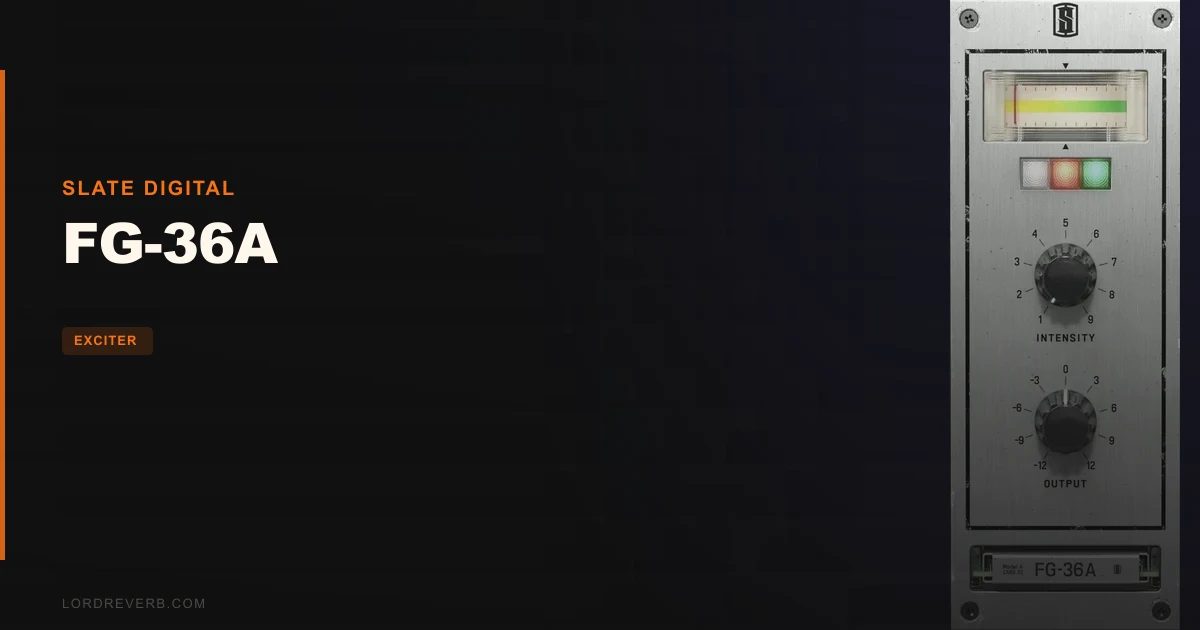
The FG-36A is Slate Digital's emulation of a 1960s Dolby 361 Type-A exciter circuit. It runs inside the Virtual Mix Rack (VMR) or as a standalone 64-bit plugin. Two controls: Intensity and Output. That's the entire interface.
It's built for producers and mix engineers who want presence and air on a track without dialing in a surgical EQ boost. Think vocals that cut through a dense 808 arrangement, or a dull acoustic guitar that needs to breathe. If you like tweaking 14 parameters, look elsewhere.
Does It Actually Deliver?
The FG-36A is a faithful emulation of a classic 1960s vintage exciter unit, brought into the VMR plugin ecosystem by Slate Digital. The original hardware it's modelled on, the Dolby 361 Type-A, was a genuine circuit used in broadcast and recording facilities for decades. It's not a made-up "inspired by vintage" marketing claim.
We loaded it on a dry lead vocal sitting around 800Hz to 3kHz, the usual mid-presence zone, and pushed the Intensity knob to around 40%. What happened: the upper harmonics from roughly 6kHz to 12kHz lifted without a harsh spike at any single frequency. The air felt natural, not like a shelved EQ boost.
That distinction matters. A standard high shelf at 10kHz adds energy broadly. An exciter like this generates new harmonic content proportionally to the input signal. The result is presence that moves with the vocal's dynamic contour rather than sitting statically above it.
It does what it promises. That's more than we can say for half the plugins we test.
Where It Shines
We tested the FG-36A across three scenarios: a lead vocal bus, a snare top track, and a full stereo mix bus. The snare was the most satisfying result. We had a session with a close-mic'd snare that sounded like it was recorded under a blanket. Intensity at roughly 35%, Output pulled back -1.5dB to compensate for perceived loudness gain. The crack returned. The transient didn't smear. The hat still sat clearly above it.
On the vocal bus, it handles breathy, airy lead vocals without turning them sibilant. That's the thing we love about this circuit: the harmonic generation doesn't peak hard at 7-8kHz the way some exciters do, which is exactly where the ess sounds live. Push it too far and you'll still get harshness, but the sweet spot is wide enough to dial in confidently.
On a mix bus, small amounts work well. We're talking Intensity below 25%. Above that, it starts to feel like everything's fighting to be the brightest element. Used subtly as a mastering-adjacent tool, it adds the kind of high-frequency density that makes a mix translate on laptop speakers without losing weight on low end.
Users on Plugin Boutique confirm zero-latency operation, which makes it viable for tracking and live monitoring sessions, not just mixing.
Where It Falls Short
Two knobs. That's it. No frequency control over where the excitation starts. No blend between dry and wet signal beyond the Output level. No visual feedback showing what frequencies are being affected. You're flying completely blind.
Compare that to something like Waves Aphex Vintage Aural Exciter, which gives you a Tune control to shift the harmonic enhancement point between 800Hz and 6kHz. With the FG-36A, you get what the algorithm gives you. Some sessions that'll be brilliant. Others it'll sit wrong and you'll have no way to adjust it.
The iLok requirement is annoying for a plugin in this price range. You don't need a physical dongle, but you do need an iLok account and iLok License Manager installed. That's an extra step that free plugins don't ask for. It's a minor friction point that adds up if you're on a client machine or a new install.
There's also no trial. You're buying blind. At half price on sale that's an acceptable risk. At full price $49? That's where we'd hesitate.
How It Stacks Up
The two most honest comparisons are Slate's FG-36A versus Sonible's free:air and versus the Waves Aphex Vintage Aural Exciter.
Free:air by Sonible is actually free, which is the obvious problem for the FG-36A. Free:air gives you a dedicated Air knob targeting 8kHz and above, a saturation blend, and a well-designed UI. For pure air on vocals, it's competitive. But it doesn't have the harmonic character of a hardware circuit model, and it lacks VMR integration if that workflow matters to you.
Waves Aphex Vintage Aural Exciter gives you that Tune control we mentioned, plus Mix and Drive parameters. More surgical. Better for tracks where you need to target a specific frequency range. Check the Waves site for current pricing as it varies significantly by sale.
The FG-36A wins on speed and VMR workflow integration. The Aphex wins on control. Free:air wins on price. Pick based on what your sessions actually need.
Is the Price Fair?
At half price, yes. That's an impulse buy for something you'll reach for on most sessions. We'd buy it ourselves at that price without hesitation.
At $49 full retail, it's harder to justify against the Aphex Exciter, which offers more control for a similar price point during Waves sales. If you're a VMR user already, the integration value tips it back in the FG-36A's favour at full price. If you're not in the VMR ecosystem at all, $49 feels steep for 2 knobs and no trial.
Watch for Slate's own sales. They run them frequently. If you can catch it at half price or below: buy it. Don't pay full retail unless you're already deep in the VMR workflow.
Score Breakdown
| Category | Score | Notes |
|---|---|---|
| Sound Quality | 4.5/5 | Harmonic excitation that tracks signal dynamics naturally, not a static shelf |
| Value for Money | 4.0/5 | Excellent at half price; borderline at $49 with no trial |
| Ease of Use | 4.5/5 | Two knobs, zero learning curve, results in under a minute |
| Features | 2.5/5 | No frequency control, no blend, no visual feedback, intentionally minimal |
| CPU Efficiency | 4.5/5 | Light footprint, confirmed zero-latency in use |
| Overall | 4.0/5 | Does one thing well enough that you'll keep it on the session template |
Alternatives to Consider
Sonible free:air, Free, targets the 8kHz-and-above air band with a saturation blend. Ideal if you need zero spend and are working outside the VMR. best free exciter plugins
Waves Aphex Vintage Aural Exciter, More control with a Tune parameter to shift harmonic enhancement from 800Hz to 6kHz. Better for mix engineers who need surgical placement rather than one-setting-fits-all. Check the Waves site for current pricing. Waves Aphex Aural Exciter review
AudioThing Type B, A Dolby noise reduction circuit-based harmonic enhancer with Drive, Frequency, and Blend controls. More textured saturation character, works brilliantly on room mics and overhead channels. A better choice if you want more mid-range harmonic density alongside the air. best exciter plugins for mixing
If you're already in the Slate VMR ecosystem, the FG-36A is the only exciter that slots natively into that chain without a workaround. That integration value is real. Slate Digital Virtual Mix Rack review
The FG-36A is a one-trick plugin. The trick just happens to work on nearly everything you throw at it. Buy it on sale, stack it on your VMR template, and stop overthinking it. If you're not a VMR user and you want frequency control over where the excitation hits, skip this and grab the Aphex instead. Two knobs is a feature to some of us. To others, it's a deal-breaker. Know which one you are before spending anything.
Frequently Asked Questions
Do I need a physical iLok dongle to use the FG-36A?
No physical dongle required. You do need a free iLok account and the iLok License Manager software installed on your machine. It's an extra setup step, but once it's done it runs quietly in the background without interrupting your session workflow.
Does the FG-36A work as a standalone plugin or only inside the VMR?
It works both ways. You can load it directly as a VST2, VST3, AU, or AAX plugin in any 64-bit compatible host, including Pro Tools, Logic Pro, Ableton Live, and Reaper. The VMR integration is a bonus, not a requirement. On macOS, VST3 is not listed as a supported format, so AU or AAX are your options there.
What hardware is the FG-36A based on?
The FG-36A emulates the Dolby 361 Type-A exciter circuit from the 1960s. The original hardware was used in broadcast and studio recording to add high-frequency harmonic presence. Slate has modelled the excitation characteristics of that circuit rather than building a generic shelving EQ with a different label on it.
Is the FG-36A good for mastering, or just for tracking and mixing?
We've used it lightly on mix buses and it holds up. Keep the Intensity below 25% for mix bus and mastering use. Push it harder and you risk over-exciting the high end in a way that'll translate harshly on earbuds. For individual track work you have more headroom to be aggressive with it.