
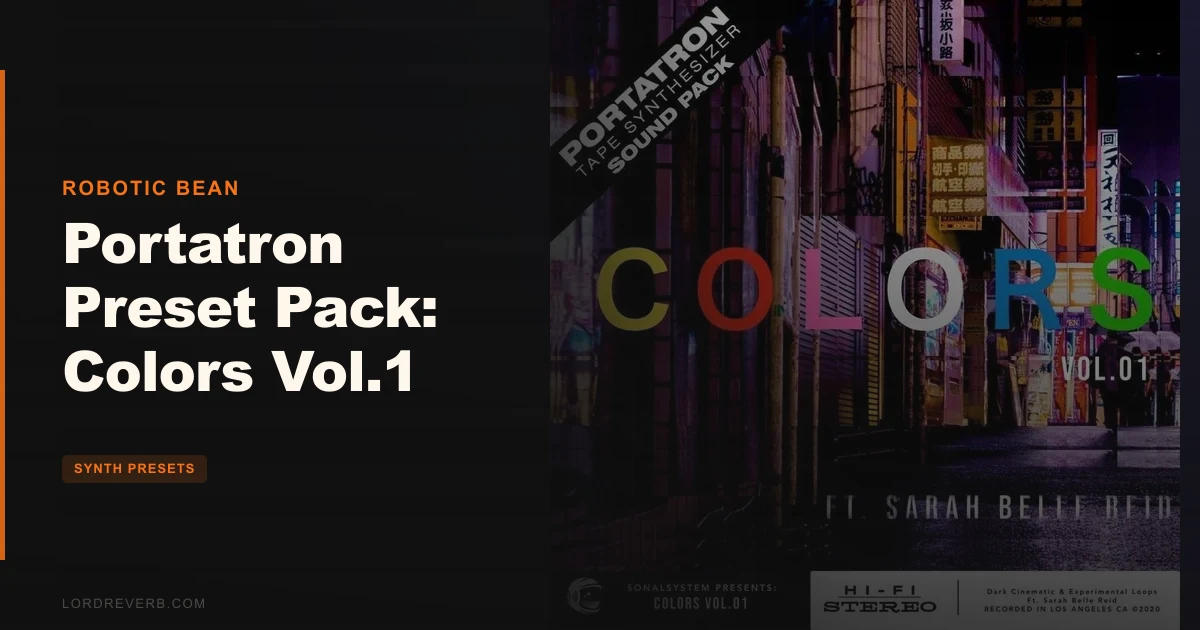
The Portatron Preset Pack: Colors Vol.1 is the best loop pack Robotic Bean has shipped for Portatron, and it's also the most niche one they've made. Most people comparing it to the Robotic Bean back-catalogue will land here wanting to know if the premium over those packs is worth it. It is, but only if you're in the right genre zip code. Colors Vol.1 was built with electroacoustic composer and performer Sarah Belle Reid, and that collaboration is not a marketing sticker, it shapes every sound in the pack. This one is for cinematic producers, experimental composers, and sound designers who want loops that feel authored, not assembled. Beat-makers chasing genre loops should look elsewhere.
How Does Colors Vol.1 Stack Up Against Other Portatron Packs?
Dark Matter and Sans Fin both live on the atmospheric end of Portatron's content library. Colors Vol.1 sits in the same neighbourhood but covers more sonic ground. We're talking 135 loops across 15 kits and 30 cassettes, with 5 stereo loop stems per kit spanning Drums, Bass, Arps, Leads, Pads, Drones, and SFX.
Dark Matter is narrower in scope. Sans Fin is more drone-focused. Colors Vol.1 is the one that actually behaves like a composer's sketchbook rather than a mood board.
The structural difference that matters most: Robotic Bean split each stereo loop into 3 shorter sub-sections and mixed those as sends layered on top of other loops in the collection. You get both the original multitrack loops individually and those pre-blended composites. That's a clever workflow decision. It's the kind of thing that saves you 20 minutes of gain-staging per session.
Performance Deep Dive: What the Numbers Actually Tell You
Let's be clear about what you get. 15 kits, each with 5 stereo loop stems. That's 75 core loops before Robotic Bean's layering approach generates the additional composite versions, which pushes the total to 135 loops across 30 cassettes in Portatron's 4-track format.
We loaded Kit 7 into a Portatron instance in Ableton Live and pulled up the stem layers. The bass stem sat at a low-frequency fundamental around 60–80Hz with subtle harmonic content creeping up to about 300Hz, not a clean sub, more of an organic, slightly overdriven low-end. We love that. It's not a sine wave; it has movement baked in from Reid's modular and vintage synthesis process.
The SFX and Drone stems are where the MIGSI influence hits hardest. Reid's electronic trumpet interface produces extended techniques, pitch bends, breath noise, resonant overtones, that translate into textures with frequency content you'd normally spend an hour building with granular processing. We ran one of the drone layers through a long reverb tail at 4.2 seconds. It sat behind a lead melody without competing. That's not luck. That's a well-recorded source.
One frustrating gap: no published BPM range, no key information per kit, no bit-depth spec. Portatron's browser doesn't display this metadata either. You're working by ear. For experimental producers that's fine. For anyone cutting to picture on a locked edit, it's annoying.
Where Colors Vol.1 Wins
The artistic identity here is real. Reid's background in electroacoustic performance, she built the MIGSI sensor interface herself, means the source material sounds like nothing you'd extract from a standard synthesis preset pack. Omnisphere's World category, Pigments' noise oscillator, Serum's wavetable editor: all of them can get you into this territory, but they can't get you here without hours of sound design work first.
Colors Vol.1 drops you directly into that territory on load.
The construction kit structure also wins. Each of the 15 kits is described as "suggestive of an emotional tendency, from sublimity to suspense." That's marketing copy, but it's accurate marketing copy. We loaded Kit 3 and Kit 11 back to back. They don't overlap tonally. The range across 15 kits is satisfying in a way that some multi-kit packs, where kit 8 sounds suspiciously like kit 4 in a different reverb, absolutely are not.
The pre-mixed composite loops are also underrated. Robotic Bean took the splits of each stereo stem and bussed them together as sends on top of other loops. The result is that some loops carry space and depth built-in at mixdown. You can drop them straight onto a timeline and they already sit correctly.
Where the Competition Wins
The Portatron ecosystem is a closed one. These .portapack files load exclusively inside Portatron. If you're on a project where Portatron isn't in your signal chain, Colors Vol.1 is worthless to you. That's a hard wall, and it's the single biggest argument for buying a general synthesis preset pack instead.
Omnisphere 2 presets from third-party designers give you thousands of sounds at similar or lower per-sound cost, with full interoperability across any DAW. Pigments preset banks from Arturia and third parties are format-agnostic. Colors Vol.1 is neither of those things.
The price is fair for what you get, but Dark Matter delivers genuine value if your aesthetic needs are less specific. And the absence of any BPM or key metadata is a real workflow gap compared to more technically documented sample packs from labels like Splice or Loopmasters, where that data is always there.
Who Should Buy Colors Vol.1 (And Who Should Skip It)
- ✅ Buy if you already own Portatron and want loop content with a genuine compositional voice rather than generic genre loops.
- ✅ Buy if you score film, games, or documentary content and need stems that already carry emotional weight without heavy post-processing.
- ✅ Buy if you're an experimental or modular-adjacent producer who works by ear and values source material quality over metadata convenience.
- ❌ Skip if you don't own Portatron. Full stop. These files are useless without it.
- ❌ Skip if you need BPM-locked or key-tagged loops to cut quickly to a grid. There's no published tempo or key data.
- ❌ Skip if you're producing genre-specific music (house, trap, drum and bass) and need loops that sit predictably in a club mix. This pack wasn't built for that.
Score Breakdown
| Category | Score | Notes |
|---|---|---|
| Sound Quality | 4.5/5 | Reid's MIGSI and modular source material produces textures genuinely hard to replicate ITB |
| Value for Money | 4.0/5 | 135 loops at $49.99 is fair; the gap over Dark Matter is justified by quality but not by quantity alone |
| Ease of Use | 3.5/5 | No BPM or key metadata published; working by ear adds friction for grid-based workflows |
| Features | 4.0/5 | Pre-mixed composite loops and multitrack stem access in one pack is a clever structural decision |
| CPU Efficiency | 4.0/5 | Pack itself carries no CPU overhead; load is entirely on Portatron, which runs light |
| Overall | 4.2/5 | Brilliant source material, limited audience; the Portatron lock-in is the only real argument against it |
Alternatives to Consider
If you're deep in the Portatron ecosystem and want more of its flavour before committing to Colors, check our Portatron Preset Pack SonalSampler Review 2026 for a different content angle from Robotic Bean at a lower price point.
Already own Colors and wondering what sits next to it in your signal chain? Our Does Come Drone With Me Work Outside Portatron in 2026? covers the drone-heavy sibling pack and addresses the interoperability question directly.
If you're weighing this against a more general synth preset approach, our Andy Lee House Synth Presets For Predator: Still Worth It is a useful comparison for understanding how genre-specific packs differ in structure and value. For DAW-agnostic loop content with published BPM and key data, Splice's curated sound packs and Loopmasters' cinematic libraries are the cleaner option if you're not already running Portatron.
Colors Vol.1 is available at Plugin Boutique and SonalSystem. It's the right buy for experimental and cinematic producers who own Portatron and want 135 loops built from genuinely unusual source material. It's the wrong buy for anyone without Portatron in their setup, or for producers who need tempo and key metadata baked in. The sounds are brilliant. The ecosystem lock is real. Go in with both eyes open.
Frequently Asked Questions
Does Portatron Preset Pack: Colors Vol.1 work in any DAW?
It works inside any DAW where Portatron runs as a plugin, including Ableton Live, Logic Pro, FL Studio, and Cubase. The pack itself is a .portapack file that loads exclusively through Portatron's browser. You can't drag the files directly into a DAW timeline or use them in a different synth. If Portatron isn't in your signal chain, this pack won't function at all.
Who is Sarah Belle Reid and why does her involvement matter?
Sarah Belle Reid is an electroacoustic composer and performer best known for the MIGSI (Minimally Invasive Gesture Sensing Interface), an electronic sensor system built into a trumpet. Her performances use modular synthesis, vintage gear, and extended instrumental techniques to create abstract, textured sound experiences. That background means the source material in Colors Vol.1 carries timbral complexity that's difficult to replicate with standard synthesis presets.
How many loops does Colors Vol.1 actually contain?
The pack contains 135 loops arranged across 30 cassettes and 15 kits. Each of the 15 kits holds 5 stereo loop stems covering Drums, Bass, Arps, Leads, Pads, Drones, and SFX. Robotic Bean also split and layered the loops as composite versions, so you get both the original multitrack stems and the pre-mixed layered loops. That's where the 135 figure comes from.
Is this good value compared to other Portatron packs?
It is the most expensive single Portatron pack in the current library, sitting above Sans Fin and Dark Matter. The premium is justified by the depth of content (135 loops vs. narrower collections), the calibre of the collaborating artist, and the layered stem architecture. If you're already inside the Portatron ecosystem and want the most complete single purchase, Colors Vol.1 is the one to buy.