
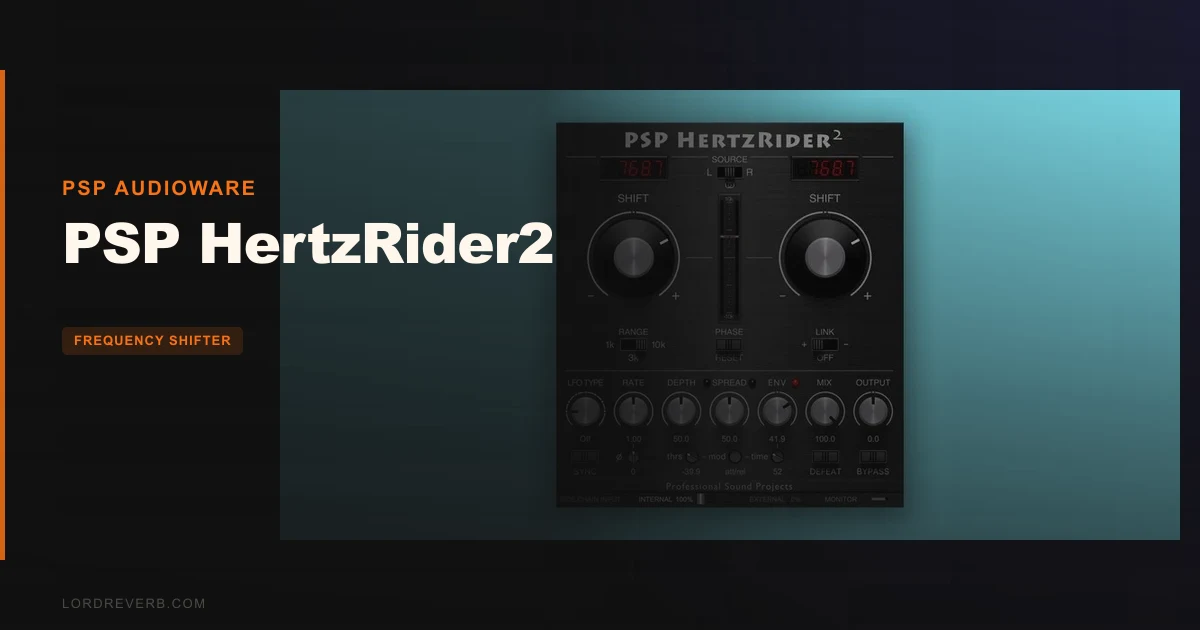
PSP HertzRider2 is a frequency shifter plugin from PSP Audioware that does one specific thing well: it shifts audio in Hz, not cents, which means it treats every frequency in your signal equally rather than scaling them proportionally like a pitch shifter would.
We pulled it up mid-session on a snare that refused to sit. The attack was too close to 200Hz to tuck under the kick without a fight. Two minutes with HertzRider2 and we'd nudged the whole drum up 40Hz without touching the transient character. That's the moment this plugin earns its keep.
This review is for producers and sound designers who already know they need frequency shifting, or who keep reading about it and wondering if it's actually useful. If you just want a pitch shifter for vocals, look elsewhere. HertzRider2 is a specialist tool, and it knows it.
What It Is and What It Absolutely Isn't
Frequency shifting moves every frequency in a signal by the same fixed number of Hz. A pitch shifter multiplies frequencies by a ratio. That distinction sounds academic until you hear what happens to a snare drum shifted up 80Hz versus pitched up a semitone. The former sounds tuned. The latter sounds like a toy.
HertzRider2 is built for inharmonic sources: snares, toms, kicks, foley, synth textures with no clear harmonic series. On those, it's brilliant. On a guitar chord or a piano, it destroys the harmonic relationships between partials and turns music into dissonance. That's not a flaw. It's physics. Know going in that this is a creative wrecker for tonal material and a precise tuner for percussive material.
It is not a pitch corrector. It won't autotune your vocals. Don't try it.
Living With PSP HertzRider2
Setup is fast. Install via iLok License Manager, no dongle required, but you will need that manager application running. It's annoying in 2026 when most competitors have moved to simpler activation, but it's a one-time friction.
The interface is small and direct. You get your shift amount, your range selector (up to 1kHz, 3kHz, or 10kHz in either direction), the LFO section, and envelope follower controls with side-chain input. That's most of it.
We ran it for three weeks across a range of sessions. On a drum bus, we used the envelope follower to let the kick's transient briefly drag the shift amount. The snare got a rhythmic pitch flutter tied to kick hits. It sounded like something from a hardware modular rack, not a plugin insert.
The LFO sync to host tempo is where it gets genuinely fun. We locked a slow sine wave to one bar on a synth pad, set the range to 3kHz, and kept the depth low. The result was a subtle, seasick shimmer that sat behind a lead without drawing attention to itself. Chorus-adjacent, but stranger. More alive.
Independent left and right channel shifting is the sleeper feature. Shift the left channel up 15Hz and the right down 15Hz and you get a stereo widening effect with a character that no stock imager produces. We loved this on synth leads. It adds movement without obvious modulation.
Latency is minimal and frequency-dependent, which the developer flags openly. In practice, we didn't hear it as a problem on any source we tested. No compensation headaches at normal session buffer settings.
The Trade-Offs Worth Knowing
The GUI is sparse. Not retina-crisp-minimalist. Just sparse. There's no visual frequency display, no spectrum analyser, no real-time feedback beyond the knob position itself. You're working by ear, which is fine for experienced users but frustrating if you're learning what frequency shifting does.
The range selector is a clever design choice that also creates a precision problem. Switching between 1kHz, 3kHz, and 10kHz ranges changes how much resolution you have per degree of knob movement. At 10kHz range, dialling in a specific 40Hz shift by hand requires patience. We wish there was a type-in field for exact values.
The LFO and envelope follower are useful but not deep. You get shape and rate on the LFO, and threshold-style control on the follower. If you want modulation routing on the level of something like PSP Studio Modular Collection, this isn't it. HertzRider2 gives you enough to be creative, not enough to build a modulation matrix.
On the upside: the CPU load is genuinely light. We ran eight instances across a session on a machine that was already working hard and saw negligible impact. PSP designed this to be lean, and it delivers on that.
Against the Field
Eventide's Physion Mk II and H3000 Factory both do frequency shifting as part of a much larger toolkit. They sound excellent. They also cost significantly more and carry far more complexity than most users need for a targeted snare-tuning job.
The Waves Soundshifter handles pitch and time stretching with more approachable pitch-shifting tools, but it's not a pure Hz-domain frequency shifter. Different use case.
For pure frequency shifting on a budget, HertzRider2 has almost no direct competition at its price point. The closest thing is a freeware Max for Live device or a modular plugin with a frequency shifter module. Neither matches HertzRider2 for stability and ease of deployment in a commercial session.
If you need creative modulation depth alongside frequency shifting, check the PSP InfiniStrip Earth Edition for PSP's approach to building flexible tools. Different category, but shows what the developer does when they go deep.
The Real Verdict
If you're regularly mixing drums, designing sound effects, or building experimental textures, HertzRider2 earns its slot in your chain. It does one job with low CPU, minimal fuss, and real results.
It's wrong for you if you want a general-purpose pitch tool, if the iLok manager install is a dealbreaker, or if you need visual feedback to work confidently. It's also wrong if your sessions are entirely tonal. A frequency shifter on melodic material requires deliberate destructive intent, not accident.
For everyone else: check the manufacturer's site for current pricing and grab the trial first.
Score Breakdown
| Category | Score | Notes |
|---|---|---|
| Sound Quality | 4.5/5 | Clean shifting on inharmonic sources with no audible artifacts at moderate ranges |
| Value for Money | 4.0/5 | Strong at its price point given the near-absence of direct competition |
| Ease of Use | 3.5/5 | Simple layout, but no visual feedback and iLok install adds friction |
| Features | 4.0/5 | LFO sync, envelope follower, side-chain, and independent L/R shifting cover real creative ground |
| CPU Efficiency | 4.5/5 | Runs lean by design; eight instances didn't stress our session |
| Overall | 4.1/5 | A focused specialist tool that delivers exactly what it promises |
Alternatives to Consider
Eventide H3000 Factory is the go-to if you want frequency shifting wrapped inside a much larger effects engine. It costs more and takes longer to learn, but the sound quality is hard to argue with. Best Eventide Plugins Ranked
PSP BussPressor won't shift frequencies, but if your drum bus problem is dynamics rather than tuning, it's worth a look from the same developer. Can PSP BussPressor Fix a Broken Drum Bus in 2026?
PSP MasterComp is another PSP tool worth having if you're building out the developer's ecosystem. PSP MasterComp Review: Still a Top Mastering Compressor 2026
None of these replace HertzRider2 for what it does. They sit next to it in a mature plugin folder, not in its spot.
Here's the honest close: a frequency shifter is a tool that most producers add once and then never pull out until they desperately need it. When you need it, nothing else will do the same job. HertzRider2 makes sure that when that session arrives, you don't waste forty minutes patching a workaround. Buy it, ignore it for a month, and then love it when a snare finally sits right at 3am.
Frequently Asked Questions
What's the difference between PSP HertzRider2 and a pitch shifter?
A pitch shifter moves frequencies by a proportional ratio, so it preserves harmonic relationships. HertzRider2 shifts every frequency by a fixed number of Hz, which breaks those relationships. On inharmonic sources like snares and drums, that produces natural-sounding tuning changes. On tonal material like chords and vocals, it creates dissonance. The right tool depends entirely on your source.
Do I need a physical iLok dongle to run HertzRider2?
No. You need the iLok License Manager application installed on your computer, but you don't need the physical USB dongle. The license lives on your machine or in your iLok cloud account. It's an extra install step, but it's not the hardware-dependent friction it used to be.
Can HertzRider2 be used on vocals?
Technically yes, creatively it depends on your intent. For natural pitch correction on vocals, it's the wrong tool. Vocals are harmonic, and frequency shifting breaks the relationships between overtones, producing a metallic, detuned quality. If that's the effect you want for a processed or experimental vocal, go for it. If you want clean tuning, use a pitch shifter instead.
What does the LFO sync feature actually do in practice?
It locks the LFO rate to your DAW's tempo, so the frequency shifting modulates in time with your session. You can set it to cycle every beat, every two bars, every quarter note, and so on. In practice it turns HertzRider2 from a static tuning tool into a rhythmic modulation effect, which works particularly well on synth pads, atmospheric textures, and processed percussion.