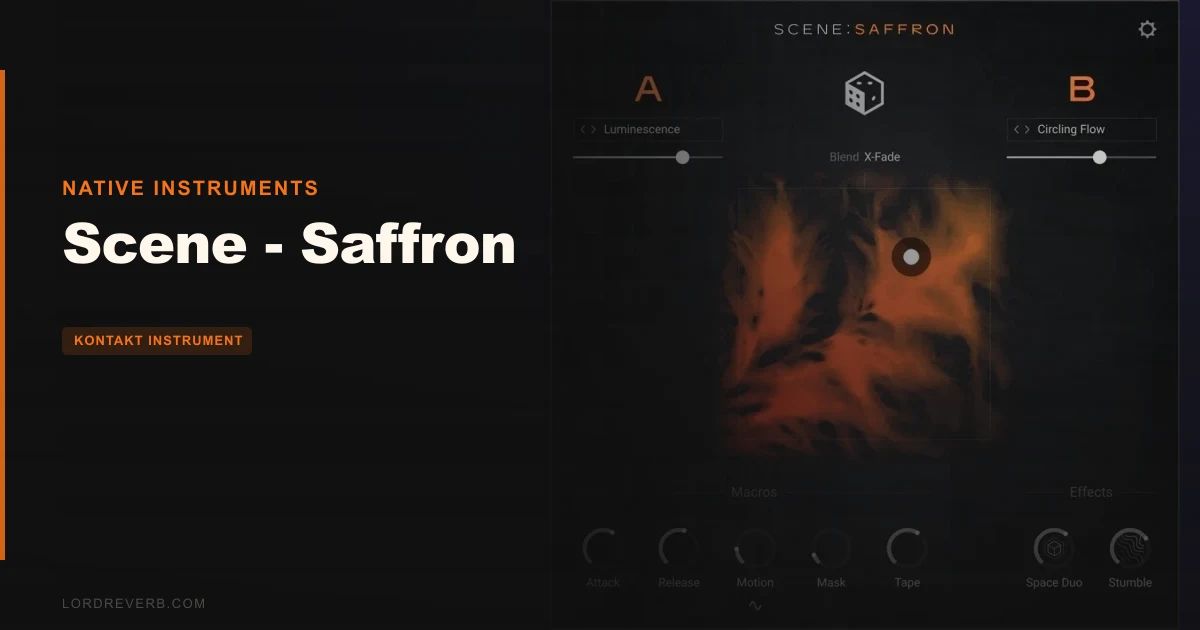
Scene - Saffron is a focused, beginner-friendly cinematic instrument that does a few things well and stops there, which is either exactly what you need or a reason to spend your $28 elsewhere. It blends strings, synths, and brass into hybrid textures across 120 presets, targets media composers who need fast results, and keeps the whole thing to 1 GB on your drive. If you're scoring short-form content and you want something you can load and play in three minutes, it fits. If you need depth, curation, and a wide palette for long-form work, this isn't your tool.
What You're Actually Getting
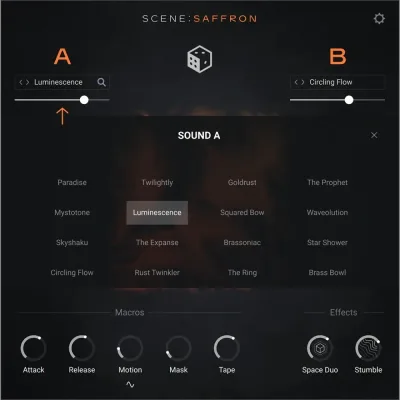
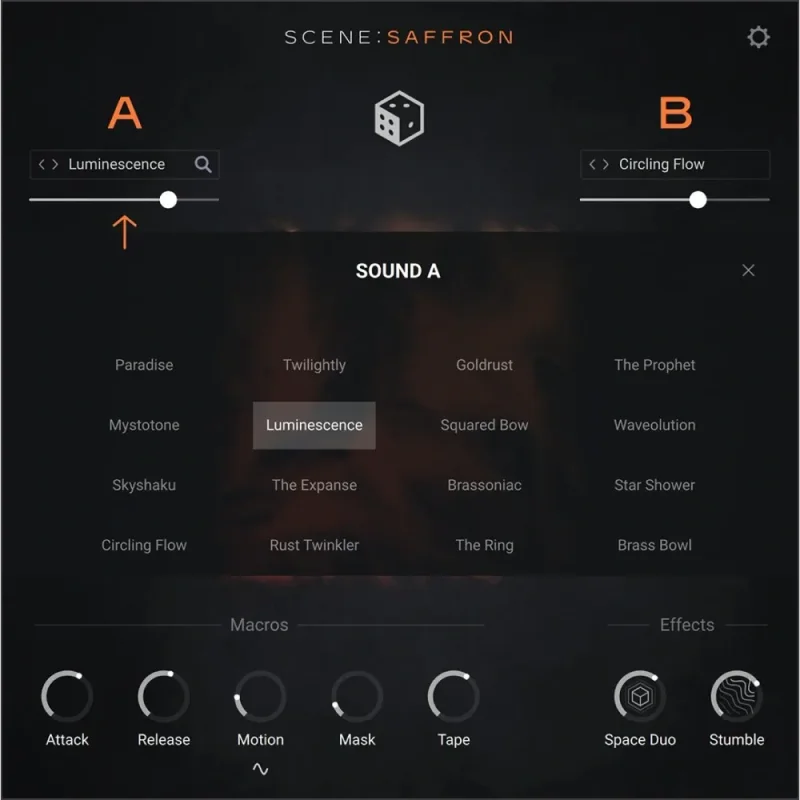
Scene - Saffron gives you 16 hybrid sound sources that pull from strings, synths, and brass. You blend them through an XY pad across a five-octave range, which is where most of the interesting motion comes from.
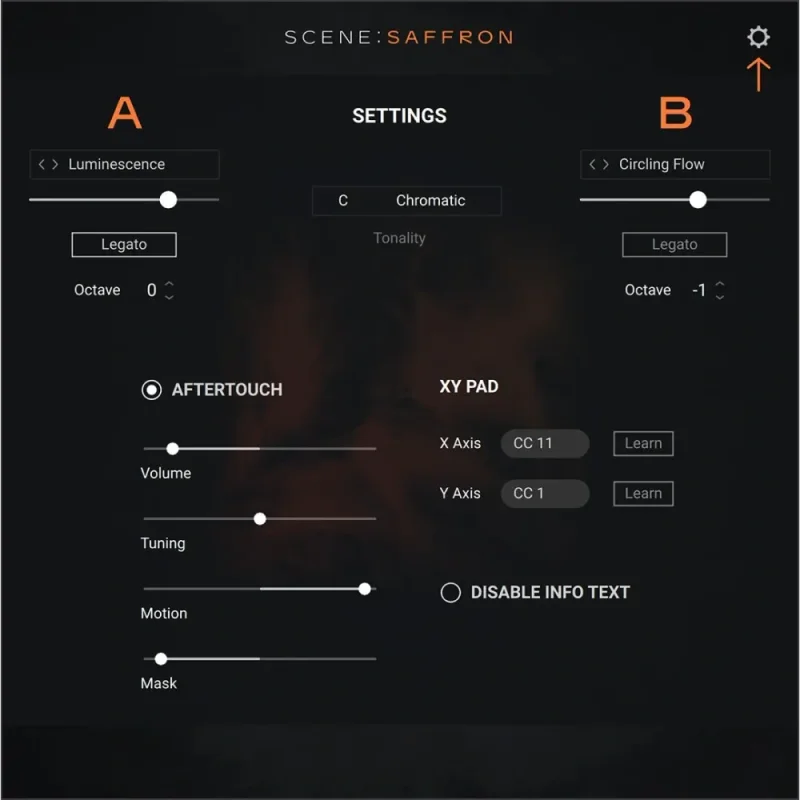
The controls are streamlined by design. You get chromatic key and scale selection, a Legato mode for smoother note transitions, and a randomize function that shuffles preset elements when you want something unexpected. The visual interface uses an earth-toned watercolor morphing background, which sounds gimmicky but is actually one of the calmer plugin UIs you'll sit with during a late session.
Polyphonic aftertouch is supported, so if your controller handles it, you get expressive dynamics without extra automation. It launched in July 2024 and sits at $28.
The Good
Loading is fast. Owners report it's in Native Access and playable in minutes, with no perceived latency and stable performance across sessions. That matters when you're on a deadline and you need a texture layer running before a sync call.
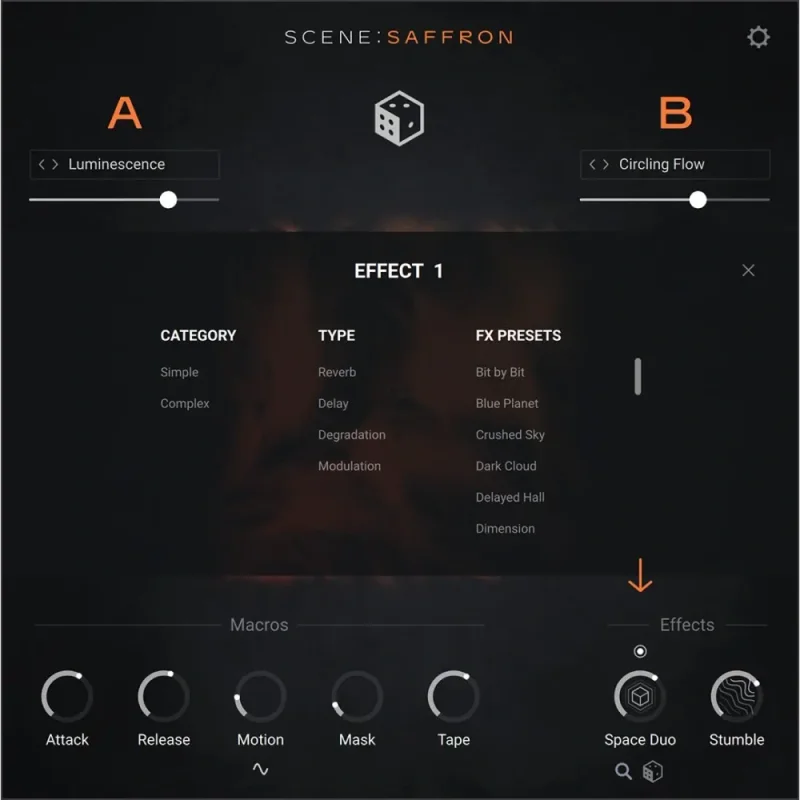
The XY pad is the strongest part of this instrument. You can drag across the pad mid-performance and the blend shifts in real time. Pull it toward the upper-left while holding a chord and the strings push forward. Nudge it right and the synth texture breathes underneath. It's satisfying to play with, and parameter modulation from a hardware controller feels immediate according to owners.
The randomize function is genuinely clever for breaking creative blocks. You're scoring a tense scene, the preset you're using feels stale, you hit randomize, and you get something weirder that actually fits better. It's not deep synthesis, but it's fast.
120 presets at $28 gives you a reasonable starting palette. For a first cinematic plugin or a quick addition to a sparse scoring setup, the value holds.
The Not-So-Good
Sixteen sound sources is the number that keeps nagging. Larger cinematic libraries give you two or three times that with more intentional curation across each source, and when you're deep in a project you feel the ceiling.
Some of the sounds have a buzzy quality. Not all of them, and it's not a dealbreaker across the board, but when you're trying to place a pad under orchestral strings in a mix, a buzzy background texture sticks out in an annoying way that can cost you a full afternoon of EQ work.
The layered pad approach is also worth thinking about before you buy. Owners report these pads can be hard to mix without a heavy footprint in the stereo field. If your arrangement is already crowded, getting Saffron to sit without swallowing other elements takes effort.
And it's not compatible with Maschine. If that's your production hub, this one's a hard pass regardless of the price.
Compared to the Alternatives
The three names that come up alongside Saffron are Spitfire's Original series, NI's Play series, and Kempler Elements. Here's the honest breakdown:
| Product | Strongest Point | Weakest Point | Best Situation |
|---|---|---|---|
| Scene - Saffron | Fast loading, XY pad blending, Legato mode | Only 16 sound sources, some buzzy textures | Quick cinematic texture layers for short-form content |
| Spitfire Originals series | Similar price point with a streamlined approach | Also a smaller, inexpensive library | When you want a comparable budget option |
| NI Play series | Built-in sequencer, contemporary music focus | Different target: more suited to modern production than film scoring | Beat-based or contemporary pop/electronic work |
| Kempler Elements | Larger library with more sound sources and curation depth | More investment required | When you need a deeper palette for long-form scoring |
Spitfire Originals is the closest comparison. Both are smaller libraries at a similar price point. The choice there comes down to which developer's workflow and sound character suits you.
NI Play series isn't really a competitor for scoring work. If you're making sync music with a contemporary angle, Play makes more sense. If you're writing cues, Saffron is the better fit between those two.
Kempler Elements wins on depth. If your budget can stretch and you want more sound sources with stronger curation, that's where we'd look first. Saffron is the trade-down option, not the upgrade.
Who Should Buy This
- ✅ Buy if you're new to media composition and need a low-cost, easy-to-navigate starting point.
- ✅ Buy if you score short-form content and need fast-loading cinematic textures without a complex interface.
- ✅ Buy if your current scoring palette needs a simple hybrid layer that responds to polyphonic aftertouch.
- ❌ Skip if you need more than 16 sound sources and broader curation for long-form or complex projects.
- ❌ Skip if you produce in Maschine. It won't load.
- ❌ Skip if your mixes are already dense and you don't want to fight a heavy pad footprint for every cue.
Specs & Technical Details
| Developer | Native Instruments |
| Price | $28 |
| Plugin Format | N/A |
| OS Support | N/A |
| Activation | Native Access |
| CPU Usage | N/A |
| Trial Available | N/A |
| Version Reviewed | N/A |
| Library Size | 1 GB |
| Sound Sources | 16 |
| Presets | 120 |
| Release Date | July 2024 |
| Maschine Compatible | No |
Score Breakdown
| Category | Score | Notes |
|---|---|---|
| Sound Quality | 3.5/5 | Useful hybrid textures undercut by some buzzy sources |
| Value for Money | 3.5/5 | Fair at $28 for beginners, thin for experienced composers |
| Ease of Use | 4.5/5 | One of the fastest setups in this category, minimal learning curve |
| Features | 3.0/5 | XY pad and randomize are clever; 16 sources is a ceiling you'll feel |
| CPU Efficiency | 4.0/5 | Owners report stable, low-latency performance throughout |
| Overall | 3.5/5 | A solid entry-level cinematic tool that runs out of room quickly |
Alternatives to Consider
Spitfire Originals series sits at a similar price point with a comparable streamlined approach. If you're torn between the two, try both demos if available. The sonic character differs, and which one fits your scoring style is a personal call.
Kempler Elements is the step up. More sound sources, deeper curation. If your budget can cover it, you'll love the additional palette. For anyone doing consistent scoring work, Kempler Elements offers the expanded palette to grow into after Saffron.
NI Play series is worth mentioning only if your work leans contemporary rather than cinematic. It has a sequencer and a different sonic angle. For film and TV work specifically, Saffron is the better NI option between those two.
Scene - Saffron is a reasonable first step into cinematic scoring tools, not a long-term foundation. At $28, you're buying speed and simplicity. If that's your current need, it delivers. If you wish for more sources and tighter curation, put that money toward Kempler Elements instead. The buzzy textures and limited palette will frustrate you inside six months.
Frequently Asked Questions
Does Scene - Saffron work with Maschine?
No. Maschine compatibility is not supported. If Maschine is your primary production environment, this instrument won't load for you and you'll need to look elsewhere.
How many presets does Scene - Saffron include?
It ships with 120 presets built from 16 hybrid sound sources that blend strings, synths, and brass. The randomize function lets you manipulate preset elements to extend the palette further.
Is Scene - Saffron good for beginners?
Yes, it's one of the easier cinematic instruments to get started with. The interface is streamlined, installation through Native Access takes minutes, and the XY pad is intuitive from the first session.
What does the XY pad actually do?
It blends the 16 hybrid sound sources across a five-octave range in real time. You drag across the pad to shift the balance between layers while you play, which creates movement and variation without any automation drawing. Owners report controller modulation feels immediate with no noticeable latency.
How large is the Scene - Saffron download?
The plugin has a 1 GB footprint. For systems with limited storage that are already housing larger sample libraries, that's worth factoring in before you buy.