
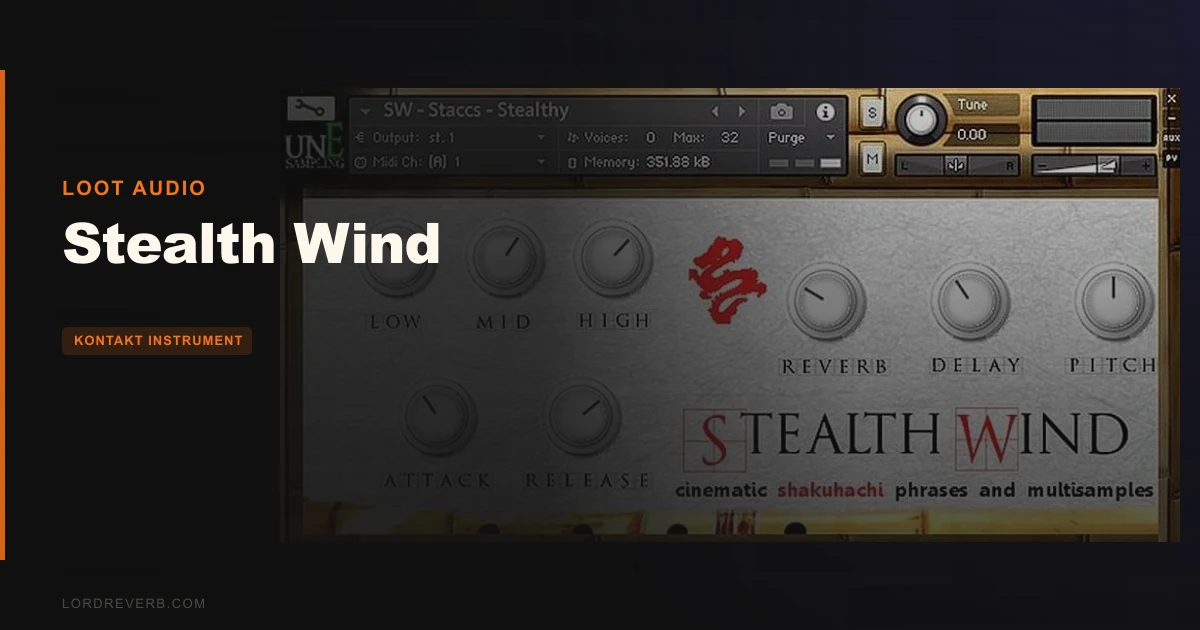
If you're scoring a stealth sequence, an ancient Asian landscape, or anything that needs a shadowy, cinematic breath of shakuhachi, Stealth Wind by Loot Audio is built exactly for that moment. At $29, it's a low-stakes purchase for a highly specific sound. It won't replace a deep, fully articulated solo woodwind library. What it does is drop a focused set of shakuhachi phrases and textures into your session and let you get out fast. The James Horner-style cinematic vibe is baked in, which is either a feature or a dealbreaker depending on what you're after. Composers working in film, game audio, or world-fusion production who need an ethnic accent rather than a full instrument will find the most use here.
Where Does Stealth Wind Actually Belong?
Picture this: you're building a cue for a ninja ambush scene, and your string ostinato needs something that whispers danger without screaming it. That's the exact gap Stealth Wind fills.
The library covers cinematic shakuhachi phrases, ethnic motifs, staccato hits, and what the developer calls "Elephant Calls" and "Enigma Calls." Those low, ghostly tones are brilliant for underscoring tension. The Enigma patches in particular, derived from re-recordings of a base shakuhachi sample, push into genuinely unusual sonic territory.
The two separate cinematic phrase patches mean you can drop pre-built movement into a cue without needing to program every note. For underscore work where the director wants "something Eastern" and your deadline is tomorrow, that's a satisfying shortcut.
The bonus Taiko drum patch sweetens the deal. It's multisampled and gives you rhythmic backbone that pairs naturally with the shakuhachi material. Pulling both into the same cue and treating them as a unit saves real time.
Ethnic and world-fusion producers will also find the lighter, more traditional phrase patches useful as texture layers. They sit underneath without demanding attention.
Where It's a Poor Fit
If you need a fully playable shakuhachi, one you can run melodies through with real legato transitions, this isn't it. The developer is upfront: Stealth Wind is an ethnic accent, not a solo instrument.
That matters. You can't dial in a chromatic melody and have it breathe naturally under your fingers. The phrase and staccato patches don't give you that kind of control. Frustrating if you came expecting a lead instrument.
Jazz composers wanting textural improvisation elements, or producers who need a shakuhachi to carry a melodic hook for three minutes, should look elsewhere. The library is too narrow for those jobs.
And if you're running the free Kontakt Player, stop here. This requires the full paid version of Kontakt 5.5.1 or above. No workaround. That's a hard limit and it rules out a chunk of potential buyers right at the door.
How To Use It Well
Start with the cinematic phrase patches and find the one that fits your tempo and key center. Because these are pre-recorded phrases, your job is curation and placement rather than programming.
Layer the Enigma Calls low in the mix. Set them back with a long reverb pre-delay, around 60 to 80 ms, so they bloom behind your main phrase. That's where they stop sounding like a sample and start sounding like a space.
When you use the staccato patches for rhythmic hits, treat them like you'd treat a percussion hit. Drop them into your session and automate the volume so they duck into the low-mid range of a swell. Don't leave them exposed at a flat velocity.
The Taiko patch earns its place as a room-filling accent. Keep the low end trimmed below 60 Hz on most playback systems, or you'll fight your subwoofer. A gentle high-pass and a touch of room reverb will make it feel recorded rather than triggered.
If you're writing ethnic-leaning tracks rather than cinematic ones, the ethnic phrase patches tend to feel more open and less dramatic. Use those as your base and treat the cinematic versions as an intensification layer when the cue needs to push.
One real-world scenario: you're finishing an action cue and the director wants a breath of "ancient Asia" in the third act. Load the cinematic phrase patch, find the one with the most forward articulation, and sit it on a send with a wide hall reverb. High-pass the reverb return above 300 Hz to keep the low end from going muddy.
The Verdict
Stealth Wind earns its $29 if shakuhachi cinematic textures are something you reach for more than once a year. The 17 patches plus the Taiko bonus give you a usable toolkit for stealth, ethnic, and tension cues. We love the Enigma Calls for their weird, unsettling edge. We wish there were legato articulations, because their absence keeps this permanently in the "accent" category rather than the "instrument" one.
If you own the full Kontakt and you score anything that calls for an Eastern breath, it's worth picking up at $29. If you need a playable, melodic shakuhachi, this will disappoint you.
Specs & Technical Details
| Developer | Loot Audio |
| Price | $29 |
| Plugin Format | Kontakt Instrument (.nki) |
| OS Support | Mac / Windows (via full Kontakt) |
| Activation | N/A |
| CPU Usage | N/A |
| Trial Available | N/A |
| Version Reviewed | N/A |
Score Breakdown
| Category | Score | Notes |
|---|---|---|
| Sound Quality | 3.5/5 | Recordings by Jon Johnston and Jonathan McCollum bring authenticity, but the narrow articulation set limits what you can do with them |
| Value for Money | 4.0/5 | At $29 with 17 patches and a Taiko bonus, the content-to-cost ratio is honest for what it is |
| Ease of Use | 4.0/5 | Small patch set, clear purpose, quick to load and place in a session |
| Features | 3.0/5 | No legato, no full instrument playability; phrase and texture patches only |
| CPU Efficiency | N/A | No data available |
| Overall | 3.5/5 | A clever, focused accent library that knows what it is and doesn't pretend otherwise |
At $29, Stealth Wind is not a library you build a career around. It's the one you pull up when a cue needs a breath of ancient danger and you don't have time to build it from scratch. The shakuhachi recordings are genuine, the cinematic phrase patches are immediately usable, and the Taiko bonus tips the value equation in your favor. The lack of legato is a real hole. If you can live with phrase-based playback and accent textures, this earns its price without argument. If you can't, it'll sit untouched on your drive and that's just wasted money.
Frequently Asked Questions
Does Stealth Wind work with the free Kontakt Player?
No. It requires the full paid version of Kontakt 5.5.1 or above. The free Kontakt Player will not load it. If you're not already running the full version, factor that cost into your decision before purchasing Stealth Wind.
What kind of shakuhachi sounds does Stealth Wind include?
The library covers cinematic phrase patches, ethnic phrase patches, staccato patches, multisampled sustains, low "Elephant Calls," and "Enigma Calls" derived from re-recordings of a shakuhachi sample. There's also a bonus multisampled Taiko drum patch. It does not include legato articulations, so it won't play back smooth, connected melodic lines.
Is Stealth Wind suitable for traditional Japanese music production?
The ethnic patches lean toward lighter, more traditional shakuhachi sounds. But the library as a whole is angled toward cinematic use, with what the developer describes as a "James Horner" vibe. For deeply authentic traditional Japanese composition, you'd want a library with broader articulation coverage.
How many patches are included in the library?
Stealth Wind contains 17 Kontakt patches plus one bonus Taiko drum patch. That includes two cinematic phrase patches, two ethnic patches, staccato patches, Elephant Calls, and Enigma Calls. It's a focused set built around a specific sonic character rather than a comprehensive instrument.