
Loot Audio’s PSI Marimba is a good buy at $40 if you own full Kontakt and want one convincing rosewood marimba with real mic control. If you only have the free Kontakt Player, close this tab. It won’t load.
What you’re paying for is sampling depth, not gadgets. Nine microphones, up to 23 velocity levels, and five mic positions you blend with faders.
That’s the whole pitch. It’s a strong one.
The catch is that we know very little about the interface and workflow side. Nothing in the material we’ve seen describes a preset library or built-in sequencer. So this is a sound-first purchase. Composers who want a marimba that behaves like a real one will love it. People who want arpeggiators and one-knob magic should look elsewhere.
What You're Actually Getting
PSI Marimba is a 52-note instrument for Kontakt. It holds 10,221 samples, 6.2 GB on disk and 3.2 GB compressed in the download.
The source is a Robert Van Sice Artist Series 4 & 1/3 Octave Rosewood Marimba. That’s a serious concert instrument, not a bargain-bin bar set.
You get a Main instrument with felt beaters, offering rolls and straight hits. A Soft instrument uses a softer beater, again with rolls and straight hits. Two more patches contain rolls only, without standard hits.
Five bonus patches add a hard rubber beater, drag strokes and interval variations. That’s more articulation range than the price suggests.
The Five Microphone Positions
This is the headline feature, and the one we’d buy it for.
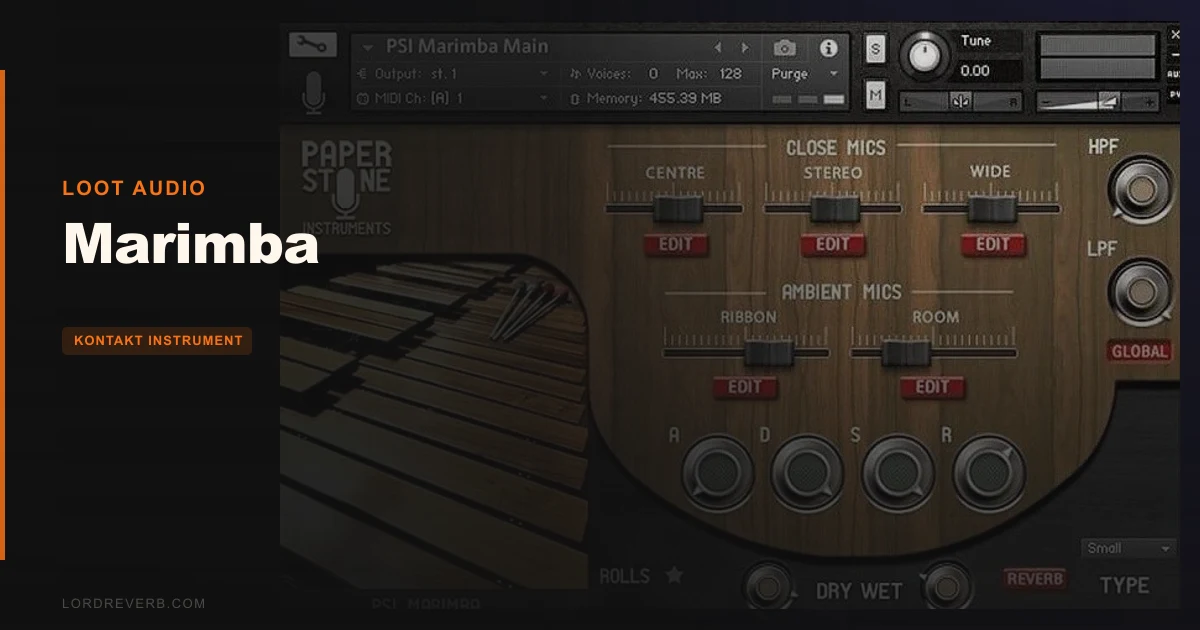
Close mics: a Neumann TLM 103 (Centre), a Neumann KM184 pair (Stereo) and an AKG C414 B-ULS pair (Wide). Ambient mics: a Coles 4038 pair (Ribbon) and a Neumann U87 pair (Room). That’s nine microphones feeding five positions, each with its own fader in the GUI.
Here’s the scene. You’re scoring a quiet cue and the marimba sounds too dry against your strings. Pull up the Room fader, ease back the Centre, and the bars start to sit in a space instead of floating in front of it. No reverb plugin needed.
Now flip it. Your arrangement is busy and the marimba disappears. Push Centre and Stereo, pull the ambient mics down, and the attack gets close and focused.
The developer calls phase alignment essential to the focused tone. That matters when you stack mics. Badly aligned multi-mic libraries go hollow and thin when you blend them. Owners report they can combine and blend all five as they see fit, and a reviewer called the sound surprisingly authentic. Phase trouble would be the first thing to show up in a blend like that, and nobody mentions it.
Ribbon is the one to try first if you want a rounded top end. Wide is your pick when the marimba needs to span the stereo field.
Velocity Layers and Playability
Samples were captured with up to 23 velocity levels. That’s the number that decides whether a marimba feels like an instrument or a keyboard trigger.
Play a slow, quiet line and the dynamics should step smoothly, not jump between obvious layers. Dig in hard and you get the full bark of the bar. With up to 23 levels to draw on, your hand does the work instead of the CC lane.
The 52-note range covers the 4 & 1/3 octave span of the instrument. Nothing more, nothing less. Notes outside the real marimba’s range simply aren’t there, which is honest, if occasionally annoying when a MIDI part wanders.
Beaters, Rolls and Drag Strokes
The felt beaters in the Main instrument are the default sound. Straight hits for melodies, rolls for sustained notes.
Rolls matter more on a marimba than almost any other mallet instrument. Bars decay fast, so a held note needs a roll to feel alive. Having rolls sampled, with two patches dedicated to rolls alone, is a genuine plus.
The Soft instrument uses a softer beater. Think lullaby lines, pad-like textures, anything where a hard felt attack would poke through.
Then the bonus patches. A hard rubber beater gives you a brighter, more percussive strike. Drag strokes add that quick smeared ornament real percussionists use. Interval variations let you play two-note shapes without stacking notes by hand.
Honestly? The bonus patches are underrated. Most people will park on Main and never open them. Don’t.
Stereo Width and Mixing
The Main instruments come with a Less Stereo Width version. It narrows the stereo field.
Why bother? Because a wide marimba can smear in a dense mix. Pan a wide stereo sample hard in a film cue and you’ll find it fighting your strings for space.
Load the narrower patch, keep the Centre mic prominent, and the marimba stays in its lane. It’s a small addition that shows someone thought about real sessions.
This is also where the mic faders earn their keep. Narrow patch plus a touch of Room gives you focus with a little air.
What We Can't Tell You
The information we have is thin on interface design, presets and workflow efficiency. We won’t pretend to know how the GUI looks beyond the mic faders, or how many presets ship.
That’s a real gap if you value workflow. Check a demo video before you buy and see how fast you can get from loading the patch to a usable blend.
The Not-So-Good
Full Kontakt is mandatory. Version 4.2.2 or later, and the free Kontakt Player won’t work. If you don’t already own Kontakt, the real cost is higher than $40.
Disk space is the second hit. 6.2 GB for a single marimba is hefty. Fine on a modern drive, annoying on a nearly full laptop.
Third, there’s no evidence of extras. Nothing we’ve seen mentions a sequencer, tremolo, built-in reverb or round-robin control. You get samples and mic faders. If you want the instrument to do the composing, this isn’t that.
Fourth, comparisons are scarce. Nobody has put it head to head with rival marimbas on articulation count or effects. So we can’t claim it beats them. We can only say what it is.
Compared to the Alternatives
Cinematique Instruments’ Marimba is the obvious rival. It offers four round-robins, four velocity layers, three articulations, an eight-step sequencer, tremolo and six reverb types.
That’s a very different philosophy. Cinematique gives you programmatic control and built-in tricks. PSI Marimba gives you far more velocity detail (up to 23 levels against four) and a deep five-position mic mix.
If you want the instrument to generate patterns and add its own space, Cinematique makes sense. If you want a naturalistic performance you play yourself, PSI Marimba is the stronger pick on sound sourcing.
We’d lean PSI for recorded realism. Cinematique wins on gadgets.
The Beginner
You’ve just started with Kontakt and want a first mallet instrument. Great, but check you own full Kontakt first. If you’re on the free Player, this won’t load.
If you do own full Kontakt, it’s friendly enough in concept: load a patch, move faders, play. The mic blending is easy to understand because you can hear every move.
Buy it if you have full Kontakt. Skip it if you’re on the Player.
The Working Composer
You’re scoring a project with a tight deadline and need a marimba that sounds real without hours of programming.
This is the user it’s built for. The 23-velocity detail rewards a good keyboard performance, and the mic faders let you match the instrument to the cue fast.
The missing sequencer won’t bother you if you’re a player. Buy it.
The Mixing Engineer
You’re blending the marimba into someone else’s arrangement and care about phase and width. The Less Stereo Width patches and the Room and Ribbon mics give you real tools for placement.
You won’t get effects, but you probably don’t want them in the instrument anyway. Buy it if you work in Kontakt.
The Sound Designer
You want a marimba as raw material to mangle. The rubber beater and drag strokes give you varied source hits, and nine mics’ worth of colour is a decent playground.
Limited info on extras means you’ll bring your own processing. That’s fine for most designers. Wait for a demo if you need built-in modulation.
The Arrangement-Pattern Fan
You like instruments that generate rhythmic patterns for you. PSI Marimba doesn’t advertise a sequencer. Skip it and look at Cinematique.
Who Should Buy This
✅ Buy if you own full Kontakt 4.2.2 or later and want a naturalistic marimba. ✅ Buy if you like shaping tone with mic faders instead of reverb plugins. ✅ Buy if you play your parts and want deep velocity response.
❌ Skip if you only have the free Kontakt Player. ❌ Skip if you want a built-in sequencer or effects. ❌ Skip if 6.2 GB of disk space is a problem.
Specs & Technical Details
| Developer | Loot Audio |
| Price | $40 |
| Plugin Format | Kontakt instrument (full Kontakt 4.2.2 or later) |
| OS Support | N/A |
| Activation | N/A |
| CPU Usage | N/A |
| Trial Available | N/A |
| Version Reviewed | N/A |
Score Breakdown
| Category | Score | Notes |
|---|---|---|
| Sound Quality | 4.5/5 | Nine mics, five positions, phase-aligned, described as surprisingly authentic |
| Value for Money | 4.0/5 | Deep sampling for $40, but you need full Kontakt |
| Ease of Use | 3.5/5 | Simple mic faders, but little known about the GUI and presets |
| Features | 3.5/5 | Great articulations, no sequencer or effects advertised |
| CPU Efficiency | N/A | No data on CPU load |
| Overall | 4.0/5 | A sound-first marimba that rewards players |
Alternatives to Consider
Cinematique Instruments’ Marimba. Four round-robins, four velocity layers, three articulations, an eight-step sequencer, tremolo and six reverb types. Pick it if you want pattern tools and built-in space.
Beyond that, we won’t name rivals we have no verified detail on. Audition any marimba on your own template before committing.
Our Verdict
PSI Marimba is a player’s instrument. Strong sampling, honest range, and mic blending that does real work.
At $40 it’s an easy yes for anyone with full Kontakt who wants a naturalistic rosewood marimba. It’s the wrong call if you’re on the free Player, short on disk space, or hoping the instrument will play itself.
Put the Room fader up and listen to those bars ring. That’s the sale.
Frequently Asked Questions
Does PSI Marimba work with the free Kontakt Player?
No. It requires the full version of Kontakt 4.2.2 or later. The free Kontakt Player won't load it, so check what you own before buying.
How much disk space does it need?
6.2 GB. The download is 3.2 GB compressed, and it contains 10,221 samples. Make sure your sample drive has room.
What microphone positions are included?
Five: Centre, Stereo, Wide, Ribbon and Room. They come from nine mics: a Neumann TLM 103, a Neumann KM184 pair, an AKG C414 B-ULS pair, a Coles 4038 pair and a Neumann U87 pair. You blend them with faders in the GUI.
What beaters and techniques does it offer?
Felt beaters in the Main instrument, a softer beater in the Soft instrument, and a hard rubber beater in the bonus patches. Techniques include straight hits, rolls and drag strokes, plus interval variations.
Is PSI Marimba better than Cinematique's Marimba?
It depends on what you want. PSI offers up to 23 velocity levels and five blendable mic positions. Cinematique offers four velocity layers, an eight-step sequencer, tremolo and six reverb types. Choose PSI for recorded realism and Cinematique for built-in pattern and effect tools.