Trap Serum Presets by Loopmasters: The Honest Review
If you're searching for a Trap Serum Presets review, the short answer is this: Loopmasters' 64-preset pack built by Adam Pollard aka Multiplier is a solid lead-and-bass toolkit for Serum owners who produce Trap, priced at $20, and best suited to producers who want MIDI-included presets they can drop straight into a session.
Quick verdict: This pack delivers where Trap producers spend most of their time: leads that cut and basses that sit low and clean. The MIDI files bundled with every preset are the real differentiator at $20. But if you're chasing atmospheric texture, wide pads, or organic character, you'll hit the ceiling fast. Three pad presets out of 64 is a design choice that tells you exactly who this is for and who it isn't.
It's 2 AM. You've got a drum pattern you're happy with. The 808 is locked in. Your hi-hats are stuttering right. And then you hit the part where the track needs a lead melody and you've been staring at Serum's blank oscillator screen for 25 minutes going nowhere.
That's the exact moment this pack was built for.
You load a preset, get an aggressive metallic lead with FM routing already dialled in, hit Macro 2 to sweep the filter from muffled to bright, and suddenly you're moving again. The bundled MIDI file gives you a starting melody so you're not building from silence. It's not a shortcut for people who don't know what they're doing. It's a session accelerator for people who do.
Produced by Multiplier exclusively for Loopmasters, this collection pulls 64 presets and pairs each one with a rendered WAV loop and a MIDI file. That pairing is where the value sits. Let's break down what you actually get.
What's In The Box
The pack ships with 64 custom Serum presets, 64 rendered WAV loops, and 64 MIDI files. One MIDI file per preset, which is a thoughtful move.
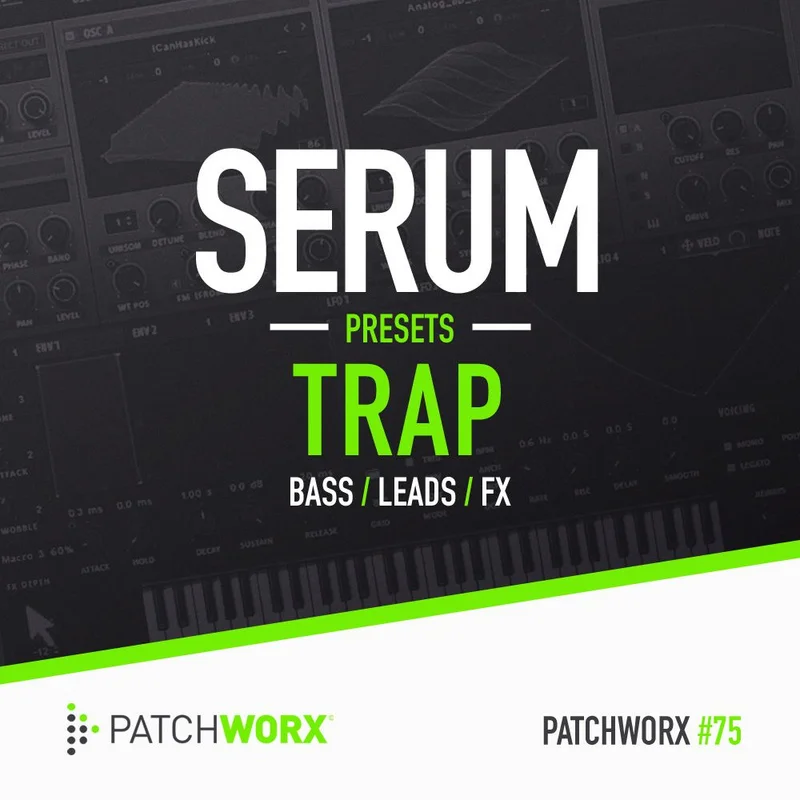
The preset breakdown by category: 21 Leads, 11 SFX, 11 One Shots, 6 Bass and Kick presets, 5 LFO Synths, 3 Pads, 3 Riffs, 3 Risers, and 1 Tom.
Sound character covers Deep Low Basses, Twerky SFX, Energetic Risers, Bell-Like Shots, Wobbly Leads, and Spaced Synths. Filter routing is mapped to Macro 2 on nearly every preset. That macro sweeps from muffled to bright without you needing to open the synth and touch anything manually.
Compatibility covers Xfer Serum versions 1 and 2. You need the full version of Xfer Serum to run any of these presets. No Serum, no pack.
Where These Presets Sit In A Real Session
Think of this pack as a starting-point library, not a finished-sounds library. You load a preset, you have a working Serum patch with modulation already configured. The MIDI file gives you a melodic idea to import into your DAW. From there, you shape tone with Macro 2, adjust the filter sweep to sit in your mix, and build around it.
The leads are where you'll spend most of your time. Twenty-one of them, all leaning toward bright and aggressive. If your drum arrangement is dense with stacked 808s and layered hi-hats, these leads are designed to punch through without needing much help from your EQ.
The bass and kick presets handle the low end. Sub patches track cleanly across three octaves, which matters when you're writing a bass line that moves. Sub basses commonly drift into mud around 100 Hz when pushed melodically. The sub bass patches in this pack hold their shape cleanly in that range.
One honest limitation to flag early: this pack is not built for your ambient breakdown or your introspective bridge. Three pad presets is the number. That's not a complaint exactly, it's just a clear signal about what the pack prioritises. If atmospheric texture is 30% of your track structure, you'll need another source for it.
Serum version matters here. Loading these on an outdated Serum install can cause missing wavetables or routing errors. Update before you buy.
The Lead Presets: Where This Pack Earns Its Money
Twenty-one lead presets is the biggest single category, and it's where Multiplier clearly spent the most design time. The FM routing on these is not subtle. You get metallic sheen that sits in the upper mids, the kind of tone that sits above a clapping snare and under the hi-hat shelf without fighting either of them.
Wobbly Leads are part of the named character set. In Trap context that means modulation that moves, LFO-shaped pitch or filter movement that gives the lead a restless quality rather than sitting static. It's a sound that's been in Trap production for years without going away because it works under fast triplet hi-hat patterns.
The FM routing that produces the metallic quality is worth understanding. FM synthesis adds inharmonic overtones to a sound by using one oscillator to modulate the frequency of another. Push the FM amount and the top end turns gritty and complex. Pull it back and you get a cleaner bell-like character. The presets here sit with the FM amount already set to a working position. You're adjusting from a good place, not building from scratch.
Macro 2's filter sweep is the real workflow win on the leads. You can go from a dark, muffled tone to a bright, cutting edge without touching the synth interface. In a live performance or a studio automation pass, that's genuinely satisfying to have on one knob. Map it to a controller and you've got real-time tonal control in the session.
If there's a complaint about the leads, it's that bright and aggressive is the only gear. Thirty, forty leads across a range of character would make this a more complete toolkit. But at 21 presets focused tightly on one sonic approach, what's here is consistent and usable.
Bass And Kick Presets: Low End That Sits Still
Six presets covering bass and kick territory. That's a smaller selection than leads, which makes sense given that Trap bass tends to start with the 808 channel rather than a Serum-designed sub. But these patches fill a specific gap.
The sub bass presets are reported to handle low frequency modulation without creating mud around 100 Hz. That's a real problem with synthesised subs in dense arrangements. The 80-120 Hz band fills quickly when you have a kick, a sub, and any low-mid content from pads or samples. A sub that drifts or gets harmonically complex in that range will fight everything around it.
Precise pitch tracking across three octaves is what makes a bass line playable. If you're writing a melodic trap bass that moves down from the root, you need the pitch to track consistently across the range. Inconsistent tracking on a sub means notes at the low end start to bloom and the note at the top of the range sounds thin. These are reported to stay consistent.
Deep Low Basses is in the named character list. That suggests these patches are sitting below the point where you'd need to high-pass them out of the way of a kick. They're designed for the sub-bass layer, not the mid-bass layer. If your 808 already handles the sub, these might reinforce or double it, but they're not going to add a lot of new frequency territory unless you pitch them up a few semitones.
Honestly, six presets in this category is thin. It's functional but not a deep resource. If bass design is the core of your trap sound, you'll exhaust these options quickly.
SFX, One Shots, And The Texture Tools
Eleven SFX presets and eleven One Shots make up a significant chunk of the pack. Twerky SFX and Bell-Like Shots are in the named character descriptions, which tells you this isn't atmospheric reverb-tail design. It's punctuation sounds. Ear candy. The stuff you drop in to fill a bar transition or accent a melody note.
Twerky SFX is a specific Trap aesthetic. It's short, pitch-bent, often filter-modulated, and it sits in a gap between a note and silence to add motion. If you've heard any commercial Trap from the last five years, you've heard this kind of sound doing that job. Eleven presets in this category gives you enough variety to cover multiple tracks without hearing the same SFX twice.
One Shots are single-trigger sounds. Bell-Like Shots in particular work as melodic accent hits on top of a lead line or in response to a vocal phrase. You trigger them once, they decay, they're done. The rendered WAV versions are useful if you want to drop them into a sampler channel rather than running Serum instances for every sound.
Custom noise oscillators adding organic texture to plucks is mentioned in the pack's design approach. Noise in the attack of a pluck gives it a physical quality, the sense that something is being physically struck rather than electronically triggered. It's a small detail but it's the kind of thing that separates a preset library that sounds synthetic from one that holds up in a full arrangement.
LFO Synths, Risers, And The Modulation Presets
Five LFO Synth presets. Three Risers. These are the motion-based sounds in the pack.
LFO Synths are presets where the LFO modulation is doing most of the sonic work. The oscillator pitch or filter cutoff or amplitude is being moved by a low-frequency oscillator, which creates rhythmic or sweeping movement in the sound. In Trap, this shows up as synths that pulse in time or wobble against the grid. Spaced Synths is in the named character list, which suggests some of these go for a wider, more atmospheric movement rather than tight rhythmic gating.
The five presets in this category feel like a missed opportunity to be more flexible. You'd want a wider range here: fast LFO gating for stuttered textures, slow LFO sweeps for evolving pads, tempo-synced movement at different subdivisions. Five presets at this level of modulation complexity leaves you wanting more options.
Risers are transition tools. Three presets cover the basic need. Energetic Risers is the named character, so these are built to build tension rather than float into a drop. A hard-hitting trap drop with a Serum riser behind it is a reliable construction and three presets gives you enough to rotate through a project without repetition. But again, three is lean.
The 1 Tom preset is worth acknowledging. One. A single Tom. It's presumably there for completeness, but it's also the kind of inclusion that makes you wonder what was cut to stay at 64 presets total.
Macro 2 And The Filter Sweep System
This is the workflow feature that owners talk about most, and it's worth understanding why it matters.
On almost every preset in this pack, Macro 2 is mapped to filter routing. Turn it down and the sound goes muffled, dark, low-passed. Turn it up and it opens to its full bright, high-frequency character. It's a single-knob tone control that works without opening Serum's interface.
That's a small thing that becomes a big thing in practice. In a DAW session, having a performance-ready macro mapped to tone means you can automate it in your arrangement view, assign it to a MIDI controller for live adjustment, or use it to ride tone against a vocal in real time without interrupting your workflow to dig into the synth.
It also makes the presets more adaptive. If a lead is too bright for where it sits in your mix, pull Macro 2 down 20-30% before you go reaching for an EQ. If the bass sounds muffled against the kick, push Macro 2 up. You might not need to add any processing at all because the tone adjustment is already built in.
For producers who just want to move, Macro 2 is enough to get there. The filter routing mapped to this control allows you to sweep from muffled to bright without opening the synth interface, keeping your workflow smooth and uninterrupted.
The MIDI Files: The Real Differentiator
Every preset in this pack ships with its own MIDI file. Sixty-four MIDI files for 64 presets. That pairing is the thing that makes this more than a standard preset library.
The melodic starting point and the sound character are calibrated together. That's different from loading a random MIDI and hoping it works on a preset you chose.
You're not committed to using the MIDI as-is. Transpose it. Edit the rhythm. Keep the melodic contour but change the pitches. Use it as a rhythm template and replace every note. The MIDI is a scaffold, not a ceiling.
The rendered WAV loops serve a different purpose. If you want the sound without running a Serum instance on every channel, you've got a pre-bounced audio version. Drop it into an audio track, chop it, reverse it, resample it. Useful for CPU management or for hybrid arrangements where you want some Serum channels running live and some baked into audio.
Sixty-four MIDI files is a lot of melodic material. With 64 MIDI files included, there's substantial melodic material in a genre-appropriate style. At $20, that's not a bad creative resource.
What It's Genuinely Good At
The lead presets are the headline. FM routing with metallic sheen, Macro 2 filter control, MIDI files included. For the moment in a session when you need a cutting Trap lead and you need it fast, this pack delivers.
The sub bass clarity is a real strength. Clean low-end modulation without mud around 100 Hz, tracking across three octaves. If you're writing melodic bass lines that move through your arrangement, these hold up technically where some synthesised subs fall apart.
The MIDI bundling separates this from most preset packs in this price range. One MIDI per preset, designed for that preset's character, is an underrated feature that speeds up the parts of a session that are genuinely frustrating.
Custom noise oscillators in the pluck design is a small detail that adds up. Organic-feeling attack transients on pluck sounds make them sit in arrangements differently than purely synthetic ones. It's clever design work at the patch level.
The Rough Edges
Three pad presets. That's the number that keeps coming up in owner feedback and it's a real limit. If you produce Trap that has atmospheric sections, slow-building tension, or ambient breaks, you're not going to find that character in this pack. You'd need to source pad sounds elsewhere.
The tonal range is narrow. Bright and aggressive is the dominant character across leads, SFX, and one shots. That's appropriate for a lot of Trap production. The preset selection emphasizes bright aggressive sounds with minimal focus on darker or organic sound design applications.
An older version of Serum will cause you problems. The requirement for a recent version is a real barrier if you haven't updated in a while.
And the Tom preset. One. It feels like a placeholder more than a resource. Nobody's building a drum kit from one Tom.
Who This Is Really For
- ✅ Buy if you produce Trap regularly in Serum and want a fast-load lead library with MIDI files already matched to the sounds.
- ✅ Buy if you want sub bass presets that track cleanly across a melodic range without low-mid build-up.
- ✅ Buy if you want a Macro 2 filter sweep on every preset for one-knob tone control without opening the synth interface.
- ❌ Skip if you need deep pad and atmospheric coverage. Three pads is not enough if that's a significant part of your sound.
- ❌ Skip if your Trap sound is dark and organic rather than bright and metallic. This pack doesn't have that character.
- ❌ Skip if you're running an older Serum install and aren't ready to update. You'll hit compatibility issues before you hear a single preset.
Specs & Technical Details
| Developer | Loopmasters / Adam Pollard (Multiplier) |
| Price | $20 |
| Plugin Format | Requires Xfer Records Serum (VST / AU / AAX) |
| OS Support | Mac / Windows (via Serum) |
| Activation | N/A |
| CPU Usage | N/A (dependent on host Serum instance) |
| Trial Available | N/A |
| Version Reviewed | Compatible with Xfer Serum v1 and v2 |
Score Breakdown
| Category | Score | Notes |
|---|---|---|
| Sound Quality | 4.0/5 | FM-routed leads and clean sub bass are strong. Tonal range is narrow but what's there is well-designed. |
| Value for Money | 3.5/5 | Sixty-four MIDI files plus rendered WAVs make the price defensible. Limited pad coverage holds it back from higher marks. |
| Ease of Use | 4.0/5 | Macro 2 filter sweep on almost every preset makes tone shaping immediate. Serum version requirement adds a setup friction point. |
| Features | 3.0/5 | Good MIDI bundling. But 3 pads, 1 Tom, and a narrow tonal range shows gaps in the feature spread. |
| CPU Efficiency | N/A | Performance depends entirely on your Serum install and DAW configuration, not the presets themselves. |
| Overall | 3.5/5 | A reliable lead-and-bass resource for Trap producers with Serum, let down by limited atmospheric coverage. |
Alternatives to Consider
If you need a darker, grittier Trap character with a heavier 808 emphasis, Patchworx Brick City Trap Serum Presets is the comparison that comes up most often alongside this pack. The two packs sit at opposite ends of the Trap palette: Multiplier's collection goes metallic and bright, Brick City goes low and dark. Which you need depends on the direction your track is already moving in.
Dark Trap For Serum is the other direct comparison, built around 808 Mafia-inspired 808 design. If your production work centres on 808 bass as the primary melodic instrument and you want a Serum-based toolkit built around that approach specifically, that pack is worth looking at alongside this one.
Both alternatives offer a different tonal direction rather than more variety within the same tonal range. If what you need is more pad coverage or organic textures on top of a solid lead library, neither of those alternatives fills the gap that this pack leaves. You'd be looking at a broader Serum preset collection from a different category altogether.
The Verdict
At $20 for 64 presets, 64 MIDI files, and 64 rendered WAVs, the Loopmasters Trap Serum Presets pack is a focused toolkit that knows exactly what it is and doesn't pretend otherwise.
The 21 lead presets with FM routing already dialled in are the strongest part. The sub bass tracking is genuinely clean. Macro 2 filter control across nearly every preset is a workflow feature that earns real use in sessions. And the MIDI-per-preset bundling is the thing that makes this worth the price over a preset pack that ships sounds alone.
But it's a specialist's buy. If you need bright, aggressive Trap leads and clean melodic sub bass with minimum setup friction, this is a confident yes. If you produce Trap with heavy atmospheric sections, organic textures, or dark low-mid character, you'll be frustrated by what's missing here. Three pad presets doesn't serve that workflow.
This pack isn't trying to be your complete Trap Serum library. It's trying to be the thing that gets your leads and bass sorted in the first 20 minutes of a session. At that specific job, it's hard to be annoyed with it.
Frequently Asked Questions
Do I need Xfer Serum to use the Trap Serum Presets pack?
Yes. The full version of Xfer Records Serum is required. The presets are Serum files and won't open in any other synthesiser. You also need a recent version of Serum installed. An outdated version may cause loading errors or missing wavetables.
What MIDI files are included and how are they organised?
Every preset in the pack ships with its own matched MIDI file, giving you 64 MIDI files in total. Each MIDI was designed to demonstrate the character of its corresponding preset, so the melodic idea and the sound are calibrated together. You can use them as-is, edit them, or just lift the rhythm pattern and replace the notes.
Is this pack suitable for genres other than Trap?
The presets are designed tightly around Trap's sonic palette: metallic leads, deep sub basses, twerky SFX, and short one shots. Some sounds will translate to adjacent genres like Hip-Hop, Drill, or Melodic Rap with minimal adjustment. The metallic FM leads in particular can fit in Hybrid Trap or electronic contexts. But the pack isn't built with cross-genre flexibility as a priority.
How does Macro 2 filter routing work across the presets?
On almost every preset, Macro 2 is mapped to the filter routing so you get a sweep from muffled to bright on a single knob. Turn it down for a dark, low-passed tone. Turn it up to open the filter to its full character. This means you can shape the tone of any preset in real time without opening Serum's interface, which is useful for automation passes or live controller assignment in your DAW session.