SYMPHONIC: Johnnys Horn is a clever, dirt-cheap Kontakt instrument that earns its keep in ambient and film scoring sessions, but don't buy it expecting a realistic orchestral horn.
We picked this up from KLANG's site. Five euros. That's the number you need to hold onto through this entire review, because it's the lens through which every criticism and every compliment makes sense. Johnnys Horn sits inside KLANG's SYMPHONIC series, a range of orchestral instruments built around unusual articulations and modular effects processing rather than studio-accurate realism. It's experimental-adjacent. The sound character is described by KLANG as "relaxed and noble," which is marketing-speak for: warm, slightly diffuse, and better suited to atmosphere than precision. If you need a solo horn that tracks a melody with dynamic accuracy across five octaves, look somewhere else. If you need a usable brass texture at $6, this is a reasonable call.
What You're Actually Getting
Johnnys Horn is a single solo French horn instrument built inside the full Kontakt environment. You get playback in one, three, or five voices, with intervals stacked on the 1-3-5 chord shape, essentially giving you an instant brass choir from a solo source sample set.
The effects chain is modular, meaning you can rearrange and toggle processors in the signal chain rather than being locked to a fixed reverb-at-the-end setup. That's genuinely useful for sound design work.
Articulations are present but sparse. Sustained notes are the core strength. Don't expect staccato runs, stopped horn flutter, or a properly recorded con sordino patch. This is a texture tool, not a performance instrument.
It requires full Kontakt 5.6.8 or higher. The free Kontakt Player will not load it. That's a hard wall and a real cost consideration.
The Good
We loaded Johnnys Horn onto a sparse film cue, a slow-moving piece sitting around 60 BPM with string pads underneath. We held a low F, let the sustain breathe, and added the three-voice interval spread. The result was warmer than we expected.
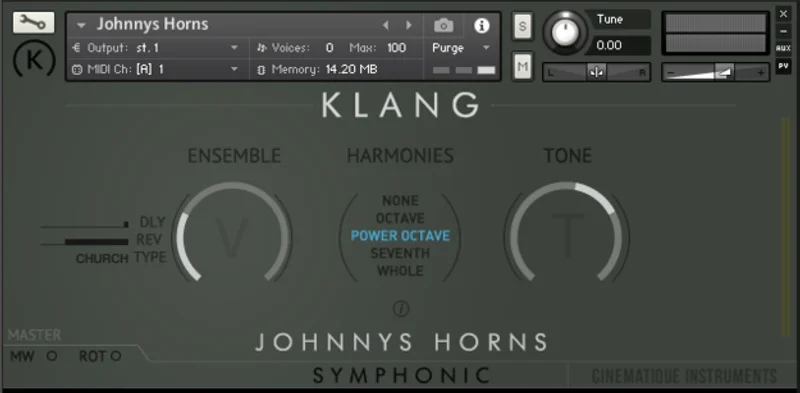
The stacking interval feature is the most satisfying thing here. Triadic voicing from a single held note is clever. In a practical session, this saves time. You're not layering three separate horn tracks and nudging velocities. One note, spread across the 1-3-5, sits in the mix with actual weight.
The modular effects routing is a genuine differentiator at this price. We routed the output through the onboard reverb, then into a pitch-shifted layer, and got something that sounded more like a brass ambient pad than a traditional horn. That works. It's a legitimate sound design tool for producers who don't need the horn to sound like a horn.
The value you get for the price is almost annoying. There's no realistic competitor at that price point.
The Not-So-Good
Here's the frustrating part: the thin articulation set actively limits where you can use this.
We tried to write a mid-tempo horn line, something melodic, with some rhythmic interest. The sustained samples don't respond with enough dynamic range to make shorter phrases feel alive. There's a bloom to the attack that works on held chords and actively fights you on anything with forward motion. Annoying.
The lack of Kontakt Player support is a real problem. If you're reading this without a full Kontakt licence, the cost of that licence dwarfs the price of this library. Suddenly the value calculation looks very different.
Documentation is almost non-existent. We couldn't find a manual, a walkthrough, or a KLANG support page that went beyond surface-level descriptions. For producers new to Kontakt scripting or modular effects routing, that's a steep onboarding cliff for what should be a five-minute install.
There are no user ratings, no community patch libraries, and almost no third-party demos. You're buying on faith.
Compared to the Alternatives
Vienna Symphonic Library's solo horn options range from moderately priced to quite expensive. You get multiple articulations, velocity layers, and performance legato that actually tracks. The gap in realism versus Johnnys Horn is not subtle.
Cinematic Studio Brass is the current benchmark for affordable orchestral brass realism. Its horn patches handle legato runs, dynamic swells, and short notes cleanly. Johnnys Horn doesn't compete with it on any technical axis.
For sound design and ambient use, something like Spitfire LABS Soft Piano review or other free LABS releases offer a comparable "free/ne arly free, texturally interesting" proposition with arguably better documentation and Player compatibility.
If you already own full Kontakt and want a cheap brass colour, Johnnys Horn wins by default. That's a narrow category. But it's a real one.
Who Should Buy This
- ✅ Buy if you already own full Kontakt 5.6.8+ and need a budget brass texture for ambient or film work.
- ✅ Buy if you want the 1-3-5 voicing shortcut for fast chord stacking without layering multiple tracks.
- ✅ Buy if you're a sound designer who treats instruments as raw material for the effects chain rather than end-products.
- ❌ Skip if you need realistic, articulate solo horn performance.
- ❌ Skip if you don't own full Kontakt. The player wall makes this expensive fast.
- ❌ Skip if you're new to Kontakt instruments and need documentation or community support to get started.
Score Breakdown
| Category | Score | Notes |
|---|---|---|
| Sound Quality | 3.0/5 | Warm and usable for textures; too diffuse for melodic performance work |
| Value for Money | 4.5/5 | At $6 this brass texture is very hard to argue with. |
| Ease of Use | 2.5/5 | No documentation, Kontakt Player wall, limited onboarding |
| Features | 2.5/5 | Interval stacking and modular FX are clever; articulation set is undercooked |
| CPU Efficiency | 4.0/5 | Light load, no issues running multiple instances alongside heavy sessions |
| Overall | 3.6/5 | Niche tool with real value in the right hands, but the right hands are a small group |
Alternatives to Consider
Spitfire LABS (Free): If you want free orchestral textures with Kontakt Player support and proper documentation, Spitfire LABS review is a stronger starting point for most producers.
Cinematic Studio Brass: If you need a horn that actually performs, Cinematic Studio Brass review is the current value-to-quality benchmark in affordable orchestral brass.
ProjectSAM Orchestral Essentials: Broader orchestral coverage including brass, with best Kontakt orchestral libraries covering how it stacks up against focused solo-instrument tools like this one.
At this price, Johnnys Horn doesn't need to beat any of these. It just needs to justify its price. It does. But none of the alternatives above have the Kontakt Player problem, and most of them come with actual manuals.
Buy Johnnys Horn if you own full Kontakt, work in ambient or scoring contexts, and have a few dollars you don't mind spending on a texture tool that might surprise you. Skip it if Kontakt Player is all you have, or if you need a horn that plays like a horn. A five-euro curiosity is not the same as a five-euro solution.
It's underrated in its lane. It's just a very narrow lane.
Frequently Asked Questions
Does SYMPHONIC: Johnnys Horn work with the free Kontakt Player?
No. It requires full Kontakt 5.6.8 or higher. The free Kontakt Player will open it in a 15-minute demo mode only, after which audio cuts out. If you don't own full Kontakt, factor in the cost of that licence before purchasing.
What does the 1-3-5 voice feature actually do?
It stacks your played note with a major third and a perfect fifth above it, giving you a three-note chord voicing from a single MIDI note. You can choose one, three, or five voices depending on how wide you want the spread. It's a fast way to build a brass choir texture without layering separate tracks.
Is SYMPHONIC: Johnnys Horn good for realistic orchestral writing?
Not really. The articulation set is thin, and the sample character is warmer and more diffuse than a close-mic'd orchestral recording. It works for slow-moving ambient or cinematic textures. For anything requiring dynamic melodic performance or detailed articulations, look at Cinematic Studio Brass or Vienna's solo horn options instead.
Where do you buy SYMPHONIC: Johnnys Horn and how much does it cost?
It's available directly from the KLANG website, with USD pricing listed at $6 on some marketplaces. Check KLANG's site for the current price, as it's a small developer and pricing can change. At that price point, there's no meaningful risk in trying it if you already own full Kontakt.