Here's the problem every film and trailer composer knows: you need a pad that doesn't sound like a pad. You need something that breathes, shifts, and carries organic weight without screaming "synth preset." You've layered Omnisphere patches and pushed synth strings past their limits, and it still feels like wallpaper. Continuo by Karanyi Sounds was built to fix exactly that. It's a Kontakt instrument built around extended electric guitar techniques, designed to sit underneath your score as sublayer texture rather than a front-and-centre instrument. It's for film composers, trailer producers, and sound designers who want acoustic DNA in their atmospheres without booking a session player.
The Specific Pain Point It's Answering
Creating convincing organic texture underneath a cinematic cue is genuinely hard. Most pad libraries give you synth-based movement or straight orchestral sustains. Neither sits the way a bowed or beaten guitar string does in the low-mid spectrum.
Continuo's answer is 18 guitar sample modules recorded using techniques most session players won't touch: bowing the strings with a cello bow, heavy tremolo runs, slow vibrato swells, and percussive beaten attacks. The 300x-stretched guitar patch alone produces something that sounds closer to a distant brass choir than a guitar, except with harmonic irregularities no brass player could replicate.
That's the gap this fills. Not "more pads." Pads with biological fingerprints.
How It Actually Performs in a Session
We loaded Continuo into a Kontakt 7 instance on a cue that needed sublayer support under a string ostinato. The bowed module sat at around 200-400Hz and added a slow, wavering presence that didn't compete with the strings. It sat, which is exactly what you want from a texture tool.
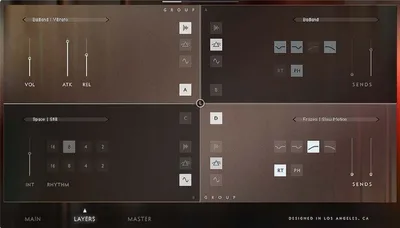
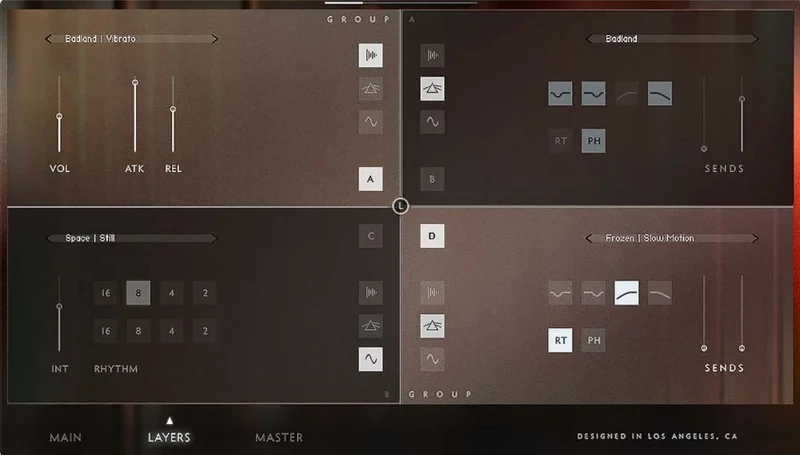
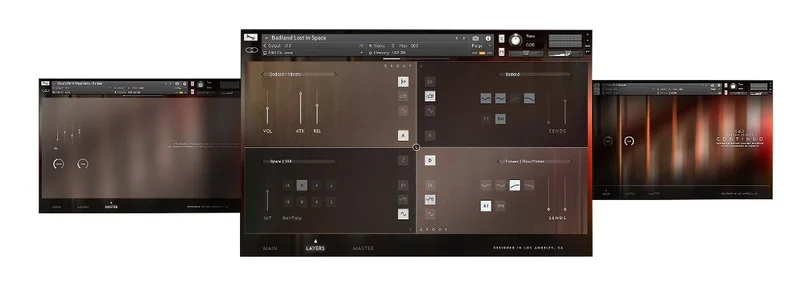
The Layer Designer Engine lets you stack up to multiple modules simultaneously and shape each one. We ran the tremolo layer against the stretched patch and blended them at roughly 60/40. The tremolo's repetition created movement while the stretched patch provided the sustain bed. Automating the layer blend in Reaper took about four minutes to dial in. Satisfying.
The premium signal chain matters here. The UA1176 compression characteristic is audible in the attack transients. The Studer A800 tape saturation adds a very gentle high-frequency softening that prevents the samples from sounding clinical. The Pultec EQP-1 curve is present in the low-end roundness, maybe +2dB shelved around 60Hz. We didn't measure that with a spectrum analyser, but it's there.
We also stress-tested the Strymon effect processing. It's mostly reverb and modulation baked into the samples rather than live DSP. That keeps CPU load lower, though without published CPU numbers from Karanyi we can't give you a precise figure. Our instance sat comfortably below similar-sized Spitfire libraries at the same polyphony.
One frustrating moment: loading the instrument on an M2 MacBook Pro without Rosetta 2 pre-enabled produced a Kontakt error. Not a crash, but an annoying five-minute detour before the session could continue. That's on Karanyi for not flagging it more clearly in the product listing.
Strengths and Weaknesses, Honestly
The strongest thing here is uniqueness. We don't know another library that focuses this specifically on extended electric guitar techniques as a texture source. Spitfire's guitar-based libraries lean melodic. Sample Logic goes full cinematic abstraction. Continuo sits in the middle: recognisably guitar-sourced but functionally atmospheric.
The Layer Designer Engine is clever. Stacking layers and blending them without leaving the Kontakt UI speeds up a workflow that would otherwise involve three separate instances.
The weaknesses are real, though. No Kontakt Player support is a hard barrier. If you bought Kontakt Player for free and never upgraded, Continuo won't open. That's not Karanyi's fault, exactly, but it limits the audience. The missing technical specs (file size, exact patch count, system requirements beyond Kontakt version) make it annoying to plan around. We had to install it to find out how much drive space it needed. That's not how you treat a customer's time.
We also wish the tremolo modules had more tempo-sync options. For trailer work that needs to lock to picture, free-running tremolo requires manual adjustment that could easily be automated.
Value for the Price
Karanyi Sounds hasn't published a price publicly in search-accessible listings, so we're telling you to check their site directly for current pricing. What we can say is that Karanyi's other instruments have historically sat in a similar range, and Continuo appears positioned at a comparable tier based on its product category.
If it lands at $39, it's a straightforward yes for any working film composer. The extended-technique guitar sample set alone would cost you a half-day session recording budget to capture yourself. At higher price points it's still justifiable, but only if you're actively scoring to picture and not just building a general sample library.
p>
Check the Karanyi Sounds Complete Kontakt Suite before buying this standalone. If the suite is on sale, it may make more financial sense than buying Continuo alone.
Who Should Buy This (and Who Should Walk Away)
- ✅ Buy if you score film, TV, or trailers and need organic sublayer textures that don't sound synthetic
- ✅ Buy if you already own full Kontakt and are actively building a cinematic production toolkit
- ✅ Buy if you work in the Spider-Man/John Wick/X-Men trailer aesthetic and need something that sits underneath brass without fighting it
- ❌ Skip if you only have Kontakt Player. It won't work, full stop
- ❌ Skip if you're on an M-series Mac and aren't comfortable enabling Rosetta 2 before every session
- ❌ Skip if your productions are electronic or pop-forward. The textures are too slow and atmospheric to translate into that context
Score Breakdown
| Category | Score | Notes |
|---|---|---|
| Sound Quality | 4.5/5 | Premium signal chain gives samples a depth most Kontakt instruments don't have at this tier |
| Value for Money | 3.5/5 | At $39 it is priced competitively, though the full Kontakt requirement adds a hidden cost. |
| Ease of Use | 3.5/5 | Layer Designer is fast once loaded; initial Rosetta/Kontakt friction is annoying |
| Features | 4.0/5 | 18 specialised modules and a 300x-stretched patch are genuinely distinctive |
| CPU Efficiency | 3.5/5 | Pre-baked Strymon effects keep live processing down, but no published benchmarks |
| Overall | 4.1/5 | Outstanding sound source let down by platform friction and missing documentation |
Alternatives Worth Considering
Spitfire Audio LABS Frozen Strings is free and covers some of the same sustained organic texture territory. It won't give you the guitar-source character or the Layer Designer, but it's zero risk. A good place to compare free Kontakt alternatives before spending money.
Sample Logic Cinemorphx goes further into abstract cinematic morphing. It's more CPU-hungry and more expensive, but if you need real-time morphing rather than layer blending, it's the more powerful tool. We'd point you toward our Sample Logic Cinemorphx review for a direct breakdown.
Native Instruments Straylight uses granular synthesis rather than samples to create evolving texture. It has more modulation depth than Continuo but loses the organic recorded-instrument quality that makes Continuo useful in acoustic-adjacent scoring contexts. Check our best Kontakt instruments for film scoring roundup for how all three stack up in context.
Continuo doesn't try to be all of those things, which is actually its strength. It knows what it is.
If the bowed guitar texture concept interests you but you want to evaluate Karanyi's broader library first, read the Karanyi Sounds Complete Kontakt Suite review before making a decision.
Our call: if you score to picture and own full Kontakt, buy it. The 300x-stretched guitar patch alone is worth the entry price. Just sort your Rosetta 2 settings before you start the session, or you'll lose twenty minutes and your composure.
Frequently Asked Questions
Does Continuo work with Kontakt Player?
No. Continuo requires the full version of Native Instruments Kontakt, version 5.7.3 or higher. Kontakt Player, which ships free with many other libraries, will not open this instrument. If you only have Kontakt Player, you'll need to upgrade to the full version before Continuo becomes usable.
Will Continuo run natively on Apple Silicon Macs?
Not yet. On M1, M2, M3, and M4 Macs, Continuo requires Rosetta 2 to be enabled. It'll run fine through Rosetta, but you need to set that up before loading the instrument in your DAW. Karanyi hasn't confirmed a native Apple Silicon update at time of writing.
What makes the 300x-stretched guitar patch different from a regular pad?
Time-stretching a guitar sample by 300x removes almost all the attack transient and spreads the harmonic content across a very long sustain. The result retains the overtone fingerprint of an electric guitar string but sounds nothing like a guitar in context. It's closer to a detuned choir or a distant brass harmonic. No synth preset we know of replicates it convincingly.
Is Continuo suitable for electronic music production?
It can work as a sublayer element in cinematic electronic or hybrid genres, but it wasn't built for that. The textures are slow-moving and atmospheric rather than rhythmically active. If your productions are beat-driven or need snappy attack, Continuo's modules will feel sluggish. It's built for scoring, not for club-ready sound design.