Hollywoodwinds is one of the best woodwind ensemble libraries available at its price point, but only if you know exactly what it is and what it refuses to do. We loaded it up for a trailer cue session that needed a full-throttle woodwind tutti ascending into a brass swell. The moment we triggered the runs patch and watched the CITE engine lock to our 138 BPM sequence tempo without a single manual nudge, we felt something close to relief. That satisfaction lasted right up until we needed a solo oboe phrase, at which point the library politely reminded us it has no interest in that conversation.
This is an ensemble-only woodwind library built specifically for cinematic scoring in the Hollywood idiom. If that describes your workflow, keep reading. If you need solo instrument control, chamber-sized sections, or fluid expressive legato, this is the wrong tool entirely.
An Ensemble Tool. Full Stop.
Hollywoodwinds covers woodwind ensemble work: tutti patches, octave-stacked patches, chord voicings, runs, riffs, and a dedicated FX bank. The tutti patch features everybody playing, including the piccolo. That's the spirit of the whole library right there.
The stacked patches, like the octaves patch, let you voice the ensemble across several different octaves in an authentic Hollywood-style stack. Played with the right velocity curve, it sounds like a full woodwind section from a mid-budget studio picture.
What it won't do: individual flute, oboe, clarinet, or bassoon. No solo articulations. No chamber-scale writing with 4-5 desks per section. If your brief calls for a fragile solo cor anglais melody, close the tab and look elsewhere.
It's also not a "modern" library in the 2024-2026 sense. No spectral morphing, no AI articulation switching, no adaptive mic trees. It knows what it is, and mostly that's fine.
Living With It: A Week on Real Sessions
Setup is painless. The library installs directly through Native Access and requires 3.45 GB of disk space. It runs inside the free Kontakt Player 6.6.1 or the full Kontakt, so no library-hunting or manual file placement.
The first thing we actually fell in love with was the CITE engine. Kontakt automatically recognizes your sequence's tempo and plays back scales and textures in time. All patches using this engine have samples recorded at multiple tempos, and Kontakt intelligently chooses the correct sample and micro-adjusts it into place. In practice, we changed session tempo from 96 to 120 BPM mid-session and the runs tracked perfectly without a single manual re-trim.
The Notation View is one of those features you don't expect to use and then can't stop using. You can visually see the music you're creating live, with the notation window displaying detailed conductor-piano reductions of the current sample being triggered. For aligning woodwind phrases to picture cuts, it's surprisingly practical.
Mic placement is handled well. You can choose exclusively Stage Mic patches or Close Mic patches, or use the hybrid patches to create a custom mix live with no artifacts. We ran Stage at 70% and Close at 30% for a "mid-distance concert hall" texture that sat cleanly under strings without eating high-mid space. No bouncing. No re-loading.
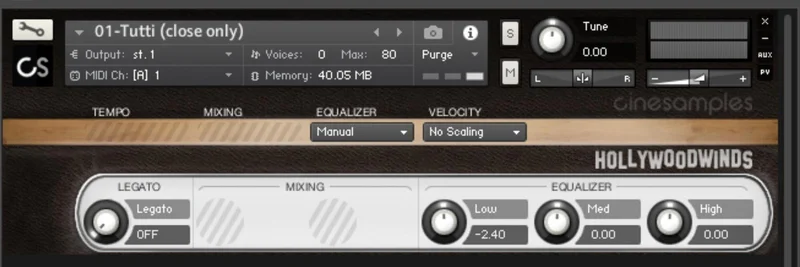
Where things get frustrating: the GUI. It's functional, but it looks like a forgotten Photoshop file from 2009. Compared to the sleek interfaces on current libraries, navigating Hollywoodwinds feels like finding a folder full of .html menus. Annoying, but it doesn't affect sound.
The keyboard patches are where the lack of true legato stings hardest. We played a slow, lyrical phrase at 72 BPM. The transitions between notes had a noticeable stitch. The samples are there, the pitch is right, but the phrasing sounds mechanical without spending time on velocity automation.
The Trade-Offs
The CITE engine and the runs library are the twin reasons to buy this. We triggered a whole-tone scale run upward at 132 BPM, let it land on a tutti chord, and the playback was so musically idiomatic we had to check we hadn't accidentally loaded a MIDI file from a real session. That level of naturalness on phrase-based content is genuinely rare at $199.
But those same pre-recorded runs are the cage. You can't reshape a phrase mid-way. You can't lengthen the tail of a riff or change articulation at bar 3. What the sample says is what you get. For fast-moving trailer work, that's fine. For adaptive underscore that has to breathe with picture edits, it's a genuine creative wall.
The 20th century FX patches are a standout. From unison ensemble quarter-tone bends, to 12-tone cluster stacks, to a massive collection of atonal rips, to clarinet "meowing," to multi-piccolo flutters, there's a lot here that you'd otherwise have to beg a live player to record. These sit in a horror or thriller cue like they were written for it.
The pricing situation is also worth being direct about. The list price is $199. At Plugin Boutique, we've seen it drop during a 35% sale. That sale appears regularly, so we'd wait for it. At the sale price, this is a clear buy. At $199 it's still defensible for cinematic composers, but less of a no-brainer.
Against the Field
The honest comparison set in 2026 looks like this:
VSL Synchron Woodwinds wins for true legato and individual section control. If you're writing SATB-style woodwind lines that need to breathe like live players, VSL is the right call. It costs significantly more.
Project SAM Orchestral Essentials wins for breadth. You get woodwinds plus brass, strings, and percussion in one box. The woodwind runs aren't as focused or as idiomatically cinematic as Hollywoodwinds, but versatility wins.
Spitfire Audio's Abbey Road Wondrous Flutes wins for solo flute character and tonal richness. It's a specialist tool for flute-forward writing, not ensemble coverage.
Hollywoodwinds wins one thing cleanly: tempo-synced ensemble runs and Hollywood-style riffs at a mid-range price. For trailer composers and cinematic scorers working fast, that's the win that matters most.
The Real Verdict
Buy Hollywoodwinds if your sessions consistently need ensemble woodwind runs, tutti phrases, and cinematic FX that lock to tempo without manual prep. On sale it's an overdue purchase. At full price, think about how often those runs actually show up in your work.
Skip it if your cues rely on expressive solo woodwind melodies, true legato phrasing, or section-level articulation control. It can't do that work, and no amount of velocity layering will change the fact that it was never designed to.
For cinematic composers, it belongs on the best Kontakt libraries for film scoring shortlist. For everyone else, it's a specialty tool you'll use on roughly 30% of sessions.
Score Breakdown
| Category | Score | Notes |
|---|---|---|
| Sound Quality | 4.5/5 | Ensemble runs and tutti patches are class-level; 48 kHz/24-bit recording is clean throughout |
| Value for Money | 4.0/5 | Strong at the sale price; slightly harder to justify at full price given no solo instrument content |
| Ease of Use | 3.5/5 | CITE engine is brilliant once you understand it; the GUI is genuinely ugly and navigation is slow |
| Features | 3.5/5 | Tempo sync and FX palette are excellent; no legato, no solo sections, no modern articulation switching |
| CPU Efficiency | 4.0/5 | Pre-recorded phrase playback keeps CPU load light; no major spikes during multi-patch sessions |
| Overall | 4.0/5 | A focused, honest specialist tool that does its job brilliantly and absolutely nothing else |
Alternatives to Consider
VSL Synchron Woodwinds is the pick if you need individual section articulation and true legato phrasing. It's priced higher, but the expressive control is in a different category. See our best orchestral libraries for Kontakt guide for a full breakdown.
Spitfire Audio BBCSO Discover includes woodwinds alongside full orchestra and has true legato on individual instruments. It's free to a point, then requires an upgrade. Worth exploring if you're budget-building your first template. Check our best free Kontakt instruments roundup for entry-level alternatives.
Project SAM Orchestral Essentials 2 covers ensemble woodwinds plus brass and strings in one package. The runs aren't as focused as Hollywoodwinds, but for composers who need a general-purpose cinematic library rather than a woodwind specialist, it's the smarter single purchase. Also see our Palm Mute Piano review for another perspective on specialist Kontakt instruments that do one thing brilliantly.
Hollywoodwinds doesn't try to be everything. The composers who love it most are the ones who already know they need exactly what it offers. Buy it when it's on sale. Don't buy it hoping it'll grow into a role it was never built for.
Frequently Asked Questions
Does Hollywoodwinds require the full version of Kontakt?
No. It runs on the free Kontakt Player 6.6.1 or higher, which you install through Native Access. You do not need to own the full version of Kontakt to use it. Installation is handled entirely through Native Access after purchasing via Plugin Boutique or Cinesamples directly.
Can Hollywoodwinds play individual woodwind instruments like solo flute or oboe?
No, and this is the library's biggest limitation. Hollywoodwinds is built exclusively for woodwind ensemble writing: tutti, octave stacks, runs, riffs, and FX. There are no solo instrument patches and no individual section patches for flutes, oboes, clarinets, or bassoons separately. For solo woodwind work, look at VSL Synchron or Spitfire's dedicated solo woodwind libraries.
What does the CITE engine actually do, and does it work in every DAW?
The Cinesamples Intelligent Time Engine (CITE) reads your session's BPM via Kontakt and selects from samples recorded at multiple tempos, then micro-adjusts the chosen sample to sit precisely in time. It works in any DAW that passes tempo information to Kontakt, which includes Logic Pro, Ableton Live, Pro Tools, Cubase, and Studio One. If your DAW doesn't sync tempo to Kontakt's clock, you'll need to set the tempo manually inside Kontakt.
Is Hollywoodwinds still worth buying in 2026, or have newer libraries made it obsolete?
It's worth buying for one specific use case: fast, idiomatic cinematic ensemble runs and Hollywood tutti phrases that sync to tempo automatically. Newer libraries from VSL and Spitfire beat it on legato, individual articulation depth, and interface design. But nothing at this price point matches Hollywoodwinds specifically for pre-recorded runs and 20th-century ensemble FX in the Hollywood idiom. Catch it on sale and it earns its place in any cinematic template.