The doubt most buyers have about CineHarps is whether it's just another thin orchestral sample library with a Hollywood name slapped on it, it isn't. CineHarps is a genuinely well-recorded solo harp library that earns its spot in a film composer's template, priced at $249 full or at a reduced rate on promotion. If you score for picture, write orchestral music, or produce anything adjacent to the Final Fantasy aesthetic, this belongs in your signal chain. If you want a harp synth or a pad generator, look elsewhere.
We tested CineHarps across a neo-classical piano piece, a cinematic orchestral cue, and a hybrid trailer build. Here's what we actually found.
Does It Actually Deliver on the Hollywood Promise?
Cinesamples recorded CineHarps at the MGM Scoring Stage in Los Angeles, the same room where scores for films like Ben-Hur and 2001: A Space Odyssey were recorded. That's not a marketing detail we'd dismiss. Room sound is expensive to fake, and you can hear it in the low-mid body of the plucked strings.
The library draws from 3 separate harps. That's not just a tripling of samples, each instrument has a different tonal character. One sits brighter and forward, one has more gut-string warmth below 500Hz, and the third lands somewhere between them. You're not hearing the same samples pitched around.
It runs on Kontakt 6.6.1 and above, and it works with the free Kontakt Player. You don't need a full Kontakt license. That's a meaningful cost saving for producers who aren't already in the Native Instruments ecosystem.
Storage: you'll need 25GB free during installation, and the library settles at 12GB after. Install time is reasonable.
Where CineHarps Earns Its Price Tag
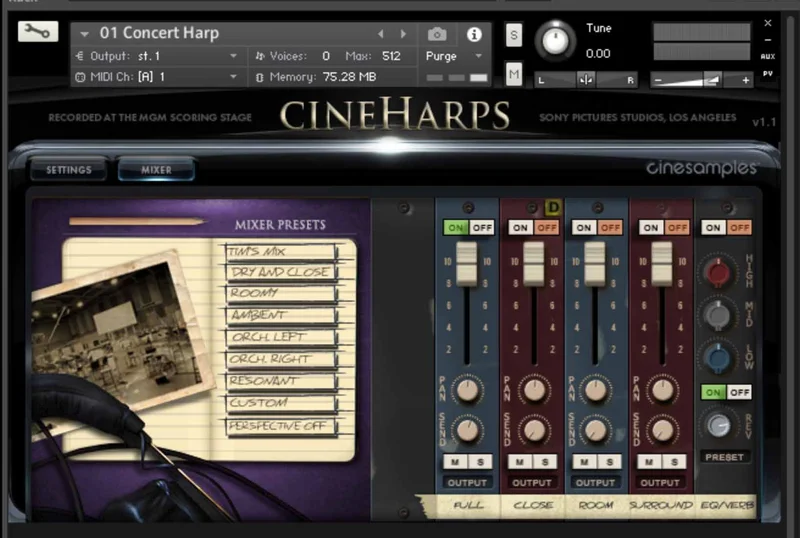
The 5 mic positions are the headline feature that separates CineHarps from most competitors in this price range. You get Close, Decca, Outrigger, Balcony, and a Mix option. That's not a small thing.
We loaded a solo harp melody and blended Close at around -6dB with Decca at unity. The result sat in a string arrangement without needing any additional reverb send. The room from the MGM stage does a lot of the spatial work for you. Satisfying workflow moment.
The plucked patches are where we spent the most time. On a slow arpeggiated progression in C major, the velocity layers responded cleanly across the dynamic range. Soft playing at velocities below 60 had real quiet intimacy, not a low-volume version of loud playing, which is a failure mode in cheaper libraries. The harmonic overtones on harder plucks ring naturally for 4 to 6 seconds before needing reverb to extend the tail.
The glissandi patches are pre-recorded runs covering multiple keys. They're convincing and they drop straight into cues. We used one on a horror-adjacent trailer build and it tracked without phase issues against a low string swell.
Integration with other Cinesamples libraries, CinePerc and CinePiano especially, is seamless because the room and mic positioning match. If you're already in that ecosystem, this is a love match.
Where It Falls Short
No arpeggiator. That's annoying, and it's a real gap.
Elysium Harp from Eduardo Tarilonte includes an arpeggiator that lets you build glissando-style runs from note input in real time. CineHarps doesn't have this. To build a custom glissando in a non-standard key, you're hand-drawing MIDI notes or using a MIDI plugin to handle the arp externally. That's extra steps in your DAW every single time.
The library is 12GB installed. For $249, that's lean. ProjectSAM's competing harp product costs roughly half the price and, while the mic options are fewer, the content-per-dollar ratio is harder to defend at full CineHarps pricing.
Hybrid sound design use cases are mentioned in the marketing but underdeveloped in practice. The effects patches are thin. If you want a mangled, processed, or textural harp sound, you'll be doing that processing yourself outside the instrument.
CPU usage is light to medium, which is good news. But the GUI feels dated in 2026 compared to what Spitfire and Output are shipping.
How It Stacks Up Against the Competition
The main comparison most buyers are making is against Spitfire Audio's Harp from the BBCSO library or their standalone offerings. Spitfire's harp recordings have more mic positions and a more detailed articulation set, but you're paying significantly more. CineHarps undercuts on price while delivering comparable room quality.
Against Elysium Harp, it's a split verdict. Elysium wins on playability and the arpeggiator. CineHarps wins on mic flexibility and the multi-harp source recording. Elysium is the better tool for a live performance feel. CineHarps is the better tool for a produced, placed orchestral cue.
Against VSL Synchron Harp, CineHarps isn't in the same category. VSL's articulation depth and legato programming are at a different level entirely. If you need that, save up. CineHarps is not a VSL replacement.
For most film compose rs working at the indie to mid-budget level, CineHarps sits in the right price bracket and delivers at that tier. best Kontakt libraries for film composers
Is the Price Fair?
At the promotional price: yes, easily. Buy it.
At $249 full price: it's harder to justify against the 12GB install size and the missing arpeggiator. The recording quality and the 5 mic positions are the argument for paying full price. If you're scoring regularly and the MGM room sound matters to your workflow, $249 is defensible.
If you score occasionally and need a harp that works, wait for a sale. They happen often enough that we wouldn't pay full price in a hurry.
Score Breakdown
| Category | Score | Notes |
|---|---|---|
| Sound Quality | 4.5/5 | MGM Scoring Stage room is the real deal; 3 harp sources add genuine tonal variety |
| Value for Money | 3.5/5 | Strong at promo pricing; thin content per dollar at $249 full price |
| Ease of Use | 4.0/5 | Clean interface, Kontakt Player compatibility removes a barrier; no arpeggiator hurts playability |
| Features | 3.5/5 | 5 mic positions and multi-harp sources are real strengths; hybrid/effects patches are weak |
| CPU Efficiency | 4.0/5 | Light to medium load; won't punish a busy orchestral template |
| Overall | 4.1/5 | A serious orchestral harp library at a reasonable price, with a few genuine gaps holding it back |
Alternatives to Consider
Spitfire Audio BBCSO Harp, More articulations and a more detailed legato engine. Costs more. Worth it if you're building full orchestral mockups at a high level. Spitfire BBCSO review
Elysium Harp by Eduardo Tarilonte, The better choice for real-time playability and live performance feel. The arpeggiator alone might make it your pick if you play harp parts in rather than draw them. We'd put CineHarps ahead for produced cue work, Elysium ahead for live-feel sessions. best harp Kontakt instruments
ProjectSAM harp options, Lower price point, fewer mic positions, but solid for composers on a tighter budget who aren't mixing multi-mic harp. best budget orchestral Kontakt libraries
VSL Synchron Harp, If you need the deepest articulation set and the most realistic legato on the market, this is where to look. Budget accordingly. CineHarps is not competing at that level, and it doesn't pretend to be.
CineHarps is a well-recorded, genuinely useful harp library that belongs in any film composer's template, at the right price. At the sale price, we'd buy it without hesitation. At $249 full price, we'd want the arpeggiator fixed and a few more GB of content before recommending it over the competition without a second thought. The MGM room makes it worth owning. The missing features make it worth waiting for a deal. best Kontakt instruments for orchestral scoring
Frequently Asked Questions
Does CineHarps require a full Kontakt license?
No. CineHarps works with the free Kontakt Player at version 6.6.1 and above. You don't need to own the full version of Kontakt to run it. That saves you a meaningful amount of money if you're not already in the Native Instruments ecosystem.
How much storage does CineHarps actually use?
You'll need 25GB free during installation, but the library lands at 12GB after the install process completes. Make sure you have the temporary space before you start downloading. The 12GB settled size is on the lean side for a $249 library, but the sample quality justifies the compression.
Can CineHarps do glissandi, or do you have to program them manually?
CineHarps includes pre-recorded glissandi patches covering standard keys. These drop straight into cues and sound convincing. What it doesn't have is an arpeggiator for building real-time glissando runs from MIDI note input, that's a gap compared to Elysium Harp. For custom keys or real-time glissandi, you'll need an external MIDI arp or manual MIDI programming.
Is CineHarps good for non-orchestral or hybrid production?
It's marketed for hybrid use but the effects and processing patches are thin. The core plucked and glissandi patches are excellent for orchestral and neo-classical work. For hybrid sound design, you'll get more mileage running CineHarps through your own processing chain than relying on the built-in effects. It's not the library we'd reach for first in a heavy-duty hybrid session.