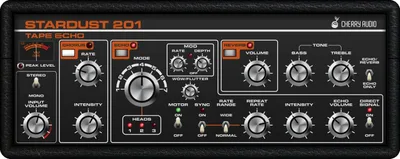
If you own Mercury-4 and you're wondering whether the Stardust 201 Tape Echo crossgrade is worth it, the answer is yes for anyone who wants a space echo emulation with spring reverb, DAW sync, and a BBD chorus at $10. But it's not a clean, unconditional yes. There are real problems here that some users hit hard, and you should know about them before you spend anything.
Cherry Audio has built a reputation for affordable, well-modeled vintage gear recreations. Stardust 201 follows that pattern. It's a hot-rodded interpretation of the Roland RE-201 and RE-301 Space Echo units, with modern conveniences layered on top. For Mercury-4 owners specifically, the crossgrade pricing is aggressive enough to shift the whole calculation.
This review covers exactly where it delivers, where it frustrates, and whether the crossgrade logic holds up.
What You're Actually Upgrading To
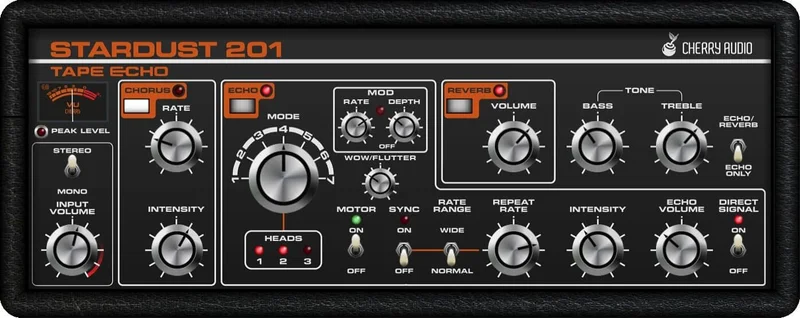
Stardust 201 isn't just a tape delay. It's a complete effects section modeled on two different Roland Space Echo units: the RE-201 and the RE-301. The developer says the plugin recreates the limited fidelity and stability of audio tape, which means you get natural high-frequency rolloff, bass rolloff, and minor speed variances that give repeats an organic, slightly warbly character.
Seven virtual tape head modes let you select different playback configurations, the same way you'd physically move a tape head on the hardware. That controls the rhythm and character of the echoes. There's no other way to get that range of textures from a single plugin without swapping delay types entirely.
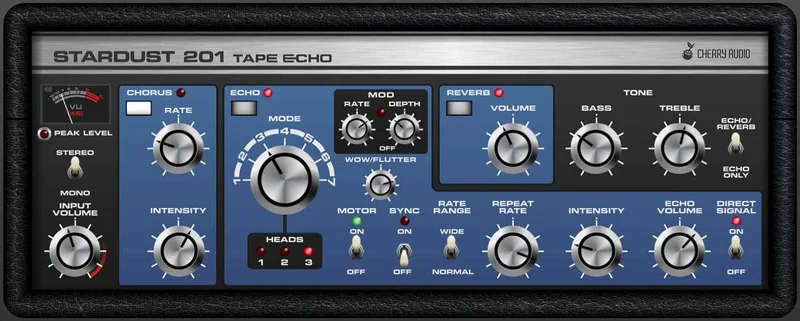
On top of the core echo, you get a spring-style reverb, a true-stereo BBD chorus circuit, an LFO echo time modulation section, a modeled input overdrive, and bass and treble EQ. The developer added a motor kill switch and 4x extended echo time range that you wouldn't find on the original hardware. DAW tempo sync is in there too.
What you're upgrading from with Mercury-4 is a synthesizer context. Stardust is purpose-built for tape echo processing. That's the shift. It's not a crossgrade within the same product family. It's a move into a completely different tool.
Who Actually Qualifies
This crossgrade is for Mercury-4 owners only. If you don't own Mercury-4, you're looking at the full version of Stardust 201 instead. That's a separate product at a separate price point.
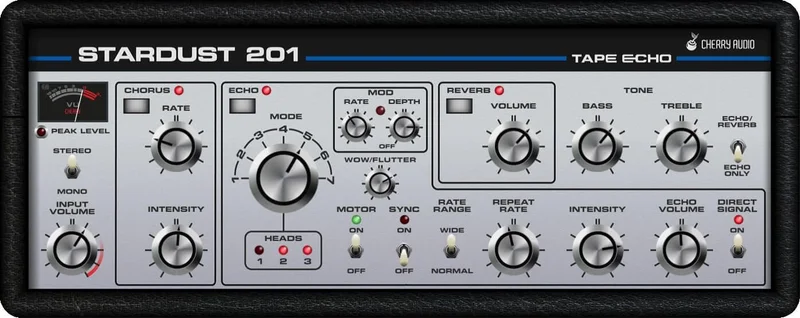
The crossgrade doesn't require you to give up Mercury-4. You keep it. You're just paying a reduced price to add Stardust 201 to your library because Cherry Audio recognizes you're already a customer.
If you own Mercury-4 and you don't already have a tape echo you love, this is a straightforward decision at $10. If you already own Arturia Delay TAPE-201, the GSI RE-201 plugin, or AudioThing Outer Space, the calculation gets more complicated. We'd think harder before buying a fourth space echo emulation, even at this price.
The Value Case
At $10, this is one of the harder arguments to dismiss in the tape echo category.
You're getting seven tape head modes, a true-stereo BBD chorus, a spring reverb, LFO modulation, input overdrive, bass and treble EQ, DAW sync, a motor kill switch, and 4x extended delay time. That's the full signal chain of a vintage tape echo unit with modern routing on top. Standalone mode is included.
Users report negligible CPU load even on heavy sessions. That's unusual for tape echo emulations, which tend to be expensive on processing. Getting clean performance at this price is satisfying in a way that doesn't need exaggeration.
Reviewers call the spring reverb the nicest among competing RE-201 emulations. That's a specific claim worth holding onto. If spring reverb is part of your workflow on any session, that single feature may justify the cost.
The comparison to Arturia Delay TAPE-201 is useful here. Arturia includes ping pong mode and ducking that Stardust doesn't have. But users who've compared them say they prefer Stardust's spring reverb. That's a real trade-off, not a clear winner either way.
What's missing at this price: a global wet/dry knob. Reviewers flag it as a disappointing omission, and we'd agree it's the kind of control that should be non-negotiable in a mixing context. Check whether that workflow gap matters in your DAW before buying.
The Seven Tape Head Modes and What They Do
The tape head modes are the core of Stardust 201. Load it on a guitar bus and step through all seven before you settle on one. Each mode changes the playback point on the virtual tape loop, which changes the timing relationships between repeats and completely shifts the rhythmic character of the echo.
Some modes produce simple single-tap delays. Others stack multiple taps at different intervals, which is where the Roland RE-201 gets its distinctive sound. The developer says cranking the intensity knob overloads the circuit and generates runaway echoes. Push it to that point to try it for yourself.
The 4x extended echo time range takes the delay well beyond what the original hardware could do. If you want thick, slow echoes with the tape character intact, that extension matters. Standard RE-201 mode would limit you. Wide mode opens it up.
The independent stereo tape head loops for wide imaging are worth exploring on any pad or synth you want to spread without losing the tape texture. Push them apart and the stereo image gets physically wide without sounding like a chorus effect.
LFO Modulation, Motor Kill, and the Overdrive
The LFO echo time modulation section is what you'd reach for when you want the repeats to drift. Increase the rate and depth and the delay time wobbles in a way that sounds like a tape transport slowing down and speeding up. It's subtle at low settings. At high settings, it's clearly audible as pitch modulation on the repeats.
The motor kill switch is the clever detail here. Kill the motor mid-performance and the delay time drops to zero, which means the repeats pile up and the pitch falls off in real time. That's a hardware behavior that tape echo users would deliberately trigger. Having it on a switch rather than requiring you to automate the delay time is a smart design choice.
The modeled input overdrive responds to level. Push the input and the developer says you get circuit saturation that adds harmonic content to the signal before the echo section sees it. Reviewers confirm that input saturation behavior matches their expectation from the hardware. That's where the "warm" description from marketing actually has a mechanical basis: you're adding even harmonics to a signal that's already being filtered by the tape model's frequency response.
Chorus, Spring Reverb, and the Problems
This is where the review gets honest. The BBD chorus and spring reverb are selling points. But both have documented issues that reviewers have flagged directly.
The spring reverb tail. Reviewers describe it as sounding unpleasant and artificial. At the same time, other users call it the nicest spring reverb among competing RE-201 emulations. That's a real split. We can't resolve it without your ears in the session. What we can say is that if the spring reverb is central to why you're buying this, download the trial first and push it hard. The tail behavior at long decay times is where the disagreement lives.
The chorus is more straightforwardly annoying. Users report that it affects the signal even at 0% intensity. That means you can't have the chorus section in your chain without it touching the sound. Unlike the delay and reverb controls, there's no true bypass at zero. For subtle blending, that's a real limitation.
Load Stardust on a clean vocal and bring the chorus down to zero. If you can hear the difference between 0% and fully bypassed, that's the problem users are describing. It's worth checking in your session before you commit to the plugin on critical tracks.
The Live Performance Problem
We'd be doing Mercury-4 owners a disservice if we buried this.
Online authorization creates a genuine risk for live performance. Users report repeated contact with support being required to resolve authorization issues, and running the plugin on stage without an internet connection is flagged as a high-risk setup. That's not a minor caveat. For any producer using this in a live rig, that's potentially a show-stopping problem.
If your use is entirely in-the-box in a studio context, the authorization system is annoying but manageable. If you're building a live performance setup around this plugin, that risk is real and documented by users who've hit it.
The standalone mode is there, which is useful. But standalone doesn't solve the authorization problem if the initial registration fails or expires at the wrong moment.
How It Compares to the Competition
Arturia Delay TAPE-201 is the most direct comparison. Cherry Audio vs Arturia tape echo comparison Arturia has ping pong mode and ducking that Stardust doesn't include. Stardust's spring reverb is preferred by users who've used both. That's where the decision splits. If you automate a lot of ping pong delay, Arturia wins that specific contest. If reverb matters more, the user consensus leans toward Stardust.
AudioThing Outer Space takes a different approach. AudioThing Outer Space review It uses convolution reverbs rather than a modeled spring reverb. That's not better or worse. It's a different flavor of authentic. If you want the physical model of a spring rather than an impulse response, Stardust is the call.
The GSI RE-201 plugin is the other established name in this category. Different character. Users who are deep into RE-201 comparison tend to have opinions about GSI versus Cherry Audio that come down to which artifacts they prefer, not which is more accurate. Both are trying to do the same thing.
For more on what to listen for across echo plugins generally, Echo Plugins Guide: 5 Controls That Shape Your Sound is worth reading before you decide. And if you're curious about Cherry Audio's wider catalog, Cherry Audio Year One Collection Review covers where they land as a developer overall.
Who Should Skip It
Skip this if you're building a live rig and internet authorization failure would cost you a gig. The risk is documented and the workarounds require support contact.
Skip it if you already own a tape echo you love and the only appeal is the crossgrade price. $10 spent on a third or fourth space echo emulation is $10 not spent on a gap in your signal chain.
Skip it if the chorus matters to you and you need true zero at 0%. That problem is real and reported by multiple users.
Skip it if you hate dealing with copy protection systems in principle. The frustration level on this one is higher than average, based on user reports.
For anyone who wants a capable tape echo primarily for studio use and doesn't already have one they love, none of those reasons apply. Cherry Audio P-10 Synthesizer Review gives you a sense of how Cherry Audio handles their other products if you want to judge the developer's quality track record first.
The Verdict
Stardust 201 Tape Echo is a legitimately capable RE-201 and RE-301 emulation with a feature set that punches above its price at $10 for Mercury-4 owners. The tape head modes work, users love the spring reverb, the CPU load is negligible, and DAW sync plus motor kill make it useful in a modern production context.
But the chorus issue at 0% is annoying. The missing wet/dry knob is frustrating. And the live authorization risk is a real problem that deserves more than a footnote.
Buy it if you're a Mercury-4 owner doing studio work who needs a tape echo and doesn't already have one. Hold off if you perform live, care about true chorus bypass, or were hoping for a wet/dry master control.
Specs & Technical Details
| Developer | Cherry Audio |
| Price | $10 |
| Plugin Format | AU / VST / VST3 / AAX / Standalone (Mac); VST / VST3 / AAX / Standalone (Windows) |
| OS Support | macOS 10.13 or above; Windows 7 or above including Windows 11; 64-bit required |
| Activation | Online registration required |
| CPU Usage | Light (users report negligible load even on heavy sessions) |
| Trial Available | Check developer site |
| Version Reviewed | N/A |
Score Breakdown
| Category | Score | Notes |
|---|---|---|
| Sound Quality | 3.5/5 | Tape model and spring reverb praised; chorus at 0% and reverb tail flagged as problematic by users |
| Value for Money | 4.5/5 | Full effects section at crossgrade pricing is hard to argue with for Mercury-4 owners |
| Ease of Use | 3.0/5 | Authorization friction and no global wet/dry knob hurt usability |
| Features | 3.5/5 | Seven tape head modes, BBD chorus, spring reverb, LFO, motor kill; missing ping pong and wet/dry |
| CPU Efficiency | 4.5/5 | Users report negligible CPU load, which is uncommon for tape echo emulations |
| Overall | 3.5/5 | Solid tape echo at a compelling crossgrade price, held back by real workflow and authorization issues |
Alternatives to Consider
Arturia Delay TAPE-201 is the closest direct competitor. Arturia Delay TAPE-201 review It adds ping pong mode and ducking that Stardust skips. Users who've compared both report preferring Stardust's spring reverb, but if ducking and ping pong are part of your workflow, Arturia is worth the comparison.
AudioThing Outer Space takes a convolution approach to its reverb rather than physical modeling. AudioThing Outer Space review Different texture. Neither is definitively more accurate. It depends whether you want a modeled spring or an impulse-captured one.
GSI RE-201 is an established emulation with a different character. If you're deep in RE-201 comparisons and the specifics of analog noise and artifact behavior matter to you, GSI is worth putting side by side with Stardust. The two serve the same use case with different approaches to authenticity.
Also worth reading: Halo Delay Review: Better Than EchoBoy, Loses to Valhalla if you're not fixed on a tape echo specifically and want to see how other delay categories compare.
Stardust 201 is underrated as a complete effects package. It's also overrated as a set-and-forget plugin by users who haven't hit the authorization or chorus problems. Know which user you're likely to be before you commit.
Frequently Asked Questions
Do I need to own Mercury-4 to buy the Stardust 201 Tape Echo crossgrade?
Yes. This listing is specifically a crossgrade for Mercury-4 owners. If you don't own Mercury-4, you'll need to purchase the full version of Stardust 201 Tape Echo instead. The crossgrade pricing reflects your existing customer relationship with Cherry Audio, not a stripped-down version of the plugin.
Is Stardust 201 safe to use in a live performance rig?
Users flag this as a genuine risk. Online authorization has caused issues for performers without a stable internet connection, with some reporting repeated support contact to resolve problems. If live performance is part of your plan, check Cherry Audio's current authorization policy before buying and have a fallback plan.
What's the difference between Stardust 201 and the original RE-201 hardware?
The developer says Stardust recreates the RE-201 and RE-301 Space Echo units and adds features the hardware never had: a motor kill switch, 4x extended echo time, DAW tempo sync, and true-stereo BBD chorus. The hardware tape loop required regular replacement and demagnetizing. Stardust doesn't. You also get selectable color themes, which the hardware definitely didn't ship with.
Does the chorus truly bypass at 0% intensity?
Users report it doesn't. The chorus section appears to affect the signal even at 0% intensity, which means there's no true bypass at that setting. That's different from the delay and reverb controls, which do behave as expected at zero. If subtle or zero-chorus blending matters to your workflow, test this in the trial period before committing.
How does Stardust 201's spring reverb compare to competing RE-201 emulations?
Reviewers report it's the nicest spring reverb among the RE-201 emulations they've compared, which is a meaningful claim given how central the spring reverb is to the Space Echo character. That said, other users flag the reverb tail as sounding unpleasant at certain settings. The split in opinion suggests the tail behavior is worth testing at longer decay times before you decide.