Yes, musiQproof is worth it if you share unreleased music with anyone before it is out, and it is a harder sell if you only ever release finished records straight to a distributor. It gives you independently verifiable proof of when a file existed, for a few euros per song at most.
Quick Verdict
We'd use it. Our score is 4.1 out of 5. The Starter option costs €9 for a single proof, and the monthly and yearly plans bring the per-song cost down to roughly €0.82 to €1.45. It is a great fit for producers, songwriters and AI music creators who send demos, beats and stems around. It is the wrong tool for anyone expecting a certificate to replace copyright registration or legal advice.
Two things hold the score back. The service only opened to the public in September 2026, so there is no track record in real disputes yet. And there is no free sample certificate, while payments are final under the terms of use.
How This Review Was Made
This is a source-based review, not a hands-on one. It is built from the musiQproof website (homepage, pricing, FAQ, the AI music page, About, Our Story and the blog), the press page with its company overview and founder biography, and the terms of use.
No account was opened for this review, so the speed claims and the real certificate output are the developer's own descriptions. Anything that cannot be verified from that material is marked as such. The prices in this review were read from the pricing section on 9 October 2026 and can change, so check the site before you buy.
What musiQproof Actually Does
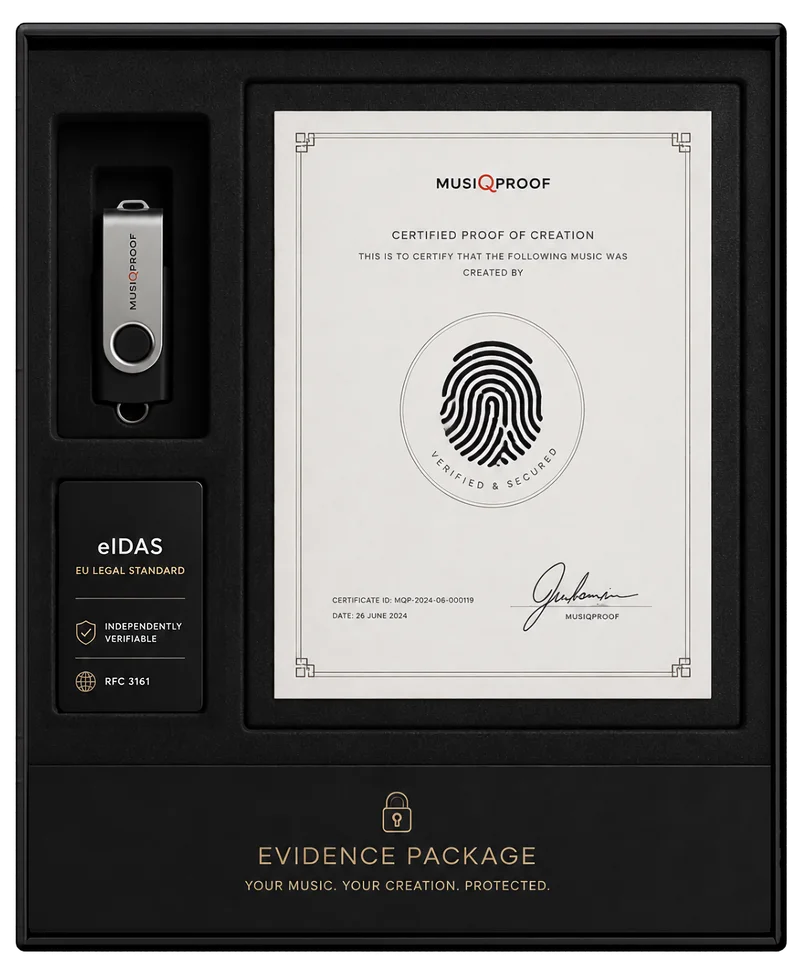
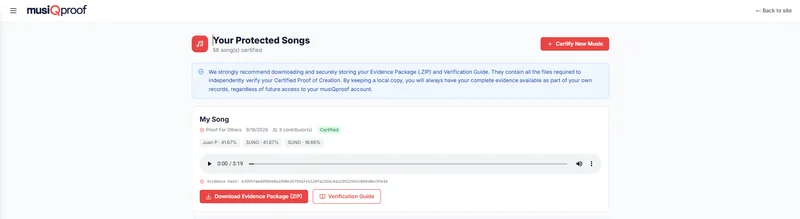
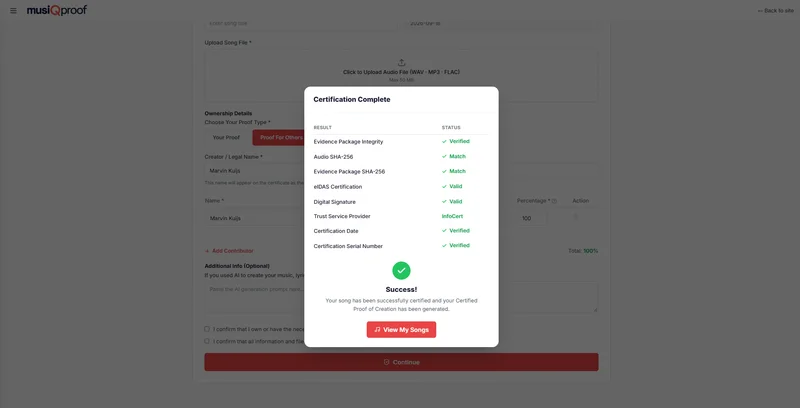
You upload a song, fill in the details, and musiQproof certifies that exact file with a legally recognized timestamp. You get a Certified Proof of Creation (a PDF) and a bundle of evidence (a ZIP) back, and both stay in your account for later download.
The idea is simple. In most countries copyright exists automatically the moment you create an original piece of music, but proving when you made something is a separate problem. The service does not create, register or replace copyright. It produces evidence that a specific file existed in a specific form at a specific date and time.
The founder, Marvin Kuijs, has more than 25 years of experience in music rights, copyright and promotion, and also founded the music-to-radio promotion platform iPluggers. According to his biography on the press page, the same misconception kept coming up in that time: creators believe that uploading to streaming platforms or registering with a performing rights organization (PRO) proves they own their music.
It does not. A PRO manages and collects performance royalties, and the site's own FAQ says that registering with one is not designed to prove when your music was created. One of the testimonials on the homepage, from a singer-songwriter in the United States, describes exactly that surprise about ASCAP.
The operating company is musiQproof B.V., based in Amsterdam. Its Chamber of Commerce and VAT numbers are published in the contact information on the press page, which is worth checking for a service that asks you to trust it with unreleased work. The registry entry itself was not checked for this review.
How New the Service Is
The Our Story page gives the timeline. The idea started in the third quarter of 2025, a closed beta ran in August 2026, the first customers certified music in September 2026, and the public launch followed the same month. The first worldwide press release went out in October 2026.
That matters for how you read everything else. The homepage talks about thousands of musicians who trust the service, but with a launch this recent that figure is the company's own claim and cannot be checked from the outside. It also explains why no court cases or dispute outcomes are published anywhere on the site, including the blog.
Who Needs This?
The target is anyone who sends unfinished music out into the world. Think of a beat you have emailed to three vocalists, a demo pitched to a publisher, a stem pack shared with a collaborator you met last month, or a library submission that sits on someone else's server for months.
The site's own scenarios are specific, and they are the right ones to think about:
- You shared a song and someone later claims they wrote the song or the melody.
- Someone uses a sample of your track in their own music without permission.
- Your distributor raises an infringement claim or asks for proof of authorship.
In each case, as the page puts it, your word alone is not enough. That is a fair and honest pitch, because the weak spot of most unreleased music is not the music. It is the lack of a dated record that someone other than you can verify.
Producers and Beat Makers
Beats, instrumentals, acapellas and stems change hands all the time before anything is released. The FAQ says you can certify demos, masters, stems, beats, instrumentals, acapellas and even project files, and that every file receives its own proof.
For a producer who sells or leases beats, that is the realistic use case. You certify the version you send, and you have a dated record of exactly what left your hands and when.
Songwriters and Artists
For writers pitching songs to publishers, labels or other artists, the value is the same. The evidence includes the song title, your legal name, any additional composers, publishers and their ownership percentages, so a pitch has a timestamped record of who claimed what share at that moment.
AI Music Creators
This is the group the site pushes hardest, and it has its own page and its own press release. The reasoning is covered in detail further down, because it is where the product stands out most.
The Four-Step Workflow
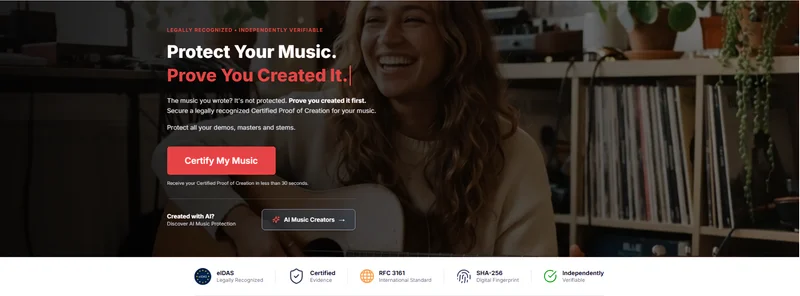
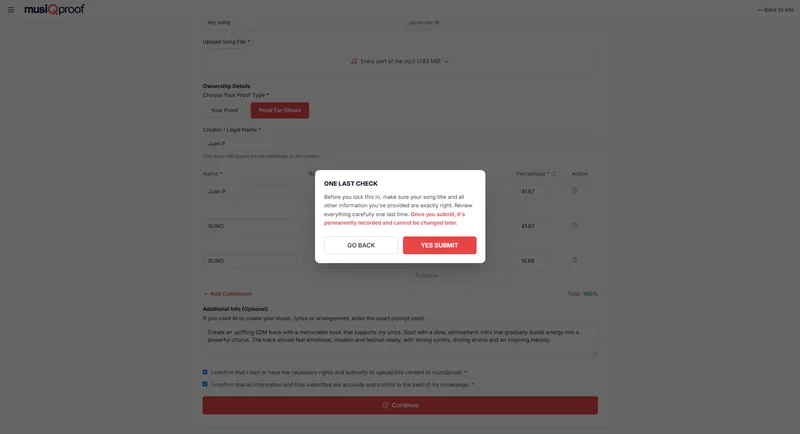
The process is short, and the developer reports that you receive the proof in less than 30 seconds. The steps, in the order you meet them:
- Create a free account.
- Upload your song and provide the details.
- Choose a certification plan and complete the payment.
- Download your Certified Proof of Creation and Evidence Package.
The homepage describes step three as the point where the proof is generated, and step four as an instant download that is "valid forever". The account is free, and the certification is what you pay for.
Upload and Registration
The account is the starting point, and certificates stay downloadable from secure cloud storage in it afterwards. The FAQ confirms that you can download your Certified Proof of Creation and Evidence Package again whenever you need them, and that a lost certificate is no problem for that reason.
You enter the song details at upload time, and this matters more than it looks. The certificate records the file together with the metadata, so sloppy entry now means a weaker document later. Spell your legal name correctly and get the ownership splits right before you pay.
Payment and Certification
You pick a plan, pay, and the certificate is generated. No free trial or free certification is mentioned anywhere in the material reviewed, so assume you pay before you see a real certificate. Payments go through Stripe, and the next section covers the methods.
That is the one thing we'd want to change. A free sample certificate would let you inspect the PDF and the Verification Guide before spending anything.
The Technology Behind the Certificate
Three standards carry the weight here, and it helps to know what each one does.
- SHA-256: a cryptographic fingerprint of your files. Change one byte and the fingerprint changes.
- RFC 3161: the international standard for trusted timestamps. It binds that fingerprint to a point in time.
- eIDAS: the European framework that gives qualified electronic trust services legal recognition.
Put together, you get a record showing that these exact files, with this exact information, existed together at the time of certification.
Who Issues the Timestamp
The FAQ names the trust service provider: InfoCert, which it describes as an EU Qualified Trust Service Provider. musiQproof says it chose InfoCert for its expertise in digital trust, so that the certificate meets the standards of the European eIDAS framework.
This is the detail that separates the product from a self-made timestamp. The time is not set by musiQproof. It comes from an independent provider, and the TSA certificate is part of what you download.
Why the Fingerprint Matters
The hash does not reveal your music. It proves that your Evidence Package has not been altered since the stamp. A third party can recompute the hash and compare it to the certified one without trusting you, or the developer.
Independent Verification
The FAQ says lawyers, courts, record labels and publishers can verify a certification with third-party tools, without relying on musiQproof. A Verification Guide (PDF) ships inside the package and explains three checks:
- that the Evidence Package has not been altered,
- that the SHA-256 hash matches the certified package, and
- that the RFC 3161 certification is valid and was issued by the trusted Time Stamping Authority.
This is the design choice we like most. A certificate that only the vendor can confirm is worth little. One that anyone can check is worth far more. The homepage even shows a "Certification Network Operational" status badge, though what exactly it monitors is not explained.
What's Inside the Evidence Package
You do not get one PDF. You get a bundle, and the contents are specific:
- Certified Proof of Creation (PDF): the official certification document.
- Complete Evidence Package (ZIP): a secure archive of everything you submitted.
- Original Music File: preserved exactly as you uploaded it.
- Song Information: your legal name, the song title, any additional composers, publishers and their ownership percentages.
- SHA-256 digital fingerprint: proof the package has not changed.
- RFC 3161 certification: the independent, eIDAS-compliant timestamp.
- Verification Guide: how to check it all yourself.
Keep the ZIP safe. The certificate points at those exact files, so losing them weakens your position. The ZIP also contains your original audio, which is why it is worth storing somewhere private. The service itself says only you can see your uploaded music, and that it is never made public.
Splits and Collaborators
Recording ownership percentages inside the evidence is a smart touch. Split disputes are among the most common fights in music, and a timestamped record of who was declared to own what is useful.
It is not a split sheet signed by everyone, though. It records what you declared, not what your collaborators accepted. If a split matters, get it agreed in writing as well.
The AI Music Angle
musiQproof runs a dedicated AI page, and this is where the product stands out. The site's argument starts from a legal gap: in many countries, music created entirely by AI cannot be protected by traditional copyright, because copyright laws often require a sufficient level of human creativity.
The certificate does not fix that. The FAQ is clear that it does not create or register copyright. What it gives you is independent, certified evidence that you were the person who possessed and certified that exact AI-generated file at a specific moment. If ownership of an AI-generated song is ever questioned, that is a record you otherwise would not have.
What Gets Recorded for AI Tracks
For AI-generated music, the Song Information can include the AI model used, the contributors, their roles and contribution percentages, and the generation prompts. The prompts are optional according to the AI page, which is worth knowing if you would rather not store them.
For tracks that mix human and AI work, the site says musiQproof documents which parts were created by humans and which were generated with AI. A testimonial from an AI producer in the United Kingdom praises exactly this: registering which parts are hers and which are AI. The press page calls the service the first platform dedicated to legally recognized proofs of creation for AI-generated music, which is a claim by the company that this review cannot confirm.
That is a clear use case in 2026. Copyright treatment of AI output varies by jurisdiction and keeps shifting, so a transparent record of the creative process is smart housekeeping. Our legal guide to AI-generated samples covers the underlying questions.
Doesn't Suno Already Show a Date?
The AI page has an FAQ entry asking why you would use musiQproof when platforms like Suno already show a creation date. The answer is independence. The certificate is separate from any AI platform, and it is yours to download, store and verify on your own.
The site's strongest point is what happens when the platform changes. If an AI platform changes its policies, removes your content, deletes your account or disappears, your independent evidence stays available to you. A date that only exists inside someone else's service is weaker evidence, because you cannot verify it without that service.
What You Can Certify
The FAQ is generous about file types. You can certify virtually any original music-related file: demos, masters, stems, beats, instrumentals, acapellas, project files and AI-generated music. Every file gets its own Certified Proof of Creation.
Unfinished Songs and Early Versions
The site recommends certifying early. Every important version, from the first demo to the final master, can be certified separately, which builds a timeline of your creative process. That is useful, but it also means the cost scales with how many versions you certify, a point covered in the pricing section.
Cover Songs
You can certify a cover. The certificate then supports your claim to your own arrangement, performance and recording. It does not give you ownership of the underlying composition or lyrics, and the FAQ adds that if you want to release or distribute a cover commercially, you still need the permissions or licences from the songwriter, publisher or master rights holder.
Music That Is Already Released
You can still get a proof after release, even if the music is already on streaming platforms or social media. The site says it is always best to certify before sharing, and the reasoning is simple: once other people have a copy, you can no longer create evidence from before that moment.
Key Behaviours to Know
From the FAQ and the terms, a handful of rules shape how you will use it.
- Permanent validity: an issued certificate does not expire, even if you cancel your account or subscription.
- One file, one certificate: change a single note, lyric or audio sample and the new version needs its own certification. The old one stays valid for the old version.
- Later uploads change nothing: if someone certifies the same song after you, their certificate simply gets a later date and time. Yours cannot be replaced or overwritten.
- Not an ownership check: the service does not verify who owns a song or whether the uploader is the original creator.
- Private by default: only you can access the uploaded files unless you choose to share them.
- After cancelling: existing certificates stay valid, but you cannot create new proofs unless you reactivate the account.
The second rule is the real workflow cost. A producer who bounces ten mixes of one song will certify ten files, or only the ones that matter. Certify the mixes you send out, not every internal bounce.
If Someone Uploads Your Song First
The FAQ is honest about this case. A certificate does not decide copyright ownership. It certifies who submitted a specific file and exactly when it was certified. That is why the site keeps repeating the same advice: certify before you share, because the earlier you certify, the stronger your independent timeline.
Pricing, Plans and Payments
The pricing section shows one pay-as-you-go option and two subscriptions, each in a monthly and a yearly version. All prices below are in euros, as shown on the site on 9 October 2026.
| Plan | Price | What you get |
|---|---|---|
| Starter (pay as you go) | €9 one time | 1 Certified Proof of Creation |
| Creator, monthly | €29 per month | 20 proofs per month, unused proofs roll over |
| Creator, yearly | €290 per year | 20 proofs per month, unused proofs roll over |
| Professional, monthly | €49 per month | 50 proofs per month, rollover, flexible credit top-ups |
| Professional, yearly | €490 per year | 50 proofs per month, rollover, flexible credit top-ups |
Every plan includes the Complete Evidence Package, eIDAS legal recognition, secure cloud storage and the right to download your certificates at any time. The Professional plan is marked "Most Popular" and adds credit top-ups of 10 to 1,000+ proofs, whose prices are only shown behind a link on the site.
The Per-Song Maths
The homepage says certification starts from €0.82 per song. That matches the Professional plan on yearly billing: €490 spread over 600 proofs a year. The other plans work out as follows, based on using every proof in the allowance:
- Starter: €9 per song.
- Creator, monthly: about €1.45 per song. Creator, yearly: about €1.21.
- Professional, monthly: about €0.98 per song. Professional, yearly: about €0.82.
Those figures are calculated for this review from the published prices, not quoted from the site. They only hold if you really use the whole allowance. Paying yearly instead of monthly saves €58 on Creator and €98 on Professional, in line with the "2 months free" label. The site adds that all yearly certifications are available immediately, which means a yearly plan does not make you wait for the monthly allowance to drip in.
Monthly Plans Come With a Catch
The monthly versions are labelled "Annual membership, billed monthly". That wording suggests a one-year commitment paid in instalments, and the FAQ refers to the "end of your annual commitment" for downgrades. The pricing section does not spell out the full terms, so read the checkout page before choosing a monthly plan.
Upgrades, Downgrades and Cancelling
- Upgrade: active immediately. Moving from one subscription to a higher one is prorated, and the extra proofs are added right away.
- From Starter to a subscription: a new subscription starts at the full plan price. The Starter purchase is not prorated or refunded.
- Downgrade: takes effect at the end of the current billing period or annual commitment.
- Stopping: you turn off auto-renew, and the plan stays active until the period or commitment ends.
- Rollover: unused proofs roll over only while the subscription is active.
Payment Methods and Refunds
Payments run through Stripe. For one-time purchases (Starter and top-ups) the options are cards including Apple Pay and Google Pay, Amazon Pay, Link, PayPal, iDEAL and Klarna. Yearly subscriptions accept cards, Amazon Pay, Link and PayPal. Monthly subscriptions accept cards, Amazon Pay and Link only, because PayPal, iDEAL and Klarna do not support recurring payments.
The terms of use are blunt about refunds: all payments become final and non-refundable. Combined with the lack of a free sample, that makes the €9 Starter proof a small but real leap of faith for a first-time buyer.
Specs and Requirements
| Spec | Detail |
|---|---|
| Brand | musiQproof |
| What It Is | Certified Proof of Creation for music files, using eIDAS and RFC 3161 timestamping |
| Platforms | Web service, runs in the browser |
| Free Option | No (the account is free, certification is paid) |
| Timestamp Provider | InfoCert, an EU Qualified Trust Service Provider |
| Version Reviewed | Website as published on 9 October 2026 |
| Output | PDF certificate plus ZIP Evidence Package with a Verification Guide |
| Standards | eIDAS, RFC 3161, SHA-256 |
| Company | musiQproof B.V., Amsterdam, the Netherlands |
| Support | Email, plus an AI chat assistant called Proofie. Typical email response time is within one business day. |
Where musiQproof Wins
Speed comes first. The developer reports certification in less than 30 seconds, and the whole flow is four steps with no paperwork. Formal registration and notary-style deposits cannot match that turnaround.
Cost is second. A Canadian producer's testimonial on the site calls it way faster and way cheaper than protecting music through a notary, while still providing legally recognized proof. That is the user's own comparison, but the per-song maths on the subscriptions makes it plausible.
Third, the evidence is independent. You are not trusting a company's database. The timestamp comes from a qualified provider, and you hold a file that anyone can check with public tools.
Fourth, the evidence is organised. The package bundles file, metadata, splits, fingerprint and instructions together, which is what a lawyer or distributor actually wants to see.
Finally, it treats AI music seriously. Recording the model, the contributors and the human and AI parts is a feature most simple timestamp services do not offer.
Where It Falls Short
The biggest limit is the plainest one. A certificate proves your file existed in that form at that time. It does not prove you are the author, and it does not prove nobody else had the same file earlier. The service says so itself: it does not verify ownership.
The site is careful with its wording, using phrases like "evidence that supports your ownership claim". Read it that way. It is evidence, not a verdict. The terms of use add that the service cannot guarantee the outcome of a legal dispute and that the weight of any evidence is assessed in the context of the individual case.
Second, versioning is annoying. Every change means a new certificate, which adds cost and admin if you iterate a lot.
Third, there is no free trial in the material reviewed. You cannot preview a real certificate before paying, and payments are final.
Fourth, the monthly plans are described as an annual membership billed monthly, and the pricing section does not explain what that means if you want to stop early.
What Can't Be Verified Yet
We can't confirm how a certificate performs in a real dispute, because no case outcomes are published and the service is only weeks old. Legal weight also depends on the country. The terms of use are governed by Dutch law, with Dutch courts as the exclusive venue, and they say the services are not represented as complying with laws outside the Netherlands. The FAQ, in contrast, says the certificate can help support your ownership wherever your rights are questioned.
The 30-second figure, the testimonials and the number of users are the developer's own. Treat them as claims until you have run a certification yourself. For anything high stakes, talk to a music lawyer. Our guide to music copyright for producers explains where this kind of evidence fits.
How musiQproof Compares
It is not the only way to build evidence of authorship, and it works best alongside the others. Each of these answers a slightly different question.
Against Formal Copyright Registration
Formal registration beats a timestamp on legal strength in some countries. As general background, not something from the musiQproof site: in the United States, registration is generally needed before you can sue over infringement of a US work, and timely registration can open the door to statutory damages. Our walkthrough on how to register music copyright shows the process.
musiQproof says plainly that it does not create, register or replace copyright. The sensible view is that it complements registration. It is quick, cheap evidence of timing, while registration is a formal legal step.
Against a Notary or Lawyer Deposit
A notary or lawyer can date and witness a file, and courts are familiar with the format. It is typically slower and costs more per song, and the testimonial on the site makes the same point. musiQproof wins on speed, price and the AI documentation. A notary may win on courtroom familiarity.
Against Your PRO, Spotify and Your Distributor
These manage royalties and delivery. They are not designed to prove authorship, and the site's FAQ spends several entries explaining why. Releases can be taken down, metadata can change, artist names can be copied and others can make competing claims. See how music royalties work before assuming either covers you.
Against a Platform Date
An AI platform's creation date lives inside that platform. If the account or the platform goes away, so does the date. An independent certificate stays with you.
A Practical Way to Use It
Because every file needs its own proof, a little discipline keeps the cost down and the evidence useful. This routine is general advice, not something the developer prescribes.
- Pick the moments when music leaves your control: an email to a vocalist, a pitch to a publisher, a submission to a library, a stem pack for a remixer.
- Export the exact file you are about to send. Do not certify a bounce and send a different one.
- Enter the song information carefully: legal name, title, collaborators, publishers and splits.
- Download the Evidence Package straight away and store a copy somewhere you control, such as an encrypted drive.
- Name your files so you can match each certificate to the version it covers.
- Certify again whenever the file changes in a way that matters.
On a Starter budget that means certifying the handful of songs that matter most. On a subscription it can become a habit that runs alongside every release.
Who Should Buy This
- ✅ Buy if you send demos, beats or stems to people you do not fully know.
- ✅ Buy if you create with AI and want a documented record of the model, the contributors and the human input.
- ✅ Buy if you run a catalogue and need organised evidence for distributors and labels, and you will use most of a monthly allowance.
- ✅ Buy if a notary is too slow and too expensive for your release rhythm.
- ❌ Skip if you expect a certificate to replace formal copyright registration.
- ❌ Skip if you never share music before it is released and distributed.
- ❌ Skip if you need a guarantee of how a court will rule.
- ❌ Skip if you want to try before you pay, since there is no free sample and payments are final.
Score Breakdown
These scores rest on the documented feature set and the developer's published figures. They will be revisited after longer use and once real-world outcomes exist.
| Category | Score | Notes |
|---|---|---|
| Quality | 4.5/5 | Standards-based evidence with a qualified provider and a verification guide |
| Features | 4.0/5 | Strong AI and splits documentation, no free preview |
| Ease of Use | 4.5/5 | Four steps and a reported 30-second turnaround |
| Value for Money | 4.0/5 | Cheap per song on subscriptions, a real cost for single-song use |
| Reliability | 3.5/5 | Registered company, but weeks old with no published dispute outcomes |
| Overall | 4.1/5 | Fast, independent evidence tool that supports ownership claims without proving them |
Alternatives to Consider
Formal copyright registration. For the strongest legal footing in countries where it matters, registering is the baseline. Start with our guide to what music copyright actually covers.
Notary or lawyer deposit. A notary can date and witness a file. It is slower and costs more per song, but courts know the format.
Your PRO and your distributor. These manage royalties and delivery, not authorship proof, as covered above.
The Verdict on musiQproof
We'd use it. For €9 per song at the Starter rate, and under €1.50 per song on the subscriptions, you get independently verifiable evidence that your file existed on a given day, backed by a qualified timestamp provider.
Use it before you share, not after a dispute starts. That timing is the entire point of the product.
It is the wrong tool if you want a legal guarantee, if you never share unreleased work, or if you will not also register your copyright where it counts. We'd still like to see a free sample certificate and a few real dispute outcomes before calling it perfect. Because the service is new, a small first purchase is the sensible way in.
Certify the song before the email goes out, because proof made after the argument starts is proof made too late.
Frequently Asked Questions
Is musiQproof legally valid?
musiQproof says its certificates use European certification technology under the eIDAS framework and the RFC 3161 timestamp standard, with InfoCert as the trust service provider. That gives you independently verifiable evidence of when a file existed. It supports an ownership claim but does not prove authorship by itself, and no service can guarantee how a dispute ends.
Does a Certified Proof of Creation replace copyright registration?
No. Copyright exists automatically in most countries, and formal registration carries legal advantages in some of them, such as the US. Think of this as evidence that complements registration, not a substitute. The service itself says it does not create, register or replace copyright.
Can I certify AI-generated music?
Yes. The AI page says you can record the AI model, the contributors, their roles and, optionally, the generation prompts, and you can document which parts were human-made. The legal treatment of AI music differs by jurisdiction, so the record is documentation, not a ruling on copyright.
What happens if I change my song after certifying it?
The new version needs its own certification, because each certificate is tied to the exact file. The earlier certificate stays valid for the earlier version.
Does the certificate expire if I cancel my subscription?
No. According to the FAQ, an issued certificate stays valid even if you cancel your account or plan. You just cannot create new proofs until you reactivate.
Is my music kept private?
The site says only you can access the uploaded files unless you choose to share them, and that they are never made public. Your Evidence Package contains the original audio file, so store your copy somewhere private.
Can I certify music that is already released?
Yes. You can get a proof after release, but it is always better to certify before you share a song, because after that you cannot create evidence from before other people had a copy.
Can I get a refund?
The terms of use say all payments become final and non-refundable. If you want to test the service, the single-song Starter option is the cheapest way in.