Affiliate disclosure: the buy button is an affiliate link to the store. If you buy through it we earn a commission at no extra cost to you. Full policy

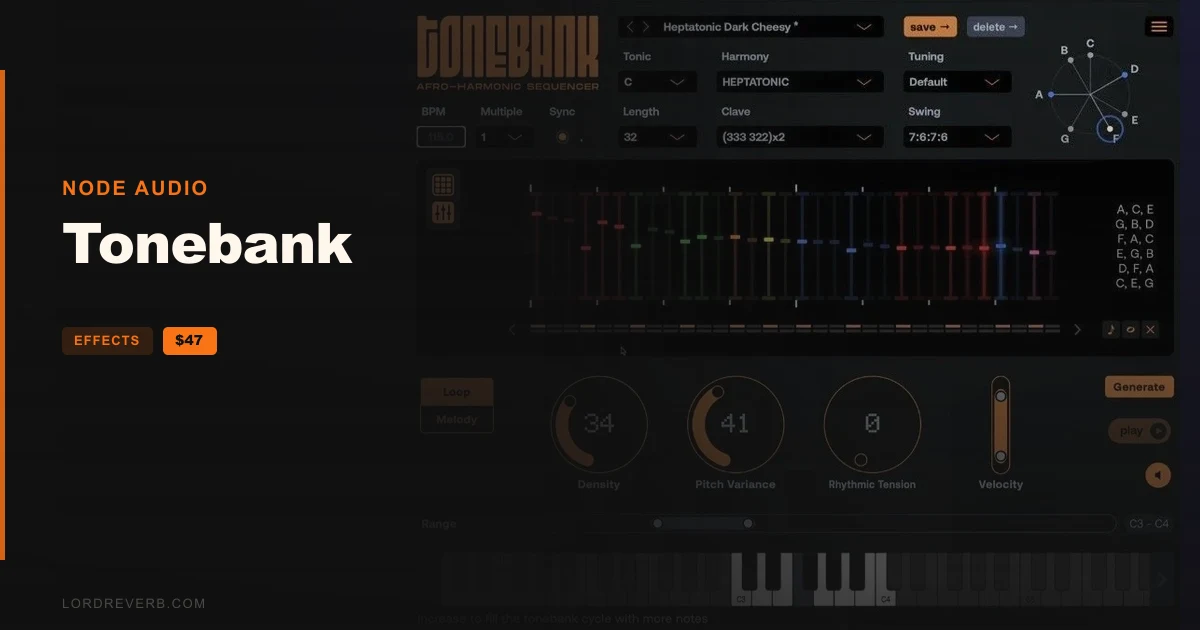
Tonebank Black Friday pricing from Node Audio brings its generative MIDI sequencer plugin to $47, 40% off, with the deal ending Dec 4, 2026.
Tonebank generates melodies, basslines and textures, and the maker says the groove and structure are built in from the start.
It does not run a plain arpeggio or a random note generator. It improvises inside rhythmically patterned harmonic loops, borrowing organising principles from traditional African music systems.
The maker pitches it against two familiar problems: arpeggiators that give predictable patterns, and generative tools that give chaos. Tonebank aims for movement, tension and release instead.
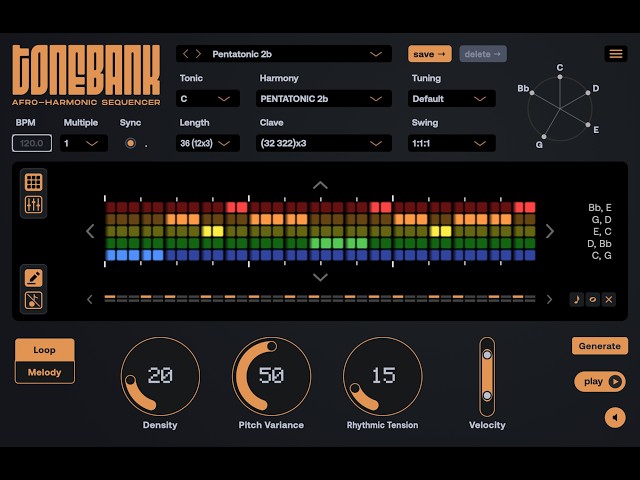
A clave sets where the harmonic changes land. A harmonic system supplies the chord set, and swing templates run from straight through 1:1, 2:1, 3:2 and triplet grooves.
Two modes shape the output:
There are 16 built-in harmonic systems (pentatonic, hexatonic, heptatonic and overtone-based). The Custom Harmony editor adds your own, with up to six rows of chords entered from an on-screen keyboard or MIDI and saved for reuse.
The Custom Clave editor, opened from the Clave dropdown via "Edit...", lets you define rhythmic frameworks beyond the built-in ones, including asymmetric metres.
Pitch Sliders show which note plays at each position. Every slider is automatable, can be mapped to a MIDI controller, and notes can be switched on or off to thin out the rhythm.
The Tonic, the root note behind all the harmonic output, can be changed in real time by incoming MIDI notes. With Sync Instances on, a Tonic change on one instance carries across every linked instance.
The maker lists techno, house, hip-hop, ambient and experimental music as the styles it is aimed at.
Yes. The Tonebank Black Friday deal takes 40% off Node Audio's MIDI sequencer plugin, bringing it to $47. The offer ends Dec 4, 2026.
Tonebank is a MIDI sequencer plugin that generates melodies, basslines and textures. It improvises inside rhythmically patterned harmonic loops, so the output has groove and structure, which the maker contrasts with predictable arpeggios and chaotic random generators.
Loop mode is an arpeggiator with controls for density, pitch variance, rhythmic tension and velocity. Melody mode generates phrases that mimic spoken and sung language, with natural phrasing and rests, so lines breathe instead of running as constant notes.
Yes. The Custom Harmony editor builds chord sets of up to six rows from an on-screen keyboard or MIDI input, and you can save them. The Custom Clave editor defines your own rhythmic frameworks, including asymmetric metres.
Prices and end dates are checked at publishing time and can change, so confirm them at the store before you buy.
Not signed in to Spotify? You hear 30 second previews. Signed in, you hear the full tracks.
Send your track and tick the Mixtape box. If we pick it, it joins this playlist and plays for everyone who opens the player.