Affiliate disclosure: the buy button is an affiliate link to the store. If you buy through it we earn a commission at no extra cost to you. Full policy

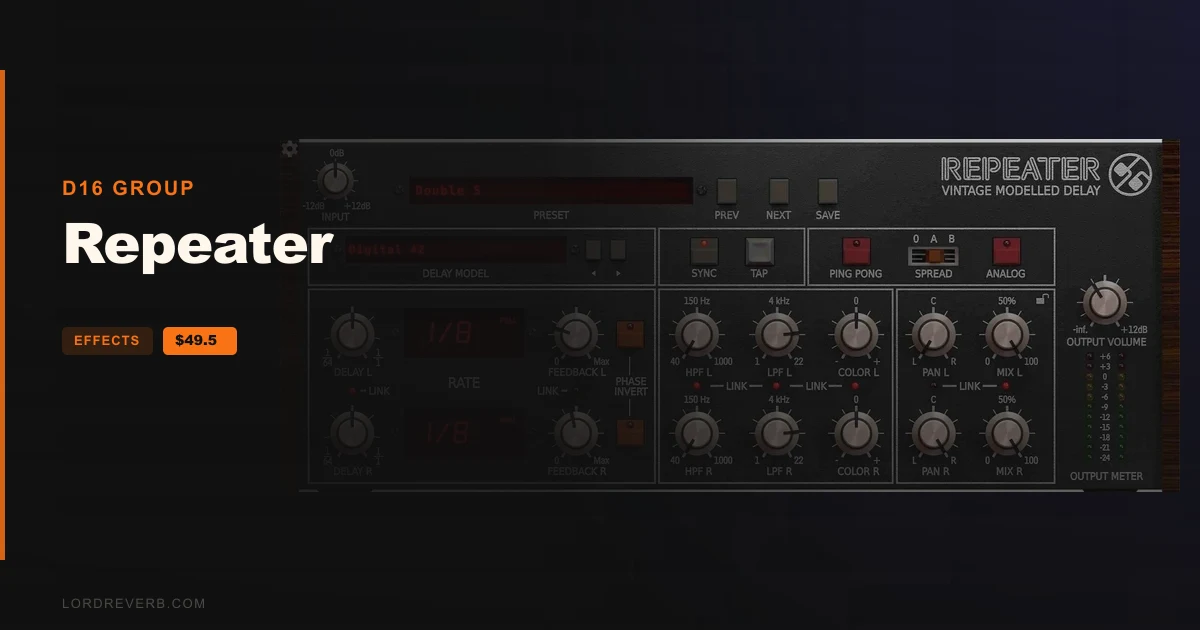
Repeater Black Friday pricing from D16 Group is 50% off this dual-delay plugin, which comes to $49.50 until Dec 1, 2026.
It's a delay effect with 23 delay models in one plugin, built by D16 Group together with Slate Digital. The models run from oil cans and plates to well-known vintage digital units.
The maker says the idea was to model every kind of delay made over the past 70 years, from tape to oil can to modern digital circuits.
On the surface it looks like a standard stereo delay with separate left and right paths. Underneath, each of the two stereo channels gets its own re-panning and dry/wet mixing, so it works as a double delay line.
The 23 units cover several families:
The maker pitches Digital 42 for guitars and vocals, with an early digital tone, some graininess and a slight scoop.
Digital 42 x 2 halves the sample rate for a lo-fi tone that D16 Group recommends for vocals, guitars and drums.
The Telephone models are lo-fi tones the maker suggests for special effects or as an insert on a vocal or a full mix.
Pitchy Delays add slight pitch modulation. Set both delay lines to the same time and you get a chorusing mono effect, and with tight times plus Spread they can widen and thicken a part.
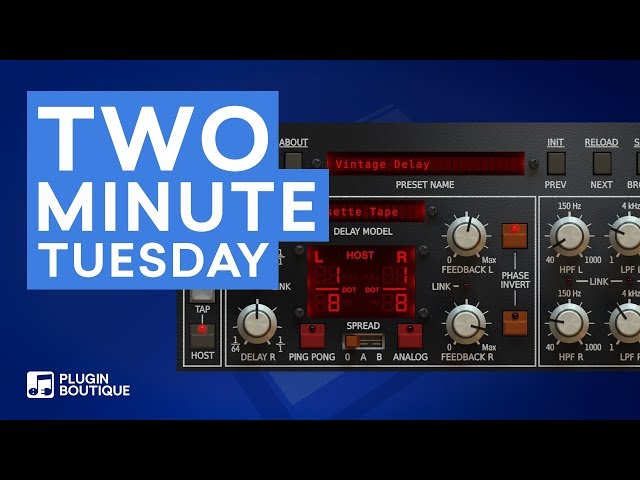
Every channel gets its own phase invert, a clipper with a Color parameter, a hi-pass and lo-pass filter pair, dry/wet balance, re-panning, and a tap function for setting unsynced delay times. Repeater also offers optional DAW tempo sync, Ping-Pong mode, an Analog mode for the feedback loop, a stereo Spread that works in two stages, very little digital aliasing, a preset browser organized by tags, MIDI-learn, and 64-bit internal processing. On Windows it runs under Windows 7, 8 and 10 (32 or 64-bit) inside a VST2, VST3 or AAX host. D16 Group asks for a 2.0 GHz SSE CPU, with a 2.4 GHz multicore system recommended.
The Mac version supports OS X 10.9 through macOS 13, on Intel at 2.0 GHz (2.4 GHz recommended) or Apple Silicon. It loads as AU, VST2, VST3 or AAX.
Both platforms call for 8 GB of RAM, with 16 GB recommended. Repeater is not a standalone program, so you need a host application (DAW) to run it.
Yes. The Repeater Black Friday deal is 50% off D16 Group's dual-delay plugin, which brings it to $49.50. The offer ends Dec 1, 2026.
Repeater is a single delay plugin with 23 modeled delay units, from tape, oil can and bucket brigade designs to digital and telephone tones. It has two delay lines, a tag-based preset browser and MIDI-learn.
On Windows it runs as VST2, VST3 or AAX, and on Mac as AU, VST2, VST3 or AAX. Any host that loads those formats can run it. It is not standalone, so a DAW is required.
Repeater has separate delay lines for the left and right channels, each with its own controls. Each of the two stereo channels also gets independent re-panning and dry/wet mixing, which makes it more flexible than a fixed-panned stereo delay.
Prices and end dates are checked at publishing time and can change, so confirm them at the store before you buy.
Not signed in to Spotify? You hear 30 second previews. Signed in, you hear the full tracks.
Send your track and tick the Mixtape box. If we pick it, it joins this playlist and plays for everyone who opens the player.