Affiliate disclosure: the buy button is an affiliate link to the store. If you buy through it we earn a commission at no extra cost to you. Full policy

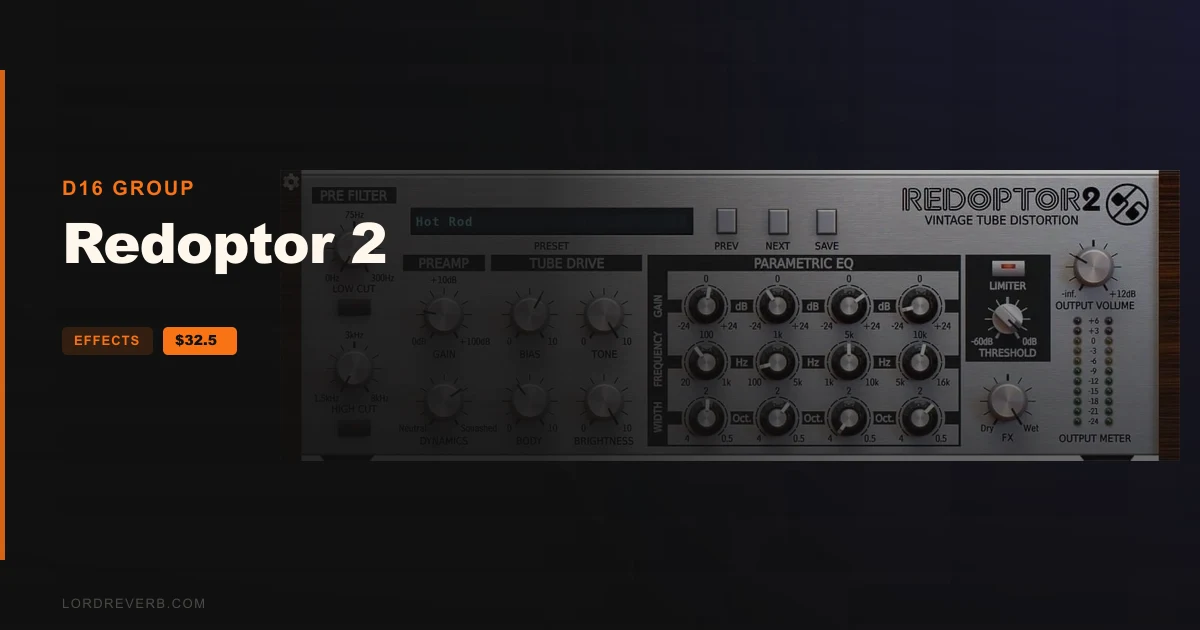
Redoptor 2 Black Friday pricing from D16 Group is 50% off, leaving this tube distortion plugin at $32.50 until Dec 1, 2026.
Redoptor 2 is a stereo tube distortion plugin. The maker says it responds to the level of the incoming audio the way a real tube amplifier does, so loud passages pick up more crunch and harmonics while quiet, decaying sounds clean up gradually.
D16 Group describes a blend of even and odd harmonics with gentle, natural compression. It contrasts this with solid-state transistor and fuzz circuits, which it says produce only odd harmonics.
The tube emulation covers the tube and its coupled circuits. An adjustable tube bias parameter adds subtle even-harmonic content and gentle transient reshaping.
If you re-amp guitar parts, fatten drum loops, sweeten arpeggiated synths or beef up bass lines, the maker names all of those as uses.
The preamp lets you set the cut-off for both the low and high ends before the signal is amplified and distorted. That range runs from lo-fi to full-spectrum.
A pre-gain compressor sits ahead of the distortion stage to add punch and rein in dynamic range. A master output limiter catches peaks on the way out.
The EQ is a parametric design with independent gain and frequency control over 4 bands.
It does. Although the design follows the mono signal paths of vintage guitar amps, each channel of a stereo signal gets its own path.
That lets the left and right sides carry different harmonics and distortion. D16 Group points to synth sounds as one case, where this can add definition and stereo imaging on top of the tube character.
Redoptor 2 is not a standalone program, so you need a host application (DAW) to run it.
On Windows, it supports Windows 7 to 10 (32 or 64-bit) and ships as VST2, VST3 and AAX. It asks for a single-core 2.0 GHz SSE CPU, with multi-core 2.4 GHz SSE recommended, and 8 GB of RAM, with 16 GB recommended.
On Mac, it supports macOS 10.13 to macOS 12 Monterey (64-bit only) and ships as VST2, VST3, AU and AAX. It needs an Intel 1.8 GHz or Apple M1 CPU, with Intel 2.4 GHz or Apple M1 recommended, and the same 8 GB of RAM, 16 GB recommended.
Yes. The Redoptor 2 Black Friday deal takes 50% off D16 Group's tube distortion plugin, bringing it to $32.50. The offer ends Dec 1, 2026.
Redoptor 2 packs tube and coupled-circuit emulation, preliminary filters, a preamp with built-in compressor, an output limiter and a 4-band parametric equaliser. It also has a tag-based preset browser, two GUI sizes and MIDI-learn throughout.
On Windows, Redoptor 2 comes as VST2, VST3 and AAX. On Mac, it adds AU to those three. It is not a standalone program, so you need a host application (DAW) to use it.
Yes. Redoptor 2 gives you tube distortion in true stereo, with the left and right channels each running through their own separate signal chain. Each side can carry different harmonics and distortion, which D16 Group says can improve definition and stereo imaging on synth sounds.
Prices and end dates are checked at publishing time and can change, so confirm them at the store before you buy.
Not signed in to Spotify? You hear 30 second previews. Signed in, you hear the full tracks.
Send your track and tick the Mixtape box. If we pick it, it joins this playlist and plays for everyone who opens the player.