Affiliate disclosure: the "Get this deal" button is an affiliate link to the store. If you buy through it we earn a commission at no extra cost to you. Full policy

The Poseidon Black Friday deal takes 60% off Pulsar Audio's EQ plugin, so it costs $39 until Dec 7, 2026.
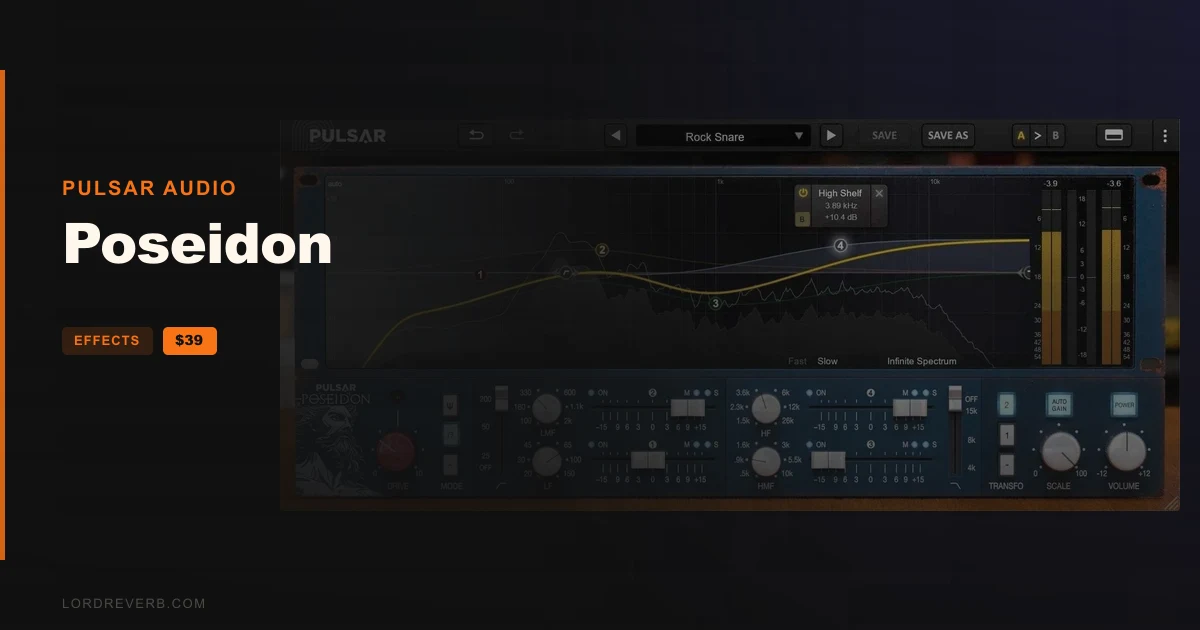
Poseidon is an inductor-based console EQ in plugin form, in VST, VST3, AU and AAX formats. Pulsar says it is modeled after a rare console whose EQ section shaped records by Queen, The Beatles, David Bowie and The Rolling Stones.
The character comes from band interaction. Push the gain of one band and the shape of the others shifts with it, so you get asymmetrical bells and exotic curves that would take three or four bands on a parametric EQ.
That behavior is hard to read on the original. Pulsar says it built an on-screen curve that reacts to those quirks, so you see what the interaction is doing.
On the hardware, each band could only be set to a few preset points. Pulsar's version lets you sweep those controls smoothly and covers a wider span, which suits current mixing work.
A full curve editor sits on screen, and you can edit every property of any filter without touching the lower panel. A real-time spectrum analyzer comes with it.
Pulsar says its Topology Preservation Technology reproduces saturation behavior, slight internal filtering and calibration quirks without simulating the whole circuit, which saves CPU.
The analog channel had no output transformer. The maker's history notes cover the console's Class A discrete preamps and its design by Malcolm Toft, Barry Porter and producer Roy Thomas Baker.
If you want a console-flavored EQ plugin that shows you its curve while you work, the Poseidon deal is the one to open.
Yes. The Poseidon Black Friday deal is 60% off, bringing the Pulsar Audio EQ plugin to $39. The offer runs until Dec 7, 2026.
Poseidon comes as a plugin in VST, VST3, AU and AAX formats. It is an EQ that Pulsar Audio models after the EQ section of a rare, legendary console.
It has Mid/Side bands, Gain Scale, Auto-Gain, an on-screen curve editor with spectrum analyzer, peak and RMS metering, and two saturation circuits with a Drive knob. Frequency knobs are continuous with extended ranges.
Each filter's curve responds to how its neighbors are dialed in, so you end up with lopsided bell shapes and unusual response curves. Pulsar says it recreated this from the original unit and made the resulting shapes visible on screen.
Prices and end dates are checked at publishing time and can change, so confirm them at the store before you buy.