Affiliate disclosure: the buy button is an affiliate link to the store. If you buy through it we earn a commission at no extra cost to you. Full policy

Halo Vision Black Friday pricing is 51% off, $144 until Dec 7, 2026, on NUGEN Audio's real-time visual analysis suite for surround and immersive mixes.
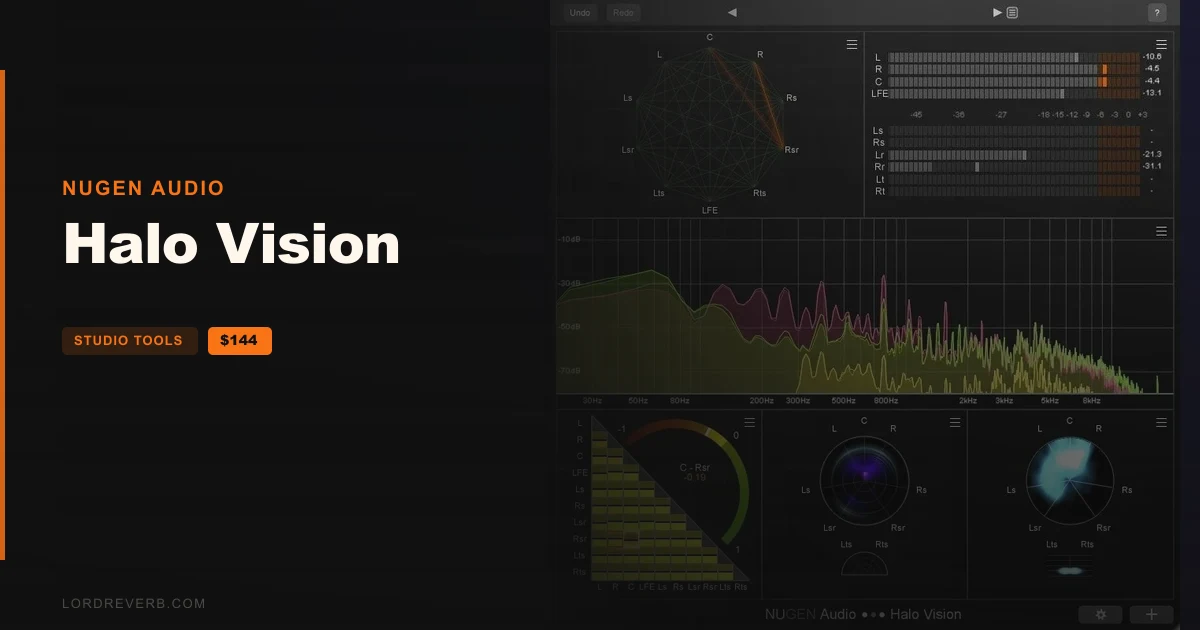
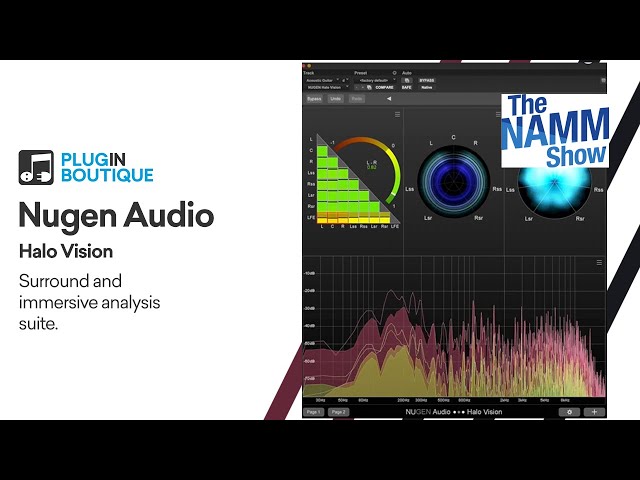
Halo Vision is a customizable metering plugin built for 3D and immersive audio. The maker says its modules show you problems that are easy to miss by ear alone.
The view list includes the Correlation Matrix, Correlation Web, Frequency Haze, Location Haze, Spectrum, True Peak and Timecode.
The displays are configurable, so you pick the views you want on screen:
The Correlation Matrix uses a larger arched meter and fires anti-correlation alerts at a threshold you set.
The Correlation Web works on the same idea. When two channels go anti-correlated, the line between them lights up.
Both correlation views use Contextual Correlation by default. Standard correlation meters normalise their calculation, so two signals can look heavily anti-correlated even when one is far louder than the other.
When that happens, summing the signals won't produce any cancellation. Contextual Correlation accounts for the gap in level between them and raises a flag only when a real problem is probable.
Frequency Haze is circular, with low frequencies at the centre and highs on the outer edge. Channel labels sit in typical speaker positions.
Location Haze shows the perceived location of your audio. Brighter sections mean more energy.
In Combined mode, the Spectrum view draws all channels in a single spectrum. In Groups mode, you organise channels into groups of spectrums.
The True Peak view gives each channel its own dB meter. The Timecode view shows the current playback position reported by the host or DAW. It needs a surround-compatible plugin host such as Pro Tools HD.
On Mac, it requires OSX 10.7 or later (64-bit only) and 512 MB RAM. On Windows, it requires Vista or above (64-bit only) and 512 MB RAM.
NUGEN Audio says the design comes from interviews with industry customers about what they want from surround and immersive analysis. The aim was a display that shows complex information without a crib sheet or on-screen clutter.
Yes. The Halo Vision Black Friday deal is 51% off, bringing the NUGEN Audio analysis suite to $144. The deal ends Dec 7, 2026.
Halo Vision supports 64-bit AAX, VST3 and AU. It needs a surround-compatible plugin host such as Pro Tools HD, so a stereo-only host will not suit it.
It is the default calculation in the Correlation Matrix and Correlation Web. It compensates for level differences between channels, so only correlation issues likely to cause phase cancellation get highlighted, instead of every anti-correlated pair.
NUGEN Audio lists surround and immersive mix analysis up to 7.1.2. Frequency Haze and Location Haze both map your signal over the full surround space, and each channel's label sits where its speaker would normally be placed.
Prices and end dates are checked at publishing time and can change, so confirm them at the store before you buy.
Not signed in to Spotify? You hear 30 second previews. Signed in, you hear the full tracks.
Send your track and tick the Mixtape box. If we pick it, it joins this playlist and plays for everyone who opens the player.