Affiliate disclosure: the "Get this deal" button is an affiliate link to the store. If you buy through it we earn a commission at no extra cost to you. Full policy

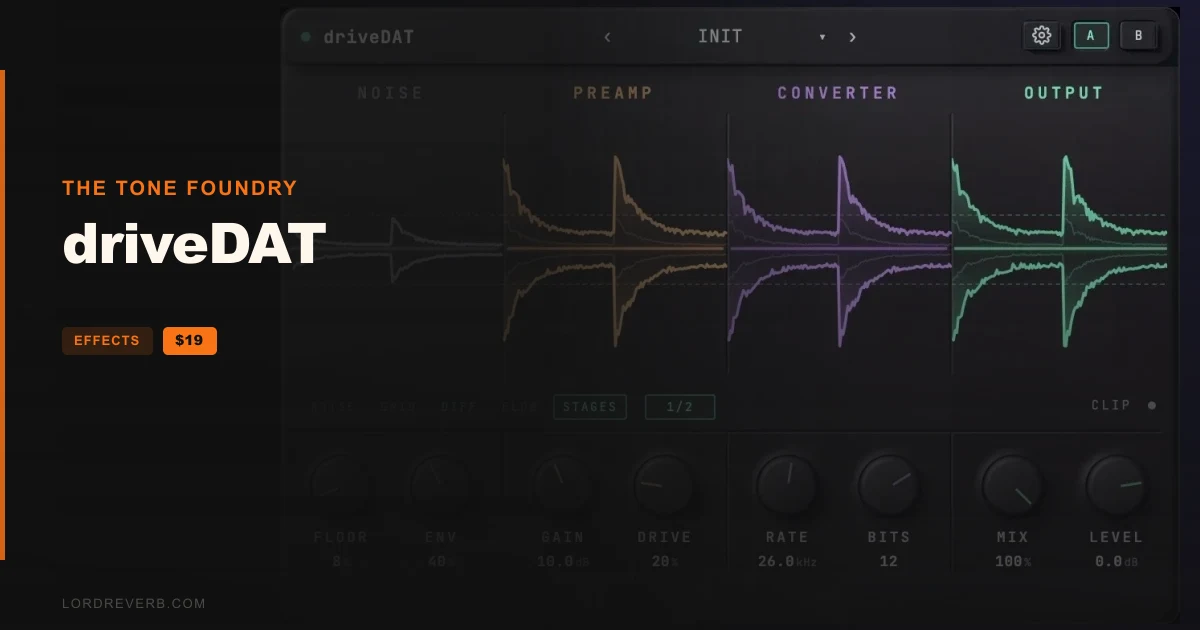
The driveDAT Black Friday deal takes 61% off The Tone Foundry's saturation and degradation plugin, bringing it to $19 until Nov 30, 2026.
driveDAT is built around one piece of hardware behaviour: a DAT recorder fed a signal that is too loud for it. According to the developer, its character comes from noise that rises and falls with the signal, a front end that compresses hard, and a converter pushed past its resolution.
Those three stages sit in the same order the deck put them.
DAT ended up a studio standard rather than a home one, used mainly for stereo mixdowns and the final tapes delivered for disc mastering. The maker points out that a DAT deck has no tape saturation, yet producers found its overloaded sound useful, and it runs all through dance and hip-hop records of the period.
Most lo-fi plugins stack effects in whatever order suits them. driveDAT follows the deck's own path instead. Noise enters where the deck's noise floor did, then the input stage limits signal and hiss together as one waveform. With a loud source signal, the hiss gets squashed down and drowned in the added distortion. The converter then samples, quantises and dithers whatever is left.
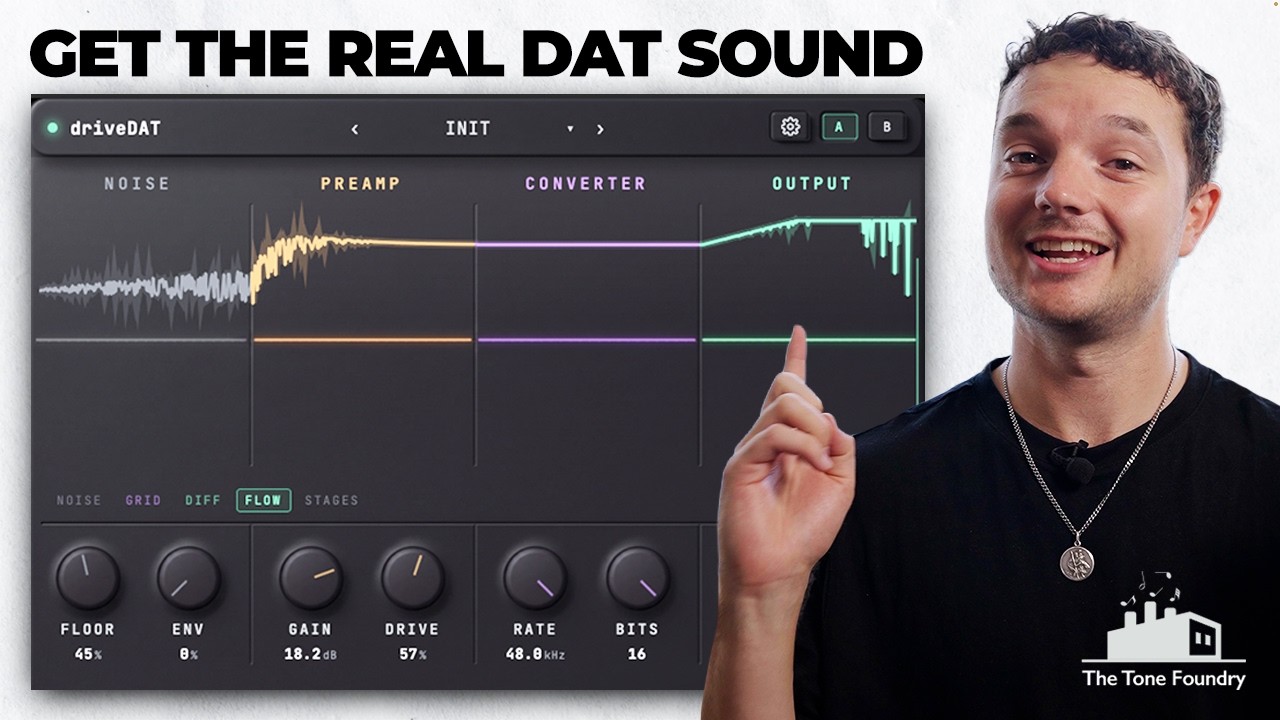
The layout is four stations with two knobs each, read left to right:
driveDAT runs at 48 kHz or 44.1 kHz, the two rates DAT itself supported. Below those rates, the deck's converter has to work outside the range it was built for. After every processing stage, driveDAT displays four views of one bar: the converter's sample-and-hold grid, the noise envelope beneath the cursor, and a spectrum plot that sets input against output. The maker says it is measured rather than modelled.
A second page called Advanced hides the controls that alter the signal path. Pre-emphasis can be set to Off, Soft or full DAT curve, and a Zero Glitch option recreates the small jump that first-generation converters produced whenever the waveform crossed zero. A slow-release limiter modeled on portable decks gives that pumping field-recorder character, Noise Squash decides how firmly the material presses into the hiss, Transient Mode keeps drum hits sharp, and Oversampling runs at 1x, 2x or 4x. Each recipe from the manual has its own preset inside the Jungle bank, which models the signal path of early drum and bass: a sampler working the break, a Reese bass compressed hard while the sub stays clean, a deck pushed into the red, and a dubplate-style master.
A/B compare captures every setting. The preset browser has search, banks and favourites, and the interface resizes from 75 to 150 percent.
Inside the manual you'll find background on the DAT format, an explanation of each knob and switch, plus guidance for recreating that classic early jungle and drum and bass grit with driveDAT.
Yes. The driveDAT Black Friday deal takes 61% off The Tone Foundry's plugin, bringing it to $19, and the offer ends Nov 30, 2026.
driveDAT is a saturation and degradation effect built around a DAT recorder being fed too much signal. It chains noise, an input stage that squashes signal and hiss together, and a converter that folds high frequencies back into the audible band.
Four stations, two knobs each: NOISE (FLOOR, ENV), PREAMP (GAIN, DRIVE), CONVERTER (RATE, BITS) and OUTPUT (MIX, LEVEL). An Advanced screen adds Emphasis, Zero Glitch, a portable-deck limiter, Noise Squash, Transient Mode and oversampling up to 4x.
It ships with 100 presets in 10 banks, including a Jungle bank with one preset per recipe in the manual. The manual covers the DAT format's history, every control, and how to get the early jungle and drum and bass sound.
Prices and end dates are checked at publishing time and can change, so confirm them at the store before you buy.