Affiliate disclosure: the buy button is an affiliate link to the store. If you buy through it we earn a commission at no extra cost to you. Full policy

The DeVerberate 3 Black Friday deal takes 31% off, putting Acon Digital's reverb reduction plugin at $68 until Dec 8, 2026.
DeVerberate 3 is an audio restoration plugin that can pull down or push up the reverb already baked into a recording. Version 3 adds a new deep learning algorithm for dialogue.
It splits incoming audio into two parts: an estimate of the direct sound and an estimate of the reverberated sound. You can then recombine the two however you like.
That means you can strip a room out of a voice, or go the other way and bring the reverb up.
The dialogue algorithm is fully automatic. The maker says a neural network was trained on thousands of high-quality voice recordings across a wide range of acoustic spaces, so it can separate speech from reverb by itself.
For music and other sources, the reverb reduction algorithm from version 2 is still included.
The Early Reflections Filter works alongside the reverb suppression algorithms. It uses statistical methods to estimate the impulse response of the early reflections, then uses that estimate to cancel their effect.
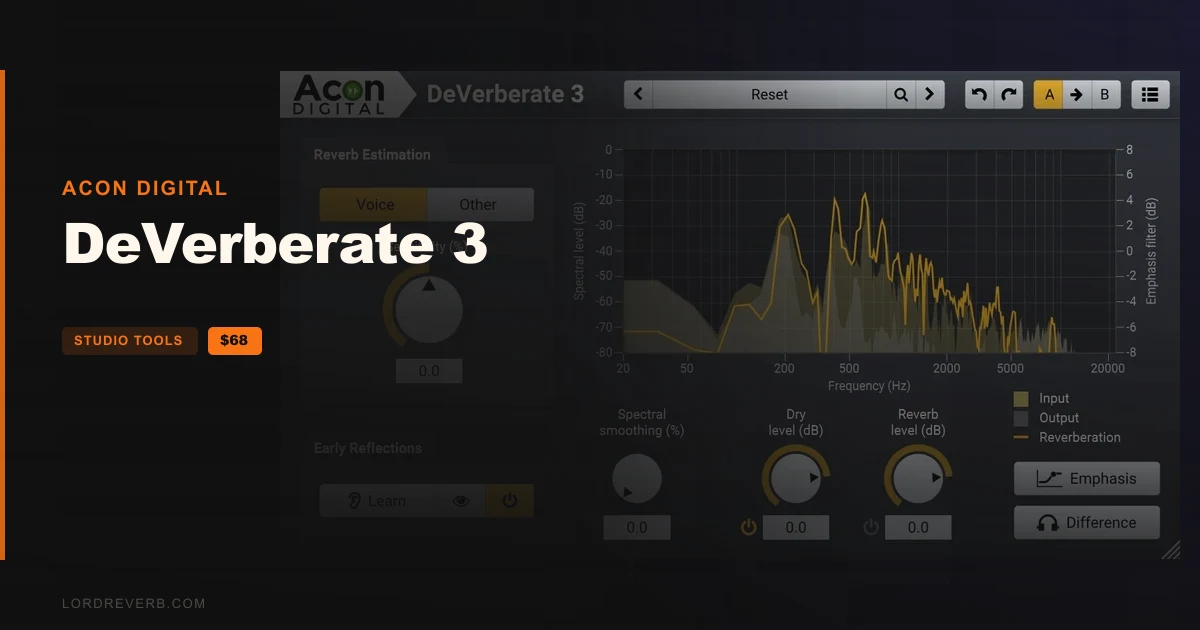
A frequency spectrum view shows three signals: the input, the output and the estimated reverberation. You can see what the plugin is taking out as you work.
The filter settings sit on a graphical frequency response curve. Drag the handles on the curve to edit them.
On Windows, DeVerberate 3 needs a host that supports VST, VST3 or AAX (Pro Tools 10.3.5 or higher), in 32 bit or 64 bit. The minimum is an Intel Core i3 or AMD multi-core processor, with an i5 or faster recommended.
On Mac, it runs natively on ARM64 and Intel under macOS / OS X 10.9 or later. Your host needs to support 64 bit AU, VST, VST3 or AAX (Pro Tools 11 or higher).
Both platforms ask for 1 GB of RAM (4 GB or more recommended) and 1 GB of free disk space.
Yes. The DeVerberate 3 Black Friday deal takes 31% off Acon Digital's reverb reduction plugin and brings it to $68. The deal ends Dec 8, 2026.
The maker says version 3 adds a new deep learning algorithm for fully automatic reverb reduction of recorded dialogue. The neural network was trained on thousands of voice recordings in varied acoustic spaces. The version 2 algorithm stays in for music and other sources.
On Windows it works in hosts that support VST, VST3 or AAX (Pro Tools 10.3.5 or higher). On Mac it runs natively on ARM64 and Intel with hosts that support AU, VST, VST3 or AAX (Pro Tools 11 or higher).
It works together with the reverb suppression algorithms. Using statistical methods, it estimates the impulse response of the early reflections in the recording, then uses that estimate to cancel out the effect of those reflections.
Prices and end dates are checked at publishing time and can change, so confirm them at the store before you buy.
Not signed in to Spotify? You hear 30 second previews. Signed in, you hear the full tracks.
Send your track and tick the Mixtape box. If we pick it, it joins this playlist and plays for everyone who opens the player.