Affiliate disclosure: the buy button is an affiliate link to the store. If you buy through it we earn a commission at no extra cost to you. Full policy

Alien Drive Black Friday pricing is 60% off, which puts Rave Generation's wavetable waveshaper and distortion plugin at $18 until Nov 29, 2026.
Instead of one fixed distortion curve, the signal reads through a bank of 256 curves, and how far it travels along a curve is a control too.
Push it far enough and the signal folds back on itself instead of flattening. That is where it stops behaving like an overdrive.
A germanium diode overdrive with a tunable tone band feeds the shaper. A shelving EQ with a resonant peak follows it.
The maker says it covers territory a clipper cannot reach: weight on a kick, metallic ringing, rhythmic folding and deliberate aliasing.
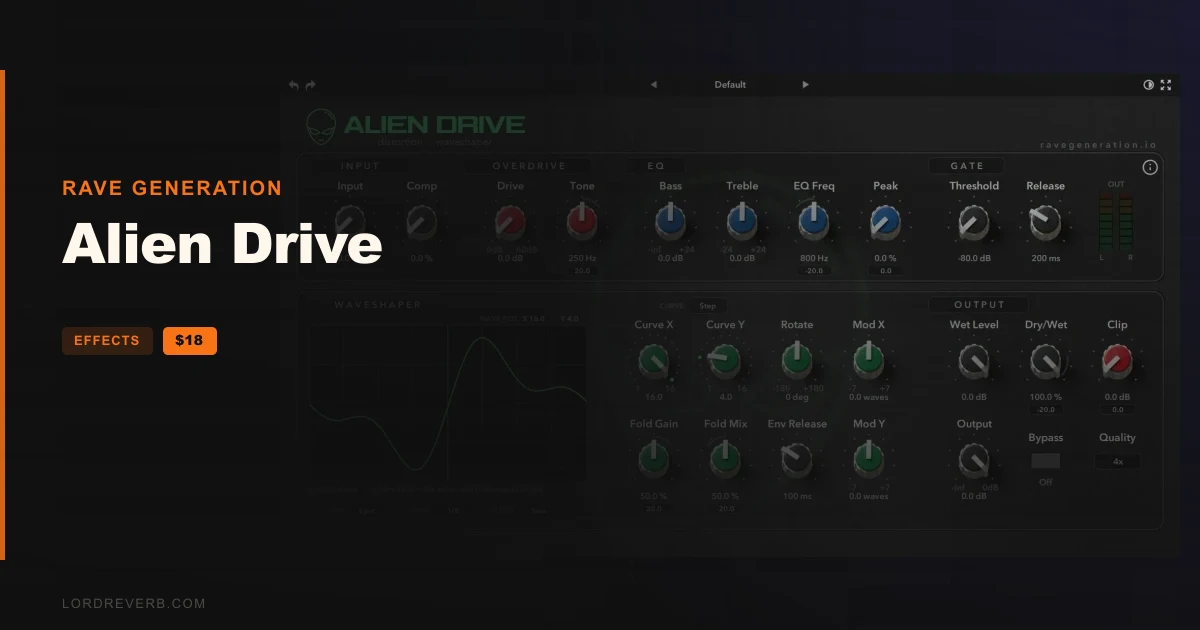
Alien Drive stores its waveshaping material as a 16 x 16 matrix holding 256 transfer curves, every one built from 2048 samples. The horizontal axis selects between families, and each family has its own personality instead of just a stronger or weaker version of one sound. The Curve Y control decides how abruptly each curve family bends, and since both axes blend smoothly, any position between two curves is available. The maker says those in-between positions are different nonlinearities, not crossfades of their neighbours.
Fold Gain determines the portion of the waveform that a maximum-level input travels across. Stay below the knob's halfway point if you only want to color the tone; past it, the waveform folds over itself and creates extra overtones that clipping can't generate. Fold Mix then lets you combine that folded signal with the overdriven one, so the attack stays punchy while the fold adds body underneath.
The overdrive gives 0 to 60 dB of soft, asymmetric germanium clipping, aimed at weight and even harmonics rather than a hard edge. Tone decides which 2.5-octave band goes into the diodes, tunable from 10 Hz to 10 kHz. Everything outside that band stays untouched.
Its EQ pairs a low shelf with a high shelf that both swing about one common frequency, and a resonant bump sits right there too. One EQ Freq control, 200 Hz to 3.2 kHz, moves the whole section. As the peak's gain rises, its bandwidth narrows, running from broad emphasis into focused ringing.
A single-knob compressor sits ahead of the distortion to even out how hard different hits push into the shaper. After the EQ stage, Alien Drive has a noise gate with a manual threshold, and its release knob offers finer resolution across the faster settings that work well on drums. Loud passages travel through the bank and quiet ones sit still. Env Release, 1 to 1000 ms, sets how far the position travels between hits.
The LFO is tempo-locked, with five modes: Sync, Trig, Free, Restart and Off. Seven targets are modulated at once: Fold Gain, Fold Mix, Clip, Tone, EQ Freq, Peak and Dry/Wet, and every one gets an independent depth control that can swing positive or negative. With Restart switched on, the cycle returns to phase 0 on each play press, which means the sound you preview is identical to the one that gets recorded.
A live graph draws the actual transfer curve at the current settings. A brighter band marks the span a full-scale input sweeps, and it moves with Curve X, Curve Y, Rotate and the envelope.
Alien Drive closes with a level control for the processed signal, a blend knob that runs the clean signal in parallel, output trim, and a unity bypass for A/B comparison. Its limiter, placed after the blend, never lets the signal pass 0 dBFS, even when you push up to 24 dB of drive into it.
Oversampling is Off, 2x, 4x or 8x on the waveshaper and clipper, with latency reported to the host. Quality Off keeps aliased folding available, which the maker calls a legitimate sound in its own right.
Yes. The Alien Drive Black Friday deal is 60% off, so the plugin costs $18 until Nov 29, 2026. It is a wavetable waveshaper and distortion plugin from Rave Generation.
Alien Drive is a wavetable waveshaper and distortion plugin. The signal reads through a bank of 256 curves instead of one fixed curve, and pushing it far enough makes the signal fold back on itself rather than flatten.
A germanium diode overdrive with a tunable tone band comes first, then the wavetable shaper, then a shelving EQ with a resonant peak. A single-knob compressor, a noise gate and an output stage with a 0 dBFS ceiling complete it.
An envelope follower moves the curve position up to seven waves either way in time with your transients. A tempo-locked LFO with five modes drives seven destinations: Fold Gain, Fold Mix, Clip, Tone, EQ Freq, Peak and Dry/Wet.
Prices and end dates are checked at publishing time and can change, so confirm them at the store before you buy.
Not signed in to Spotify? You hear 30 second previews. Signed in, you hear the full tracks.
Send your track and tick the Mixtape box. If we pick it, it joins this playlist and plays for everyone who opens the player.