XILS-lab MemoryTone Brings Memorymoog to Modern DAWs
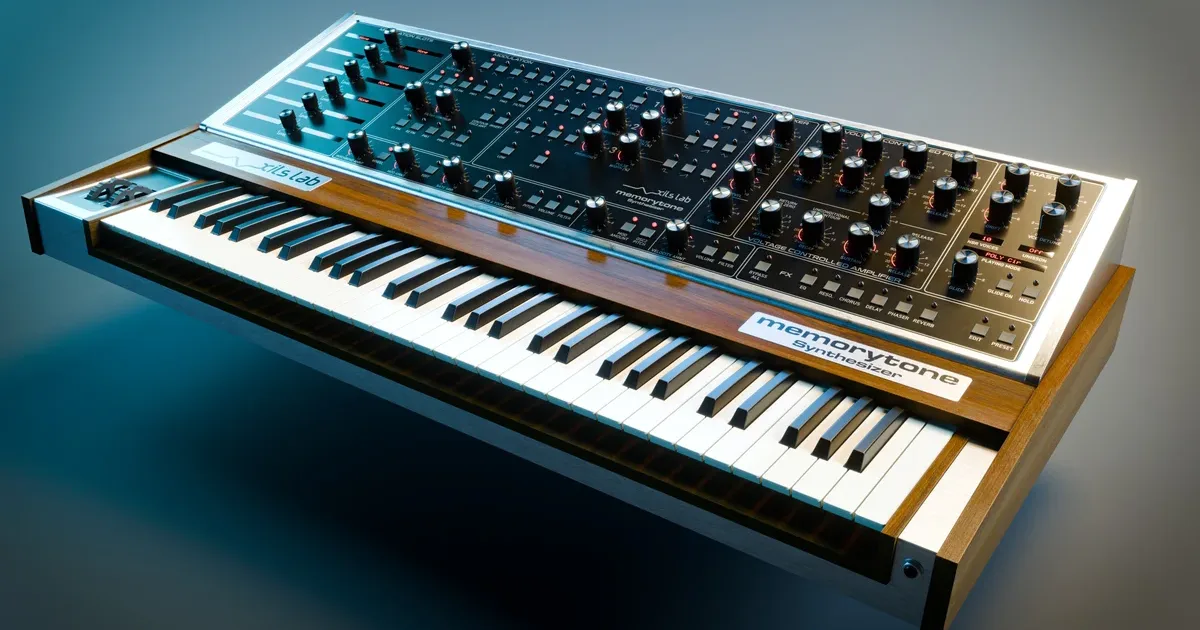
XILS-lab has announced MemoryTone, a software synthesizer modeled on the Memorymoog, the six-voice polyphonic analog instrument that Moog Music produced from 1982 to 1985 before the company’s bankruptcy in 1987. The plug-in is available now through the XILS-lab store.
The core architecture mirrors the original’s three oscillators per voice, but MemoryTone scales that up to 16 voices and up to 18 oscillators running in unison. The 24dB/octave self-oscillating ladder filter is included, along with level-dependent drive and saturation built into the mixer stage, which XILS-lab says reflects how the hardware actually behaved when pushed rather than a purely textbook recreation. Analog drift and voice-to-voice detune variations are modeled with restraint, keeping the instrument playable rather than unstable.
Beyond the core synthesis, the plug-in adds six freely assignable modulation slots, an arpeggiator, a programmable sequencer, and MPE support. Effects include EQ, chorus, delay, phaser, reverb, and a three-band resonator. Playing modes cover mono, poly, circular poly, unison, and both mono and polyphonic glide.
The Memorymoog was used by artists including Jan Hammer, whose Miami Vice scores put the instrument in front of a massive mainstream audience, as well as Geoff Downs and Jon Lord. XILS-lab’s preset library draws on that legacy while adding more contemporary sounds. MemoryTone runs as a VST, AU, or AAX plug-in on Mac and Windows.

Based on a press release from XILS-lab , source.